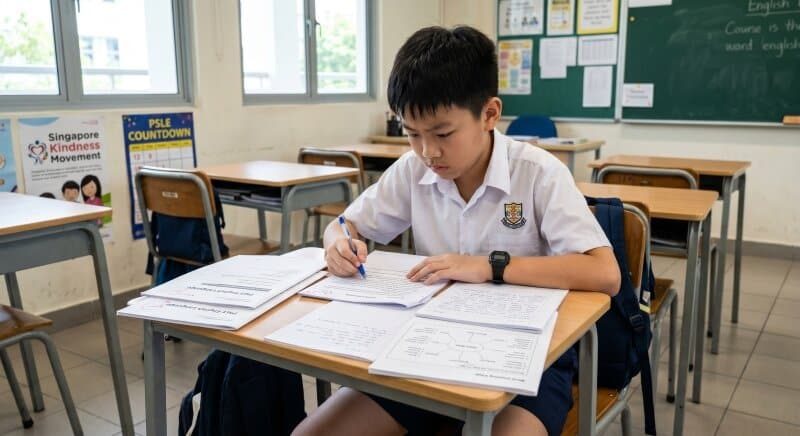
The PSLE examinations are five months away. Primary 6 is not the year to start from scratch — it is the year to consolidate, sharpen, and perform under pressure. This guide tells you where to focus support to make the greatest difference.
The brutal truth: you cannot remediate five years of reading gaps in five months, and you cannot shift from AL5–6 to AL1–2 in a single term. What you can do is diagnose exactly where your child’s marks are leaking, and invest in fixing those specific leaks rather than doing more of everything.
The PSLE English examination has shifted. From 2025, the weightings are:
A student who moves from 28 out of 36 in composition gains 8 marks. A student who closes Synthesis and Transformation errors, fixes comprehension inference answers, and sharpens Visual Text Comprehension technique in Paper 2 can gain 15–20 marks across the same paper. The marks are in Paper 2. Parents focus on composition because it is the most visible — but the strategic priority is Paper 2 first, composition second.
Paper 2 carries 90 marks (45% of the grade) and is a sustained cognitive marathon. A 500–600-word passage is followed by 13–15 open-ended inference questions, plus grammar, cloze, Visual Text Comprehension, Synthesis and Transformation, and editing.
The most reliable gap: open-ended inference. Students lift directly from the text or produce grammatically shaky answers under pressure. An ELIS study found that even high performers struggled to identify the strongest evidence to support their reasoning. They could infer; they could not defend it convincingly.
Visual Text Comprehension was redesigned in 2025 into a paired format (visual + linked text) that is harder than the old single-visual format. If your child only saw the old format in P5, this is new terrain.
When your child sits a practice Paper 2, identify exactly where the marks fall: S&T errors? Cloze? The open-ended section? VTC? Knowing the answer means the next three months of drilling has a bullseye instead of a scatter.
Oral carries 40 marks (20% of the grade). The new SBC format presents a photograph and three questions with no sub-prompts or scaffolding. Students who rely on being led by the examiner find this exposing.
Oral confidence is built systematically across the year, not in the two weeks before the exam. If practice has not started, begin immediately. Your child needs dozens of practice rounds with real photographs and real feedback on fluency and opinion structure. If a tuition centre is involved, the rhythm must begin now.
The 70-minute Paper 1 window covers Situational Writing (20 mins) and Continuous Writing (40 mins), plus 10 minutes for planning and review. Students who skip planning produce compositions that run dry mid-way or rush their endings.
Research consistently shows that five minutes of planning before writing produces better-structured compositions and time to spare. The second key move is editing against the Content rubric, not just spelling and grammar. A student who plans, writes, and reads their draft against “Did I address the prompt fully?” and “Is my ending resolved?” catches five to ten structural marks.
One composition per week with marked feedback is more valuable than four unsupervised drafts. Improvements accumulate from refined technique, not volume.
Repeat this cycle two to three times before PSLE. Your child will have drilled the identified leaks, sat multiple full papers, and built automatic responses under pressure.
If your child needs structured support to execute this rhythm — diagnosis, component-focused drilling, full mock analysis, and oral development — WRITERS AT WORK runs a dedicated P6 PSLE English programme built on exactly this rhythm. Our STORYBANKING® approach is designed for the final sprint: diagnosis first, then targeted refinement, not new content. Get in touch to discuss where your child sits and what a focused final five months can realistically achieve.
Open-ended comprehension inference. This component requires a child to read a dense passage, infer meaning from implicit clues, find the strongest evidence from text, and write a grammatically correct answer under time pressure. It sits at the intersection of reading skill, inferential thinking, writing fluency, and exam stamina. A student with weak foundational reading comprehension cannot close this gap in six months; a student with reasonable comprehension but poor exam technique can show measurable improvement in four to six weeks of targeted practice. The key is honesty: if your child’s independent reading is very limited, tuition can narrow the gap but will not fully bridge it in a single term. Paper 2 work is still the highest-value use of time, but expectations should be realistic.
Past papers are more reliable signals of what SEAB actually tests. Assessment books are useful for building foundational skills, but they tend to be slightly easier than the real exam and do not always reflect the exact mark scheme SEAB uses. The best approach is to use past papers as your primary timed practice (at least two to three full papers), and use assessment books as supplementary component-level drilling only. For example, if your child struggles with S&T, working through five S&T questions from an assessment book daily with a tutor is reasonable. But do not use assessment books as your main timed-paper practice; that role belongs to past papers.
One composition per week with marked feedback is the gold standard. Two per week is fine if both are marked and analysed. Beyond two, the returns diminish and fatigue compounds. The quality of feedback matters more than volume. A student who writes one composition and receives feedback on planning quality, emotional engagement, and language choices learns more than a student who writes four compositions with only spelling corrections. If your child is doing more than two unsupervised compositions per week, redirect that time toward Paper 2 drilling or oral practice instead.
Treating PSLE performance as the central emotional topic of family life. The second most common mistake is panic-enrolling in additional tuition after one weak result without first diagnosing what went wrong. But the most costly mistake is parental anxiety about exam performance broadcasting itself to the child. Children absorb that anxiety and become less resilient under pressure, not more motivated. MOE’s own guidance to P6 parents explicitly warns against this. Your job is to manage your own stress, create a calm home environment, ensure your child rests adequately, and support diagnostic problem-solving after each assessment. That is enough. Your child does not need your anxiety on top of exam pressure.

Jemmies Siew, Managing Director and Co-Founder of WRITERS AT WORK Enrichment Centre. With over 15 years of experience in education, entrepreneurship, and marketing, Jemmies has helped shape Singapore’s English enrichment landscape through her vision for transformative learning.
She is passionate about connecting real-world issues with language learning, helping students think critically and express themselves clearly. Connect with her on LinkedIn to follow her insights on education, content marketing, and thought leadership.



Start practising and learning

