
Many Singapore parents notice the same pattern: their child sails through Primary 3, then suddenly in Primary 4, the work feels different. Comprehension passages get longer. Composition marking drops. Grammar mistakes appear. In one parent survey, over 60% of first-time English tuition enquiries came from families with P4 children.
It is not that P4 students have got weaker. It is that P4 is the year foundational gaps become visible.
P3 typically has one end-of-year examination. P4 moves to a full four-paper structure spread across the year — weighted assessments in Term 1, Term 2, Term 3, and End-of-Year. This is the first year many children face sustained examination pressure.
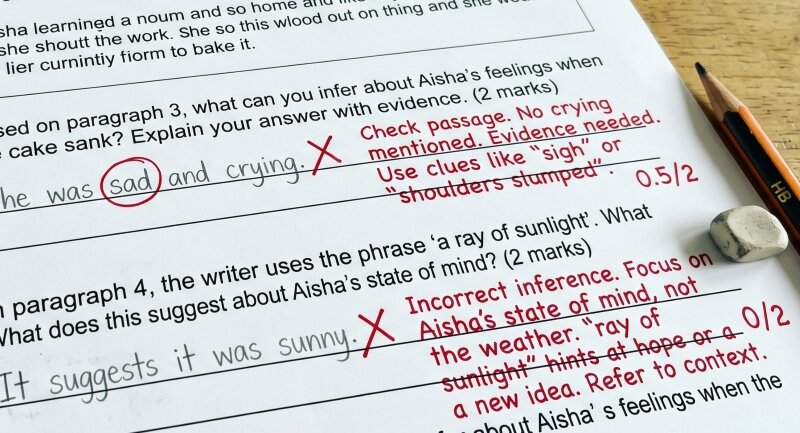
In comprehension, factual retrieval (find the answer) gives way to inference questions requiring students to read between the lines. As one tuition provider puts it: “A weaker student sees actions. A stronger student reads meaning through actions.”
Composition expectations escalate. P3 passes on recount structure. At P4, marking rewards narrative with conflict, tension, and resolution. A straightforward recount that earned a good mark in P3 scores below average in P4.
Grammar scope widens: tenses, agreement, prepositions, conjunctions, relative clauses, voice, reported speech. These must work automatically under pressure. Synthesis and Transformation — which scales to 10 marks at PSLE — often appears in formal assessment for the first time.
Passage length increases. Reading speed expectations rise. Students manage multiple high-demand components in one sitting.
Vocabulary Range
Students recall basic meanings but lack vocabulary use — word choice, collocations, context, synonyms. When a cloze task requires matching meaning or composition needs an expressive adjective, they freeze. They have not built the vocabulary bank that reading volume creates.
Comprehension Inference
The shift from “find it” to “reason about it.” A student who located answers in P2 and P3 freezes when asked, “Why did the character feel that?” or “What comes next?” The old strategy fails.
Composition Structure
Many P4 students write grammatically correct sentences but cannot construct a story. They produce recounts rather than narratives with setup, complication, and resolution. Without explicit frameworks for story structure, they write what feels natural — which is rarely what examiners expect.
Grammar Under Pressure
A student may understand tense rules in isolation. But asked to fill a grammar cloze or produce a complex sentence in real time, accuracy falls apart. Knowledge has not become automatic.
Cognitive Load
Upper-primary texts demand more simultaneous information management. When intrinsic load (content complexity) meets extraneous load (unfamiliar formats and time pressure), working memory exceeds capacity.
Foundation Gaps Become Visible
P1 and P2 have no formal exams. P3 has one end-of-year exam. Gaps in grammar, vocabulary, and composition may have gone undetected for three years. P4 is often the first year parents and teachers see them clearly, because assessment now exposes them. A child with shaky tense knowledge and limited vocabulary can pass P3. P4 assumes all that is solid and moves forward. The child falls suddenly out of step.
Reading Strategy Widens the Gap
Research shows that by P4, reading strategy use — flexible, metacognitive, purposeful — varies sharply between high and low-proficiency peers. A child without active reading habits falls further behind.
The FSBB Moment
From 2024, Full Subject-Based Banding is in place. At the end of P4, students receive a formal recommendation: Standard or Foundation English in P5 and P6. Parents rightly attend to P4 results.
Read Aloud Daily
Spend 10 to 15 minutes each day reading aloud with your child. Pause and ask: “Why did that happen?” “How does she feel?” “What comes next?” These moments build the inferential reasoning most P4 students lack.
Keep a Vocabulary Log
Once or twice a week, ask your child to write down three words they encounter but are uncertain about. Look up meanings together, note context, and revisit them.
Structure Composition First
Teach a simple three-act framework: What is the situation? What goes wrong? How does it resolve? Before writing, talk through the story together. Structure first, words second.
Practice Oral at Home
Oral accounts for 16 marks at P4 and 40 at PSLE. After dinner, look at a picture together. Ask: “What is happening?” Then: “Why?” Then: “What do you think?” Encourage opinion-forming, not description.
Diagnose Before Drilling
If gaps exist, diagnostic assessment comes before practice papers. Drilling without strategy teaching produces failure, not improvement. Research shows visible improvement takes 6 to 10 weeks of structured support, with deeper repair taking 6 to 12 months.
WRITERS AT WORK runs dedicated P4 English programmes focusing on inferential reading, composition structure, grammar accuracy, and oral confidence. Our STORYBANKING® approach builds the vocabulary bank and story frameworks children need to manage the P4 transition. Reaching out now — not waiting until P5 — prevents gaps from widening.
Families who see sustained improvement are not those who panic-buy revision books. They are the ones who identify gaps clearly, choose support thoughtfully, and give the process time.
P4 is the year to look clearly at where your child’s English actually is.
It is genuinely the pivot year, but not for the reasons you might think. P4 is the year when the cumulative effect of foundation gaps becomes undeniable, vocabulary gaps, grammar gaps, reading strategy gaps. But it is also the year when early intervention has the highest return on investment. A child who receives targeted, well-designed support across P4 enters P5 in a fundamentally different position than one who does not. The earlier you identify the gap and act, the more time you have to repair it before the stakes get higher at P5 and P6.
Not necessarily a reading problem, it is a comprehension strategy problem. Reading widely builds vocabulary and general knowledge, which is excellent. But reading for pleasure and reading analytically under examination conditions are different skills. Your child might love stories but have never learned to annotate for emotion and causation, to separate what the text says from what it implies, or to locate textual evidence for an inference. These are teachable skills. A tuition centre can diagnose whether the issue is reading speed, inferential reasoning, vocabulary-in-context, or something else entirely. Do not assume you know the gap until you have tested it.
If your child is showing signs of struggle, inconsistent grades, comprehension confusion, composition avoidance, grammar errors under time pressure, the answer is as soon as you notice the pattern, not later. Waiting until the End-of-Year Examination means you have only a few weeks to attempt repair. Starting in Term 1 or Term 2 gives a full term to diagnose, teach, and consolidate. That said, do not start tuition as a reflexive response to a single weak result; start when a pattern emerges. And be realistic about the timeline: expect 6 to 10 weeks to see visible improvement, and 6 to 12 months for truly stable, comprehensive gains.
Read aloud with your child for 10 to 15 minutes most days, and ask inferential questions. “Why do you think that happened?” “How do you think she felt?” “What will happen next?” This builds the inferential reasoning that most P4 students are missing, and it costs nothing. Pair it with a vocabulary log, three words a week written down and looked up together, and you have the two most high-return investments you can make at home.

Jemmies Siew, Managing Director and Co-Founder of WRITERS AT WORK Enrichment Centre. With over 15 years of experience in education, entrepreneurship, and marketing, Jemmies has helped shape Singapore’s English enrichment landscape through her vision for transformative learning.
She is passionate about connecting real-world issues with language learning, helping students think critically and express themselves clearly. Connect with her on LinkedIn to follow her insights on education, content marketing, and thought leadership.



Start practising and learning

