
If you have spent the past year watching your child fill out English worksheets and you still feel the same marks coming back week after week, you are not the only one. The composition stays flat. The comprehension answers stay vague. The vocabulary list does not turn into vocabulary in the writing. Most parents notice this pattern long before they know what to do about it. The honest answer is that worksheets were never going to fix it on their own.
This is not because worksheets are useless. They are good at one thing. They show you where a child is struggling. They do not, by themselves, change how a child thinks about language. That kind of change comes from structured teaching, with a teacher who models the work, points out the why behind every correction, and walks a child through a progression that builds genuinely over time. At WRITERS AT WORK, that is the entire reason we exist.
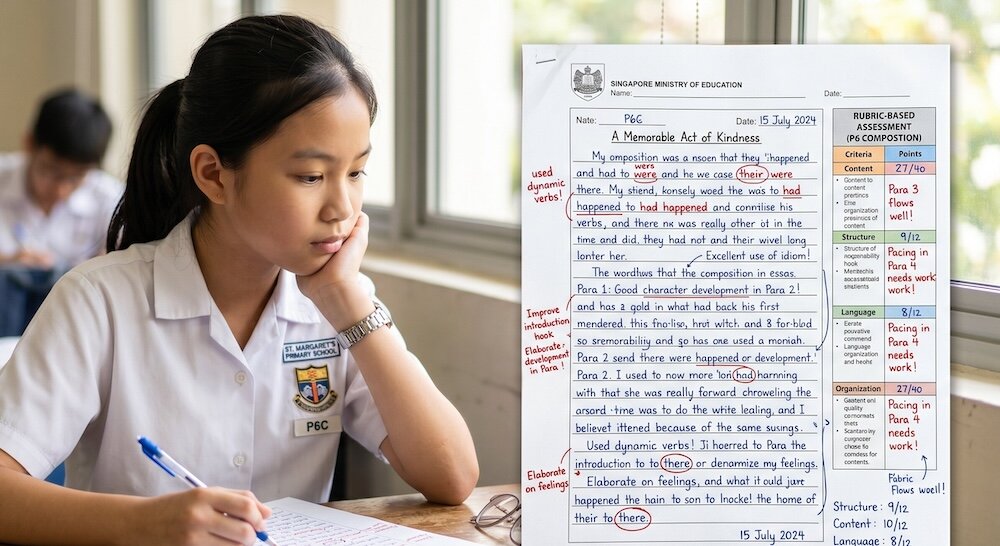
Walk into most tuition centres in Singapore and the scene looks the same. Children with their heads down. Pages ticked, blanks filled, errors circled in red. It feels like progress because something has been completed. But months pass, and the same mistakes show up in the same places.
Worksheets work as diagnostic surfaces. They reveal what a child cannot yet do. They do not teach the child how to do it. A grammar error caught on a Friday worksheet returns on Monday because the worksheet showed the mistake but did not change the underlying thinking. A short composition still reads short because the child never saw a stronger one being built, sentence by sentence, in front of them. The form of practice has been completed. The substance of the lesson has not happened.
Language is not a subject that improves through repetition alone. Children get better at English the way they get better at any genuine skill. They need to see it modelled by someone who knows what they are doing. They need to try it themselves with someone who can guide them. They need feedback that explains the why, not just the what. And they need a curriculum that revisits and deepens the same skills across the years rather than scattering them across a folder of unrelated worksheets.
Research has been clear on this for decades. Explicit, structured, cumulative instruction works because it builds knowledge deliberately and reduces the cognitive load on a child trying to learn many things at once. Studies on student writing find that the children who receive epistemic feedback, meaning feedback that explains why an answer is stronger or weaker, produce significantly better writing than those who receive only corrective marks. Studies on metacognitive writing instruction show that students who are taught to plan, monitor and evaluate their own work, then adjust it based on what they notice, outperform those who are not. And the Spiral Curriculum, developed by the cognitive psychologist Jerome Bruner, has demonstrated repeatedly that students learn best when ideas are revisited in widening circles, with each pass deepening what was learned the time before.
None of this happens in a worksheet folder. It happens in a structured lesson designed to make it happen.
Whether your child is in Primary 3 or Secondary 3, a structured English lesson that actually moves the needle does four things that worksheets cannot.
The first is clear modelling. Before a child can write a strong introduction, they need to see one being built. A skilled teacher shows the thinking out loud, names the moves that turn a flat sentence into a vivid one, and then steps back and lets the child try. This is the I do, we do, you do progression that educational research consistently identifies as the foundation of skill-building. It is also the part that worksheets, by design, leave out.
The second is feedback that closes the loop. A mark or a tick tells a child whether they were right. A short comment in the margin tells them what was off. Only a real conversation, with a teacher who knows the child’s previous work, can tell them why and what to do differently next time. This is the level of feedback that lifts writing quality measurably and durably, and it requires a structured lesson environment to take place.
The third is metacognition. The strongest writers in a Primary 6 classroom are not the ones who have memorised the most phrases. They are the ones who have learned to plan, draft, check and adjust their own work. That habit has to be taught. It does not appear by accident at the end of a worksheet.
The fourth is the link between speaking and writing. Children who develop strong oral language develop stronger writing because they have already heard themselves use the words and the sentence shapes. A composition lesson that does not include any speaking work is missing the bridge. A structured English programme integrates the two on purpose. Our PSLE Oral Topics 2025 Guide explains how the oral side of this connects directly to PSLE preparation.
The Spiral Curriculum is the cleanest description of how children actually learn over time. It has three features. The same topics get revisited at regular intervals. Each revisit deepens the complexity. Each new layer connects explicitly to what was learned before. The benefit, well documented in educational research, is that skills get reinforced and applied in widening contexts, rather than learned once and forgotten.
The model also carries a quiet warning. If the early foundation is shaky, the later skills never fully develop. This is one of the reasons that Primary 3 and Primary 4 matter so much for English. A child who has not built a clear sense of how a paragraph holds together at lower primary will struggle to build a strong composition at PSLE, no matter how many worksheets they complete in the year before the exam. The fix is not more practice. It is a properly sequenced curriculum that builds the foundation in the right order.
This is exactly how the curriculum at WRITERS AT WORK is designed.
WRITERS AT WORK has been teaching English to Singapore primary and secondary students since 2012. In that time, more than 9,850 students have come through our programmes and over 10,000 parents have seen the difference structure makes. Our piece on the benefits of W@W’s structured curriculum gives a closer look at how the system is put together.
At the centre of every lesson is STORYBANKING®, the proprietary methodology we developed from hands-on classroom experience dating back to 2007. STORYBANKING® was built to solve a specific problem we kept seeing across high-ability and struggling students alike. A Primary 6 student writes one beautiful composition by chance, with a topic that happens to suit them, then sits down the following week and produces something flat because the theme has shifted. STORYBANKING® gives students a personalised library of story material and a clear pathway from idea to plot to polished language, so good writing becomes a transferable skill they can reproduce under any exam condition.
The curriculum is structured around a true spiral model. Story-planning frameworks progress from Primary 3 through Primary 6, with each level building on the previous one. By the time a student reaches Primary 5 and Primary 6, they have already internalised the foundation. They are not learning to plan a story from scratch. They are learning to execute a story plan with the kind of fluency that PSLE markers reward.
The programmes cover every key stage:
The single most important upgrade a structured programme delivers is the quality of feedback. Every composition and essay at WRITERS AT WORK is graded against an exclusive in-house rubric that does what a generic tick-and-correct cannot. It identifies which specific skill is underdeveloped, points to the lesson concept that addresses it, and gives the teacher a way to talk to the student about why their writing is being scored the way it is.
This is the epistemic feedback that educational research consistently identifies as the single biggest predictor of writing improvement. It is also the part of teaching that costs the most time and craft, and is the first thing cut in a worksheet-heavy model. Regular weekly in-house quizzes and periodic assessments give both teachers and parents a clear, continuous view of progress, so gaps are caught and closed long before they show up in a school examination report. Our piece on the benefits of structured English writing classes goes further into how this builds over a school year.
The outcomes are what they should be when structure and feedback are taken seriously.
These results are not chance. They are what happens when a curriculum is sequenced properly, when teachers model the work, and when feedback is rigorous enough to change how a child thinks about their own writing.
Strong English supports almost every subject in the Singapore education system. Word problems in Mathematics get solved more cleanly. Science answers get structured more clearly. Humanities essays get argued more persuasively. The reasoning and the writing habits that get built in a structured English lesson keep paying off long after a single exam is over.
Our alumni have gone on to law, engineering, medicine and accountancy, with English fluency among the quiet enablers that helped them write strong applications and hold their own in university interviews and classrooms. Writing is not just an exam skill. It is a life skill. The earlier it is built well, the further it carries.
If you have been waiting for the worksheets to start working, this is the moment to consider something better. WRITERS AT WORK runs structured English programmes for every level from Pre-Primary 1 through to Secondary 4, in both Pure Onsite and Pure Online formats, with the same STORYBANKING® methodology and the same diagnostic feedback at the heart of every class.
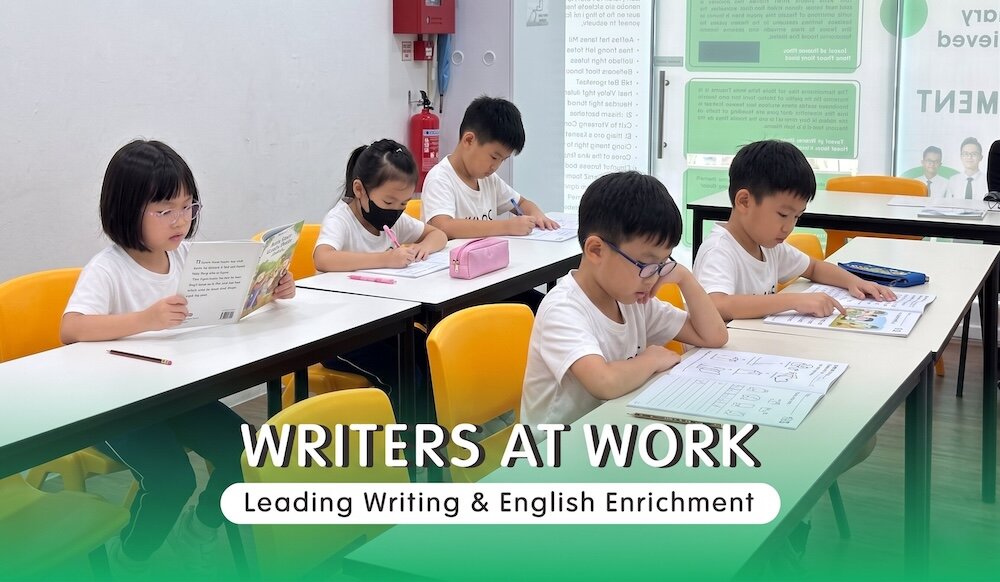
The question to ask of any English tuition is what the lesson actually does. If the bulk of the time is spent completing worksheets and going through corrections, your child is being shown what is wrong but not being taught how to think differently. A structured programme teaches the underlying skill, models the work, gives feedback that closes the loop, and revisits the same skill in widening contexts across the year. That is the difference between a child who improves and a child who stays in the same band of marks for two years.
Lower primary is the best time to start, not the time to wait. The Spiral Curriculum model rests on the idea that early foundations carry the later skills. A child who builds clear story structure and confident vocabulary in Primary 3 and 4 walks into Primary 5 already several steps ahead. By the time PSLE preparation begins in earnest, the foundation is doing the heavy lifting.
It is not too late. Many of our Primary 6 students join with months rather than years before the exam, and our PSLE-focused programmes are designed to close gaps quickly while building the composition and oral techniques that move marks in the right direction. The structure works at every stage, but the earlier it starts, the more compound the benefit.
You should be able to see specific changes in your child’s writing within a school term. Sentences that used to be flat carrying more texture. Plans that used to be missing now visible at the top of the page. A vocabulary that has grown into use, not just into a list. Our diagnostic feedback system also gives parents a continuous view of where their child sits across the rubric, so the progress is visible long before the next school report card.

Jemmies Siew, Managing Director and Co-Founder of WRITERS AT WORK Enrichment Centre. With over 15 years of experience in education, entrepreneurship, and marketing, Jemmies has helped shape Singapore’s English enrichment landscape through her vision for transformative learning.
She is passionate about connecting real-world issues with language learning, helping students think critically and express themselves clearly. Connect with her on LinkedIn to follow her insights on education, content marketing, and thought leadership.



Start practising and learning

