The March school holidays are short, but they can still make a difference. In one week, your child can get the rest they need, reset their routine, and keep their English skills warm, without spending the break buried in worksheets.
If you are wondering how to plan the week so your child feels refreshed and ready for Term 2, here are five simple ways to start the holidays right.

Because the break is only a week, rest does not need to mean “doing nothing for days”.
Think of it as a two-day reset. Give your child time to slow down, sleep a little better, and recover from the term’s pace.
A realistic approach is a 48-hour reset at the start of the holiday:
Day 1–2: Slow down
👉 Allow your child to sleep slightly later, but do not shift their bedtime too far.
👉 Keep the morning calmer. Avoid stacking tuition, errands, and activities back-to-back.
👉 Give them “blank time” so the brain can actually rest, not just switch from one activity to another.
Why this matters for English
When children are tired, English becomes harder than it needs to be:
👉 They give shorter oral answers because they cannot organise their ideas quickly.
👉 They use simpler vocabulary because word recall becomes slower.
👉 They rush writing and skip details because they feel mentally drained.
A short rest reset helps them return to English practice with a clearer head. For many children, this alone reduces resistance to writing and reading.
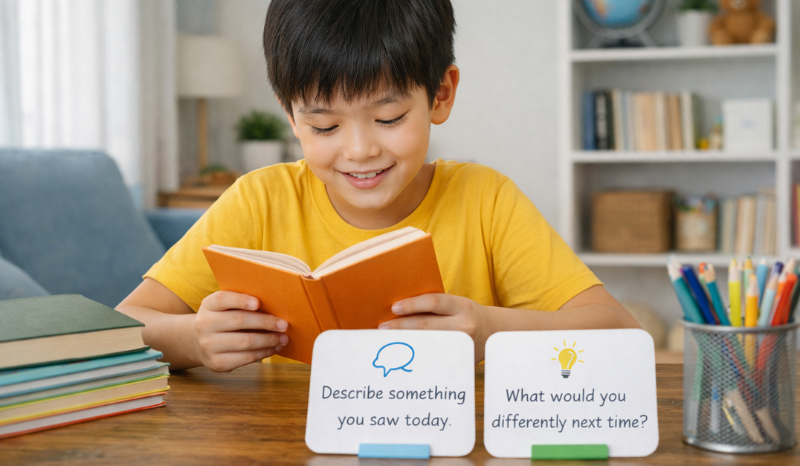
For a short holiday, the goal is not intensive improvement. It is continuity.
Think of English like fitness. If you stop completely, the first few days back feel uncomfortable. If you keep a light routine, your child returns to school with less “warm-up time”.
If you want something easy to follow, try this:
This keeps the total time low, but the skill exposure high.
Pick one option:
To make reading more effective without making it heavy, use one follow-up question:
These questions train comprehension thinking and expression, while still feeling light.
Many parents worry about oral because their child “can talk at home” but freezes during oral practice.
This happens because oral requires:
A simple way to build this in the holidays is a daily or alternate-day 60-second talk.
Choose one prompt:
Vocabulary grows faster when children use words in context.
Try quick games:
Even 5 minutes makes a difference, especially for P4–P6 students whose oral and writing marks depend heavily on word choice.
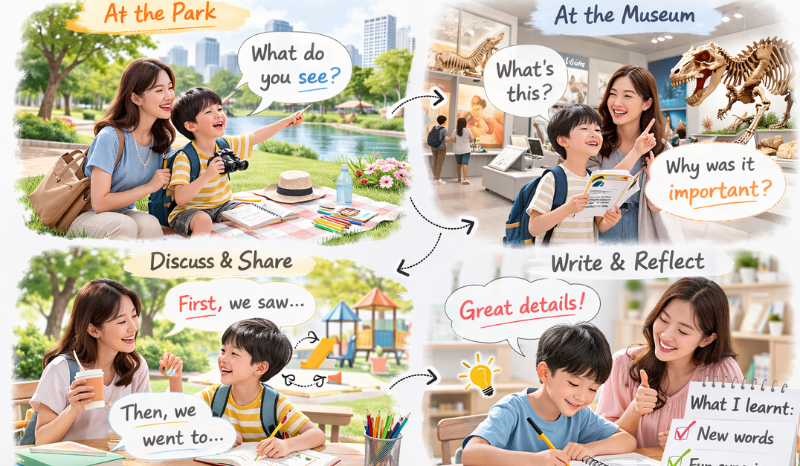
When the holiday is only one week, you do not need to plan a trip. You just need one meaningful outing that becomes a “content source” for English.
One outing gives children:
✅ fresh experiences to describe
✅ vocabulary used naturally in context
✅ story ideas they can reuse in composition
It can be a museum, a park, an event, a visit to a new neighbourhood, or even a simple activity-based day out.
You can do this in three simple steps:
Step 1: Before the outing (1 minute)
Ask:
This primes observation.
Step 2: During the outing (keep it casual)
Ask one observation question:
Step 3: After the outing (2 minutes)
Ask your child to retell it:
Or:
This strengthens oral structure and descriptive writing, without making it feel like homework.
March holidays work best when practice feels “hidden”.
Instead of forcing long writing sessions, pick activities that naturally train:
✅ sequencing
✅ detail-building
✅ explanation
✅ creativity
If your child builds or makes something (crafts, baking, LEGO, simple DIY), ask them to explain:
✅ What they made
✅ What materials they used
✅ The steps in order
✅ What they would improve next time
This improves oral clarity and trains logical flow, which later supports composition planning and comprehension explanation.
Children often struggle with story flow because they either:
✅ jump too quickly to the ending, or
✅ add random events without a clear sequence
A quick holiday game fixes this.
Use a simple prompt:
Then ask your child to tell the story using a 3-part structure:
1️⃣ What happened
2️⃣ What went wrong
3️⃣ How it ended and what was learnt
This trains clear story structure, which children need for composition.
If your child dislikes writing, reduce the barrier. Writing practice does not need to be long to be useful.
Try:
✅ 3 sentences a day, or
✅ one short paragraph twice a week
Give a simple structure:
First…
Next…
Then…
Finally…
This keeps writing fluency warm without turning the break into revision.
Because the March break is short, parents often feel stuck:
A short holiday programme helps because it creates:
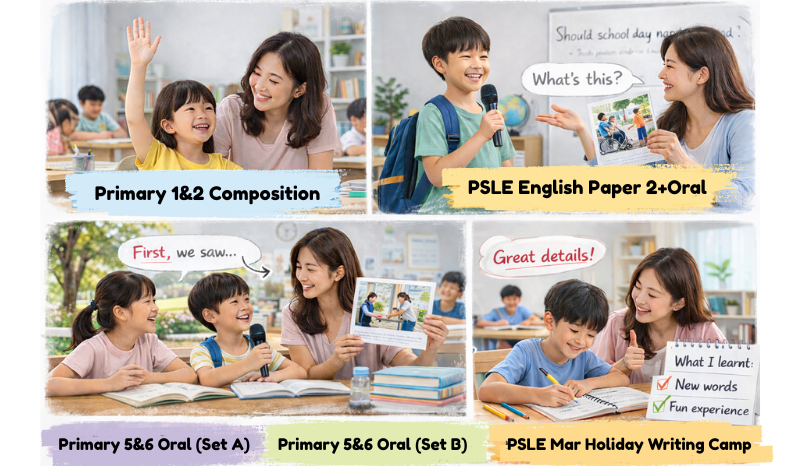
At WRITERS AT WORK, our March Holiday Program, with five onsite course options:
For younger learners, the goal is confidence. Many children at this stage struggle because they do not know:
A focused programme helps them practise story-building in a guided way so writing feels less stressful.
For upper primary, oral is often where children lose marks because:
A structured oral course helps students build the habit of:
Click here to understand the difference between Oral Thematic Set A and Set B
For many P6 students, Paper 2 challenges come from accuracy and speed. Even if they understand, they may struggle with:
A focused programme supports students by reinforcing key skills in a guided way so they return to school with better control and confidence.
Some P6 students can write, but their compositions do not stand out because:
A writing camp gives students guided practice to build stronger content, clearer structure, and more confident writing choices.
A one-week break does not need a complicated plan.
A good holiday start can look like this:
If you would like your child to build stronger confidence in writing, oral, or PSLE-focused skills during the March holidays, explore the course options on our Holiday Programmes page.
Yes. A short break is enough to reset and keep skills warm. Even 10–15 minutes a day of reading, speaking, or vocabulary helps your child return to school with less “warm-up time” in Term 2.
Match the course to your child’s current need. If they are younger, confidence and simple composition building matter most. For Primary 5 and 6, oral clarity and answer expansion are common focus areas. For Primary 6, Paper 2 accuracy, oral performance, and composition development are usually priorities.
Keep it short and predictable. Use “small wins” like a 10-minute reading habit and a 60-second daily talk. If you prefer not to manage this at home, a structured onsite programme can provide routine and guidance without daily parent planning.
You can view all course options and details on our Holiday Programmes page.

Jemmies Siew, Managing Director and Co-Founder of WRITERS AT WORK Enrichment Centre. With over 15 years of experience in education, entrepreneurship, and marketing, Jemmies has helped shape Singapore’s English enrichment landscape through her vision for transformative learning.
She is passionate about connecting real-world issues with language learning, helping students think critically and express themselves clearly. Connect with her on LinkedIn to follow her insights on education, content marketing, and thought leadership.



Start practising and learning

