Below is a curated list of 20 common idioms that will help you stand out in your next English writing class for primary school or secondary school revision.
Meaning: A misfortune that eventually results in something good happening later on.
Meaning: Something that is very easy to accomplish.
Meaning: What you do is more significant than what you say you will do.
Meaning: To avoid speaking directly about a difficult or embarrassing topic.
Meaning: To endure a painful or difficult situation that is unavoidable.

Meaning: A way to wish someone good luck, especially before a performance.
Meaning: To decide to stop working on something.
Meaning: Doing something poorly or taking shortcuts to save time or money.
Meaning: To become difficult to control or chaotic.
Meaning: To describe exactly what is causing a situation or problem.
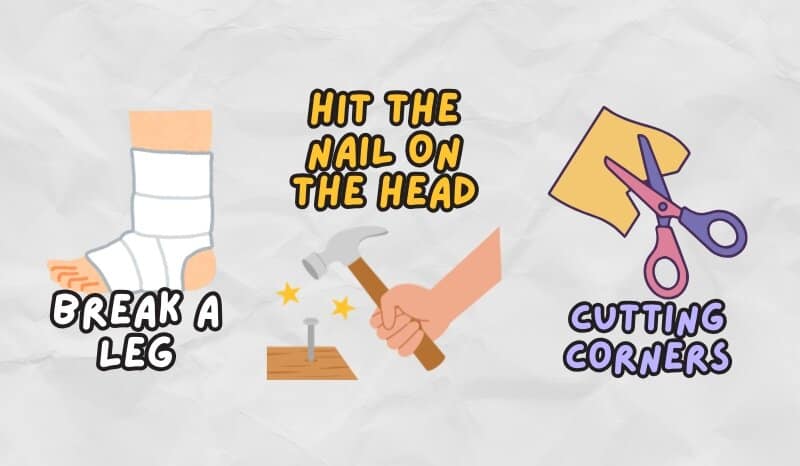
Meaning: To accidentally or prematurely reveal a secret.
Meaning: To be too late to take advantage of an opportunity.
Meaning: You must work hard or suffer a bit to achieve a goal.
Meaning: To be very alert, quick to understand, and reacting well to a situation.
Meaning: Something that happens very rarely.

Meaning: To joke with someone or tease them by telling them something that isn’t true.
Meaning: To be loyal or persist through both good and bad times.
Meaning: Feeling slightly ill or not quite yourself.
Meaning: To find a way to understand something complex or strange.
Meaning: A situation where you can enjoy the advantages of two very different things at the same time.
Using these idioms correctly can transform a “good” essay into a “great” one. However, the key is moderation. Overusing idioms can make your writing feel forced or “cluttered.” At our English composition writing classes in Singapore, we guide students on how to “sprinkle” these phrases naturally within their narratives and arguments.
If you are looking for the best creative writing classes for kids in Singapore, look no further. At WRITERS AT WORK, we don’t just provide a list of words; we provide the “Thinking Frameworks” that allow students to express their unique voices with confidence and precision.
Ready to take your writing to the next level? Explore our Types of Idioms: A Comprehensive Guide or check out our Writing Good Introductions to see how to hook your reader from the very first sentence.
For those preparing for major milestones, we also offer specialised resources for the PSLE Past Years Composition Questions, our PSLE Oral Topics 2025 Guide, and a deep dive into Past Years PSLE Oral Questions. Join us and discover why we are the top choice for parents seeking excellence in English education.

Agnes Ng, Co-Founder and Teaching & Curriculum Director of WRITERS AT WORK. An NUS Honours graduate and published author with over 30 years of experience, Agnes has been the architect of the organization’s student-centric curricula since 2012.
Dedicated to teacher mentorship and academic excellence, she has guided hundreds of students to achieve outstanding results. Her expertise and commitment to high-quality education remain the cornerstone of WRITERS AT WORK’s success in empowering every learner.



Start practising and learning

