
Many parents want their children to speak better English, but they often think improvement only happens during lessons, reading time, or exam preparation. In reality, one of the most powerful ways to build spoken English is also one of the simplest: daily conversation. The small conversations your child has every day — at the dinner table, on the way to school, while shopping, or before bedtime — can quietly shape how confidently and clearly they express themselves. When children are encouraged to speak regularly, they learn to organise their thoughts, use new vocabulary, respond naturally, and become more comfortable with the English language.
Speaking well is not just about knowing many words. It is about being able to use those words at the right time, in the right way, and with the right tone. Children who speak English often in everyday situations get more chances to practise sentence structure, pronunciation, vocabulary, and confidence. They also learn how to explain opinions, describe experiences, ask questions, and listen to others. Unlike formal practice, daily conversation feels natural, with no pressure to “get everything right”, making it easier for children to experiment with language and grow more comfortable expressing themselves.
When children speak English more often, they begin to form thoughts directly in English instead of translating from another language in their heads. This is important because translation can slow them down; a child may know what they want to say but struggle to find the correct English words quickly. Regular conversation helps reduce this hesitation. For example, instead of asking only, “Did you finish your homework?”, parents can ask, “What was the most interesting thing you learnt today?” This encourages fuller responses, and over time, children become better at explaining ideas in English naturally.
Children may memorise vocabulary lists, but they remember words better when they use them in real situations. A simple conversation about food, school, hobbies, or current events can introduce useful words in a meaningful way. For instance, while talking about a school project, a parent might introduce words such as “challenging”, “creative”, “solution”, or “improve”. The key is not to turn every conversation into a vocabulary lesson but to casually model better words. For example: Child: “The book was very nice.” Parent: “That’s great. Would you say it was exciting, meaningful, or inspiring?” This helps the child move beyond basic words and develop a richer vocabulary.
Many children know the answer to a question but respond in short or incomplete sentences. For example: Parent: “Why did you enjoy the activity?” Child: “Because fun.” Instead of correcting harshly, parents can gently model a complete sentence: “You can say, ‘I enjoyed the activity because it was fun and I got to work with my friends.’” When children hear well-formed sentences regularly, they begin to copy these patterns, improving both speaking and writing since strong sentence structure supports clear communication.
Being able to express an opinion is an important skill, especially for oral examinations, class discussions, interviews, and presentations. Daily conversations give children practice in saying what they think and explaining why. Parents can ask questions such as “What do you think about this?”, “Do you agree or disagree?”, “Why do you feel that way?”, and “What would you do differently?” These questions encourage children to go beyond one-word answers and support their views with reasons, examples, and personal experiences. Instead of saying, “I like it,” a child may learn to say, “I like it because it teaches people to be more responsible,” which is a big step towards clearer and more mature speech.
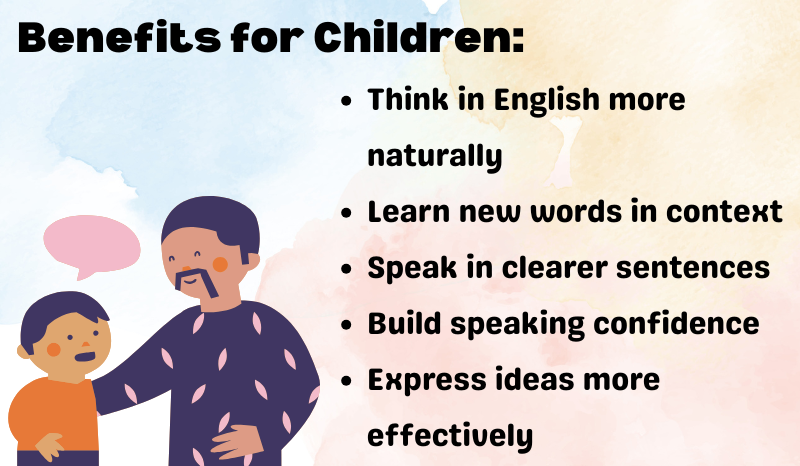
Some children are afraid of speaking English because they worry about making mistakes, and this fear can make them speak less, slowing their progress. At home, parents can create a safe space where children feel comfortable trying; the goal is not perfect English every second but regular, meaningful practice. When parents listen patiently, respond warmly, and avoid interrupting too often, children become more willing to speak, and confidence grows when they feel their ideas matter. A child who speaks confidently at home is more likely to speak confidently in school, during oral exams, and in social situations.
Good speaking begins with good listening. Through daily conversations, children learn how people ask questions, respond to ideas, use tone, and take turns in a discussion, while also becoming more aware of pronunciation, expression, and natural phrasing. Parents can support this by speaking clearly and using full sentences, as children absorb language patterns from the adults around them even when they are not consciously studying. This is why simple, regular exposure to good spoken English can make a real difference.
Parents do not need to prepare complicated activities; a few thoughtful questions each day can help. Instead of asking questions that lead to “yes” or “no” answers, try open-ended questions such as “What was the best part of your day?”, “What was something difficult today?”, “What did you learn from that experience?”, “How would you describe your friend?”, and “What would you do if you were in that situation?” Parents can also encourage children to retell events in sequence by asking, “First, what happened?”, “Then what did you do?”, and “How did it end?” This helps children organise their thoughts clearly, which is especially useful for oral communication and composition writing.
While correction is helpful, too much correction can make children feel nervous, and if every sentence is interrupted, a child may stop wanting to speak. Instead of correcting every mistake immediately, focus on one or two important points and repeat the sentence correctly in a natural way. For example: Child: “Yesterday I go to the library.” Parent: “Oh, you went to the library yesterday? What book did you borrow?” This corrects the grammar without embarrassing the child, and the aim is to keep the conversation flowing while gently guiding the child towards better English.
Helping your child speak better English does not always require long study sessions; sometimes, the most effective practice happens in ordinary moments. A five-minute conversation in the car, a short chat during dinner, or a bedtime discussion about the day can all help your child become a better speaker. When children speak English regularly, they gain vocabulary, fluency, structure, confidence, and the ability to express ideas clearly, and over time, these small daily habits can lead to big improvements. At WRITERS AT WORK, we believe that strong communication begins with consistent practice, and with the right guidance and encouragement, every child can learn to speak with greater clarity, confidence, and expression.
Ready to help your child grow in English with the right support at every stage?
At WRITERS AT WORK, our programmes are designed to meet students where they are and help them progress with confidence.
For primary students, our PURE Composition Writing Programmes help children build creativity, develop stronger ideas, and learn how to write vivid, well-structured compositions. Our Comprehensive English Programmes support students in key areas such as grammar, comprehension, oral communication, and writing, giving them a strong all-round foundation for school and national exam success.
For secondary students, our Secondary Programmes are designed to sharpen critical reading, strengthen essay and situational writing skills, and build the exam strategies needed for lower secondary assessments, upper secondary demands, and the O-Level English papers.
Beyond the classroom, students and parents can also tap into our wider learning resources through W@W eSeries, and stay updated with tips, insights, and student support on TikTok and Facebook.
You can help by speaking to your child in English during everyday moments, such as mealtimes, car rides, or bedtime. Ask open-ended questions that encourage your child to explain, describe, and share opinions instead of giving one-word answers.
No. Correcting every mistake can make children feel nervous or discouraged. Instead, focus on one or two important errors and model the correct sentence naturally. For example, if your child says, “Yesterday I go to school,” you can reply, “Oh, you went to school yesterday? What did you do there?”
Even 5 to 10 minutes of meaningful conversation each day can help. The key is consistency. Short, regular conversations are often more effective than occasional long practice sessions because they help children build confidence and fluency over time.

Agnes Ng, Co-Founder and Teaching & Curriculum Director of WRITERS AT WORK. An NUS Honours graduate and published author with over 30 years of experience, Agnes has been the architect of the organization’s student-centric curricula since 2012.
Dedicated to teacher mentorship and academic excellence, she has guided hundreds of students to achieve outstanding results. Her expertise and commitment to high-quality education remain the cornerstone of WRITERS AT WORK’s success in empowering every learner.



Start practising and learning

