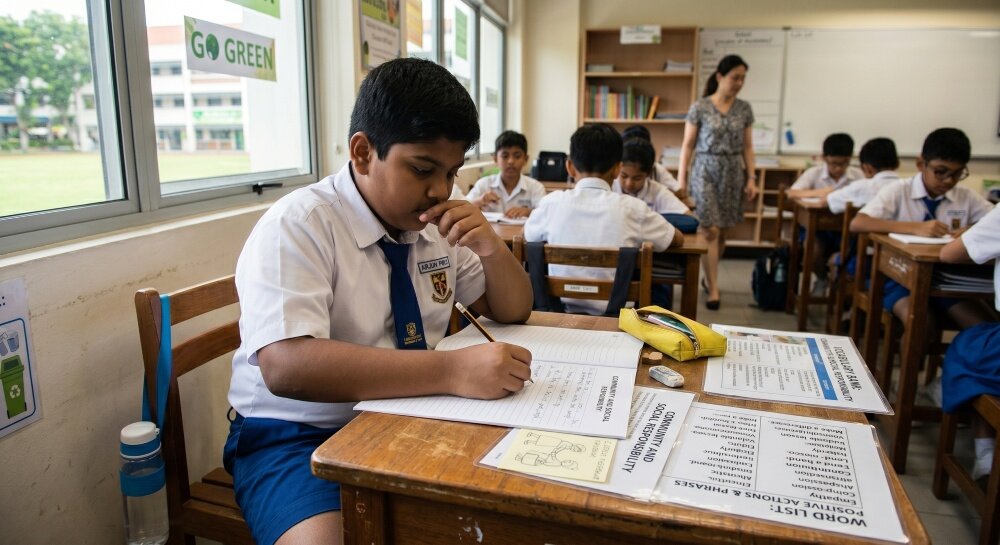
Community and social responsibility is one of the most culturally embedded themes in PSLE English composition, and one of the most rewarding to teach well. Every Singapore upper-primary student encounters this material through the Values in Action (VIA) programme, which is compulsory in all MOE schools, and through the lived reality of HDB neighbourhoods where community care is not optional but woven into the fabric of daily life. By 2030, around one in four Singaporeans aged 65 and above will be living alone — approximately 122,000 people — a statistic that transforms what might feel like a distant social issue into something that lives two floors up. Markers know your child is writing from the inside of this world.
This guide gives parents a practical picture of the vocabulary, phrases, and craft moves a P5 or P6 child needs to handle this theme with maturity and control.
Markers reward grounded Singapore scenarios over vague moralising. Stronger compositions are anchored in places upper-primary students genuinely know: a void deck during a thunderstorm, an elderly resident in the lift who has never once said hello, a community garden growing on a ground floor, a flag day outside an MRT station, a neighbour who arrives with food and quiet company after a loss. The theme also stretches across VIA projects, Active Ageing Centres, community clubs, hawker-centre scenes where care emerges unbidden, and the small moments where a student discovers that kindness requires more than good intention — it requires actually stopping. Children who can write community-responsibility compositions well usually handle other reflective, dilemma-driven prompts as a result. For deeper grounding in the top 10 PSLE composition themes, this fits naturally alongside any prompt asking for moral reflection or relationship development.
Strong verbs do most of the work. Instead of “helped the old lady”, a P6 child should be able to choose between volunteered, contributed, intervened, galvanised, united, reached out, acknowledged, or rallied — each naming a different quality of social action.
Vivid adjectives — selfless, compassionate, indifferent, resilient, tight-knit, overlooked — name the emotional and social texture rather than labelling it as “very nice”.
Collocations such as community spirit, social responsibility, volunteer work, foster unity, elderly resident, random act of kindness, kampung spirit, and take responsibility give compositions the polished, idiomatic feel that examiners reward in the higher Content and Language bands.
We have laid out the full bank — strong verbs, vivid adjectives, thematic nouns, idioms, collocations, and Singapore-context example sentences for each — in a downloadable companion Word document, Community and Social Responsibility: Full Vocabulary and Phrase Bank. Pull three to five new items into each practice composition rather than memorising everything; this is the same approach we recommend in our broader guide to expanding your child’s vocabulary bank.
A handful of well-rehearsed phrase patterns help a child structure a community-responsibility scene under exam pressure.
These belong to the same family of usable phrases we teach in our general guide on good phrases for P5 and P6 composition writing, and pair well with sensory writing — see how to use the five senses in your writing for ideas on grounding a community scene physically.
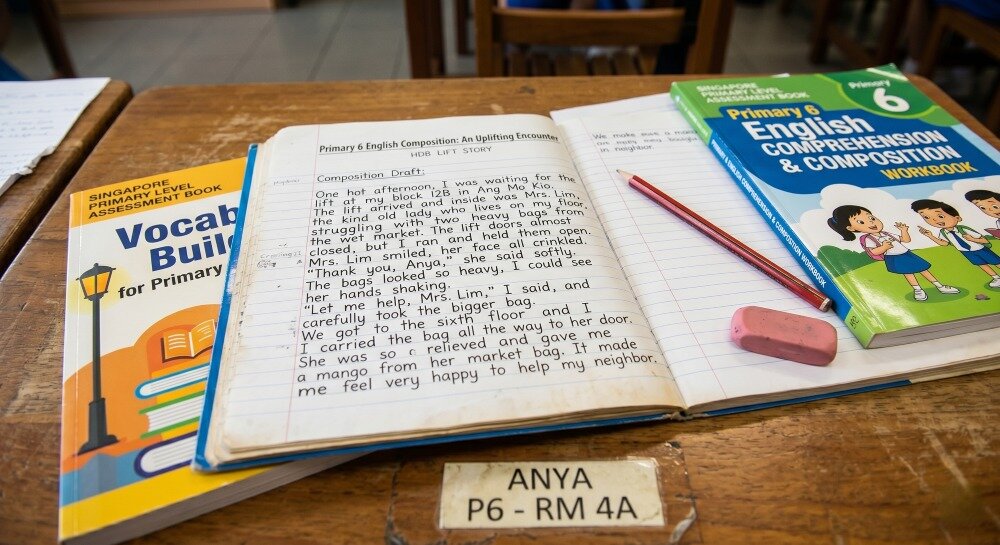
For a deeper look at endings, see our composition conclusion tips, and for the wider list of mistakes, our PSLE composition mistakes to avoid.
Set this 10-minute prompt: “For as long as Jia Hui could remember, the old man on the twelfth floor had never once said hello. Then one evening, the lights in the corridor went out.” Ask your child to use at least three vocabulary items from the Word doc bank, one collocation, and one of the sentence starters above. After writing, ask them to highlight every strong verb in their own draft. If there are fewer than five, that is the rewrite focus. The Band 4 challenge is to end with a sentence that shows what Jia Hui discovered about herself or her community — not by telling (“She learnt that…”) but through a single quiet action. This drill mirrors the planning rhythm we cover in our PSLE composition planning tips, and pairs well with our guides on how to start a composition and what makes writing good introductions.
If your child needs help building this vocabulary base and the planning rhythm to deploy it under exam pressure, WRITERS AT WORK runs Primary 5 and Primary 6 composition programmes throughout the year. Our STORYBANKING® approach builds the small bank of well-understood phrases and flexible story skeletons children need on exam day. Start with our practical guide on writing good introductions, then get in touch to find the right class for your child.
Yes. The best compositions on this theme often have very little external plot. The real story is internal: a shift in how the character sees their neighbour, a moment of empathy breaking through indifference, a small action that costs something unexpected. A quiet story where nothing much happens except that the narrator’s heart opens is far more mature than a dramatic one with a rescue or a grand gesture. Quietness is a strength on this theme.
The fastest fix is reading aloud together. Ask your child to read their draft aloud to you; sentences like “Everyone should be kind” or “Social responsibility is important” will sound preachy heard aloud in a way they might not on the page. Then ask: “Could you show me this through a character’s action instead?” This works because moralising is aural as well as visible; surfacing it together makes it easier to reframe. Three or four supervised read-aloud sessions usually move the needle.
Yes, and it often works very well because the student has lived memory rather than invented detail. Two cautions: First, the composition should not describe the project as a transaction (“we went and helped them and it was a good experience”). The best compositions find the human moment inside the project — a conversation, an unexpected connection, a moment when the student realised something about themselves or about community. Second, ensure the narrative voice is the student’s own, not a retelling of the “official” VIA lesson. The personal, messy, uncertain voice is what examiners reward.

Agnes Ng, Co-Founder and Teaching & Curriculum Director of WRITERS AT WORK. An NUS Honours graduate and published author with over 30 years of experience, Agnes has been the architect of the organization’s student-centric curricula since 2012.
Dedicated to teacher mentorship and academic excellence, she has guided hundreds of students to achieve outstanding results. Her expertise and commitment to high-quality education remain the cornerstone of WRITERS AT WORK’s success in empowering every learner.



Start practising and learning

