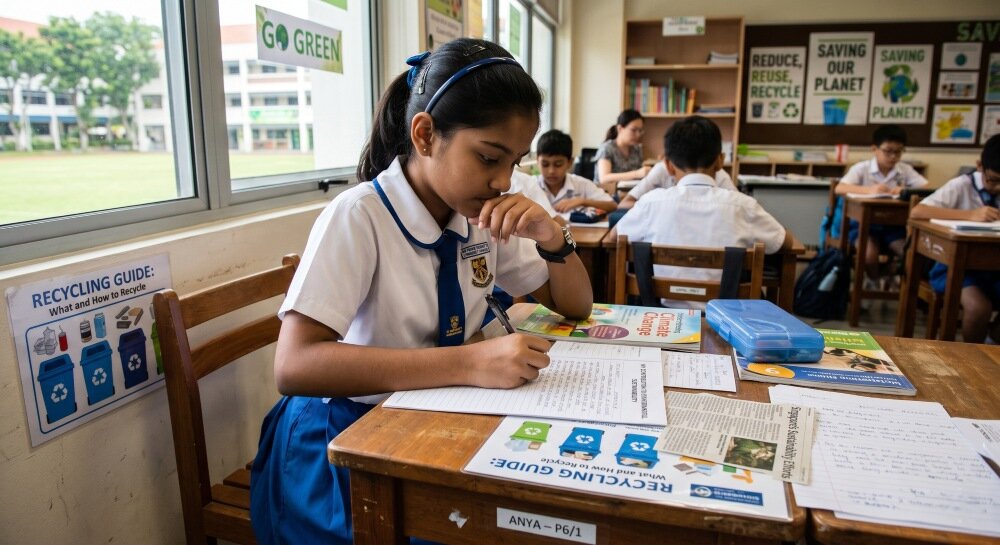
Markers reward grounded Singapore scenarios over abstract global campaigns. The strongest compositions anchor themselves in places and moments upper-primary students genuinely know: a family argument about single-use bottles, a school rooftop solar panel installation, a flooded void deck forcing residents to wade through ankle-deep water, a neighbour’s contaminated recycling bin, a grandmother remembering how different Singapore’s weather used to feel. The theme also stretches across climate anxieties — haze season, rising sea levels, the dwindling space of Semakau — and moments of quiet personal agency: returning a tray to the rack, refusing a plastic straw, choosing one reusable bag. Children who can write this theme well usually handle other reflective, dilemma-driven prompts naturally as a result. For a broader picture of what PSLE markers look for, see our guide to the top 10 PSLE composition themes.
Strong verbs do most of the work. Instead of “hurt the environment”, a P6 child should be able to choose between conserved, contaminated, depleted, incinerated, emitted, devastated, accumulated, reclaimed, dwindled, or sustained depending on what the scenario demands.
Vivid adjectives — sweltering, murky, relentless, fragile, overflowing, stagnant, irreversible, parched, overwhelming, lifeless — name the specific sensation rather than labelling it as “very bad”.
Collocations such as reduce waste, renewable energy, rising sea levels, carbon neutral, flash flood, food waste, eco-friendly habits, conserve energy, climate change, sort recyclables, green building, protect the environment, and waste generation give compositions the polished, idiomatic feel that examiners reward in the higher Content and Language bands.
We have laid out the full bank — strong verbs, vivid adjectives, thematic nouns, idioms, collocations, and Singapore-context example sentences for each — in a downloadable companion Word document, Environment and Sustainability: Full Vocabulary and Phrase Bank. Pull three to five new items into each practice composition rather than memorising everything; this is the same approach we recommend in our broader guide to expanding your child’s vocabulary bank.
A handful of well-rehearsed phrase patterns help a child structure an environmental scene under exam pressure.
These belong to the same family of usable phrases we teach in our general guide on good phrases for P5 and P6 composition writing, and pair well with sensory writing — see how to use the five senses in your writing for ideas on grounding a climate or flood scene physically.
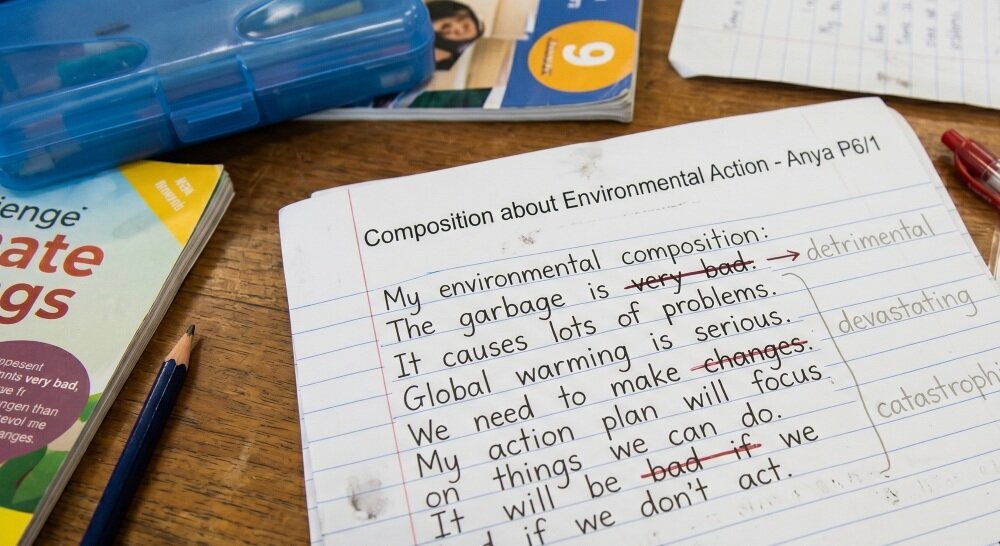
For a deeper look at environmental errors, see our composition mistakes to avoid, and for the wider picture on reflective conclusions, our seven conclusion tips.
Set this 10-minute prompt: “Siti had never really thought about the sea until the afternoon her grandmother pointed out, quietly, that the water had moved closer. Write what happened next.” Ask your child to use at least three vocabulary items from the Word doc bank, one collocation, and one of the sentence starters above. After writing, ask them to highlight every strong verb in their own draft. If there are fewer than five, that is the rewrite focus. The Band 4 challenge is to end without using the words “climate change”, “global warming”, “the environment”, or “pollution” — convey the threat entirely through what the two characters see, remember, and feel. This drill mirrors the planning rhythm we cover in our PSLE composition planning tips, and pairs well with our guides on how to start a composition.
If your child needs help building this vocabulary base and the planning rhythm to deploy it under exam pressure, WRITERS AT WORK runs Primary 5 and Primary 6 composition programmes throughout the year. Our STORYBANKING® approach builds the small bank of well-understood phrases and flexible story skeletons children need on exam day. Start with our practical guide on writing good introductions, then get in touch to find the right class for your child.
Yes. Environment is one of the fastest-growing themes in PSLE-level prompts, both as a setting (a flood, a haze day, a recycling moment) and as a reflective subject (a moment of realisation about waste, a family conversation about climate). Singapore’s Green Plan 2030 and the MOE Eco Stewardship Programme make environmental and sustainability literacy a core competency for every primary student, which means the theme is only going to feature more prominently. A child who can write this theme well usually handles other dilemma-driven and reflective prompts across other themes too.
There is no rule against global scenarios, but two cautions are worth flagging. First, the strongest PSLE compositions are anchored in what the child has genuinely observed or experienced. A composition about melting ice caps in the Arctic reads as research-based rather than lived; one about a flooded void deck feels immediate and authentic. Second, examiners are looking for specific detail — the look of contamination in a recycling bin, the smell of haze, the weight of floodwater at the ankle — not generalised global facts. “Protecting the environment” is too large a scale. “Refusing a plastic straw and choosing a reusable bottle” is right-sized for a P6 narrative. Frame the theme through Singapore, through the local, through the personal.
The fastest fix is asking the question “And then what?” whenever they write “she realised the environment was important.” Make them show you the realisation through what happens next: a changed choice, a question asked, a silent moment, a conversation overheard. Environmental compositions fail most often when they end with a moral (“we must all protect the environment”) rather than a small, specific, credible change. A character who sets their phone face-down is a band 4 ending. A character who has a grand epiphany about saving the planet is band 1–2. Push for the specific action.
Yes, and this can be a very sophisticated ending if handled well. A composition that ends with the narrator walking past the overflowing recycling bin without stopping — and thinking about it later with discomfort or regret — is not a failed ending, but an honest one. The trap is making the reader feel the narrator’s awareness of the gap between awareness and action. Do not make it a moral failure; make it a human one. This often produces more nuanced, Band 3–4 writing than an easy, preachy resolution.

Agnes Ng, Co-Founder and Teaching & Curriculum Director of WRITERS AT WORK. An NUS Honours graduate and published author with over 30 years of experience, Agnes has been the architect of the organization’s student-centric curricula since 2012.
Dedicated to teacher mentorship and academic excellence, she has guided hundreds of students to achieve outstanding results. Her expertise and commitment to high-quality education remain the cornerstone of WRITERS AT WORK’s success in empowering every learner.



Start practising and learning

