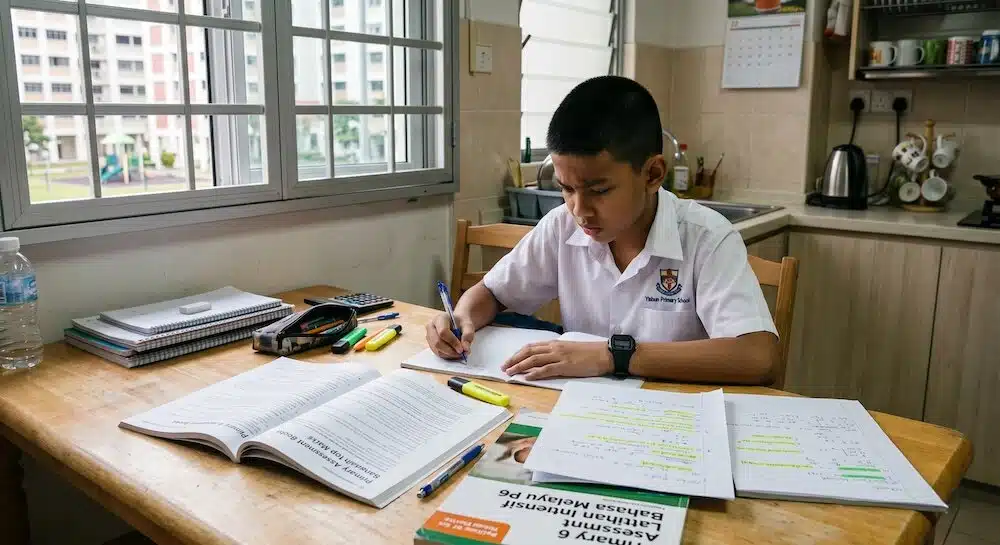
Few themes feel as immediate to a Singapore upper-primary student as examinations, school performance, and the pressure that surrounds them. The PSLE arrives at age twelve, earlier and with higher stakes than almost anywhere else in the developed world, and your child knows it. Psychologists across Singapore have reported up to a 20 per cent annual rise in cases of exam-related stress in students since 2021, and Singapore families collectively spent S$1.8 billion on private tuition in 2023 — nearly double the figure from a decade earlier. When your child sits down to write a composition on this theme, they are writing about something they live every single week.
This guide gives parents a practical picture of the vocabulary, phrases, and craft moves a P5 or P6 child needs to handle exam and study stress with control — without sliding into cliché, melodrama, or hopelessness.
Markers reward grounded Singapore scenarios over generic anxiety. Stronger compositions are anchored in places upper-primary students genuinely know: a kitchen table at midnight cluttered with assessment books, a void-deck tuition centre on a Saturday morning, the silence inside an examination hall right before the invigilator says “you may begin”, a bus ride home after results day with a marked paper folded inside a school bag. The theme also sits inside the wider top 10 PSLE composition themes and overlaps with reflective dilemma prompts about effort, fairness, and family expectations. A child who can write this theme well usually handles other emotionally complex prompts as a result.
Strong verbs do most of the work. Instead of “study very hard”, a P6 child should be able to choose between revised, persevered, scrutinised, persisted, faltered, stammered, intervened, or recoiled depending on what is actually happening in the scene.
Vivid adjectives — apprehensive, crestfallen, gruelling, hollow, mortified, relentless, resolute, weary — name the sensation rather than label it as “very nervous”.
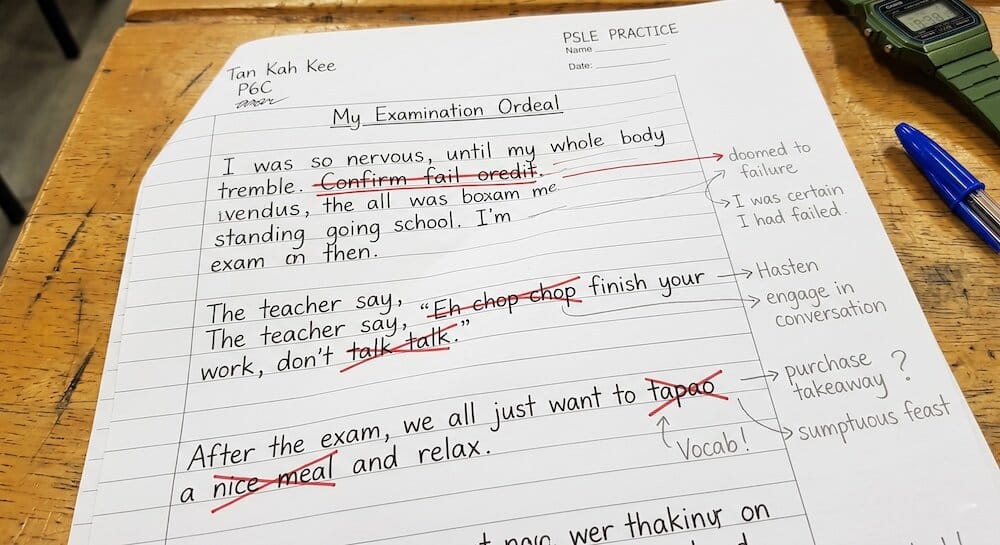
Collocations such as sit an examination, mounting pressure, academic stress, high-stakes exam, careless mistake, manage expectations, cope with stress, and revision schedule give compositions the polished, idiomatic feel that examiners reward in the higher Content and Language bands.
We have laid out the full bank — strong verbs, vivid adjectives, thematic nouns, idioms, collocations, and Singapore-context example sentences for each — in a downloadable companion Word document, Exams Education and Study Stress: Full Vocabulary and Phrase Bank. Pull three to five new items into each practice composition rather than memorising everything; this is the same approach we recommend in our broader guide to expanding your child’s vocabulary bank.
A handful of well-rehearsed phrase patterns help a child structure an exam scene under exam pressure.
These belong to the same family of usable phrases we teach in our general guide on good phrases for P5 and P6 composition writing, and pair well with sensory writing — see how to use the five senses in your writing for ideas on grounding an exam scene physically.
For a deeper look, see our PSLE composition mistakes to avoid and our guide to PSLE composition conclusion tips.
Set this 10-minute prompt: “When Kavitha turned over the examination paper and read the first question, she felt the blood drain from her face. Write what happened next.” Ask your child to use at least three vocabulary items from the Word doc bank, one collocation, and one of the sentence starters above. After writing, ask them to circle every emotion word in their draft. If the draft contains any of “nervous”, “scared”, “happy”, or “sad”, that is the rewrite focus — every emotion should be shown through physical sensation, action, or internal thought rather than named directly. The Band 4 challenge is to end with a sentence that shows what shifts for Kavitha — not a grand resolution, but a single quiet decision. This drill mirrors the planning rhythm we cover in our PSLE composition planning tips, and pairs well with our guide on how to start a composition.
If your child needs help building this vocabulary base and the planning rhythm to deploy it under exam pressure, WRITERS AT WORK runs Primary 5 and Primary 6 composition programmes throughout the year. Our STORYBANKING® approach builds the small bank of well-understood phrases and flexible story skeletons children need on exam day — so they walk in calm and walk out with something to say. Start with our practical guide on writing good introductions, then get in touch to find the right class for your child.
Yes — it is one of the most universally recognisable themes in PSLE composition, and markers reward genuine emotional intelligence on it. The caution is around resolution. A composition that ends in unresolved hopelessness, physical self-harm, or a child suffering without any adult intervention is not appropriate at upper-primary level. Strong endings model healthy responses: the student who confides in a parent, the teacher who notices something is wrong, the friend who quietly listens, the protagonist who decides to ask for help. These are not soft endings — they are mature ones, and they tend to score higher than dramatic collapse.
Replace the named emotion with a physical sensation. “Apprehension gnawed at her”, “her hands trembled as she turned the page”, “a cold dread settled in her chest” all carry the same emotional information without the flat word “nervous” or the bare intensifier “very”. A useful drill: take any of your child’s recent compositions, highlight every emotion-naming word (“nervous”, “scared”, “happy”, “sad”, “angry”), and challenge them to rewrite each sentence so the emotion is shown, not named. Three or four supervised drills usually transfer the habit into the next exam draft.
Either works, but specificity always wins. A composition about a Science SA1, a Maths prelim, a spelling test, or a class quiz reads with more authority than one about a generic “big exam”. Local detail is part of the emotional truth — the invigilator’s footsteps, the assessment book stack, the bus ride home with a folded paper inside the school bag. Markers can tell when a child is writing from lived familiarity versus when they are inventing a vague exam scene; the lived version almost always scores higher in Content.
A composition can end on a quiet or bittersweet note, but not on a hopeless one. The protagonist who walks home from the examination hall not knowing how she did, while noticing the late-afternoon sun on the void deck floor, is a perfectly mature ending. The protagonist who ends the composition convinced she will fail, with no adult around and no shift in her thinking, is too bleak for upper-primary. The simplest rule: by the final paragraph, something inside the protagonist should have shifted, even if her circumstances have not.

Agnes Ng, Co-Founder and Teaching & Curriculum Director of WRITERS AT WORK. An NUS Honours graduate and published author with over 30 years of experience, Agnes has been the architect of the organization’s student-centric curricula since 2012.
Dedicated to teacher mentorship and academic excellence, she has guided hundreds of students to achieve outstanding results. Her expertise and commitment to high-quality education remain the cornerstone of WRITERS AT WORK’s success in empowering every learner.



Start practising and learning

