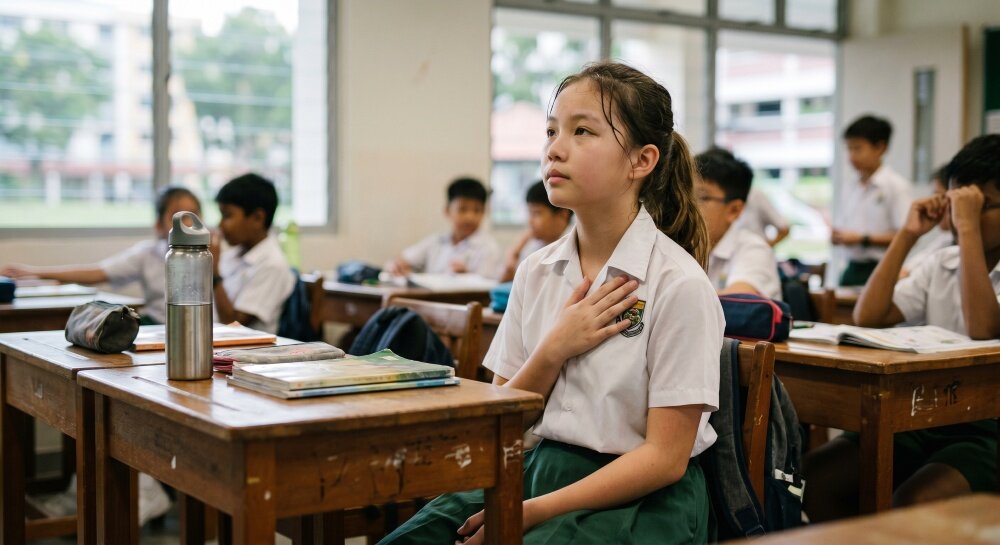
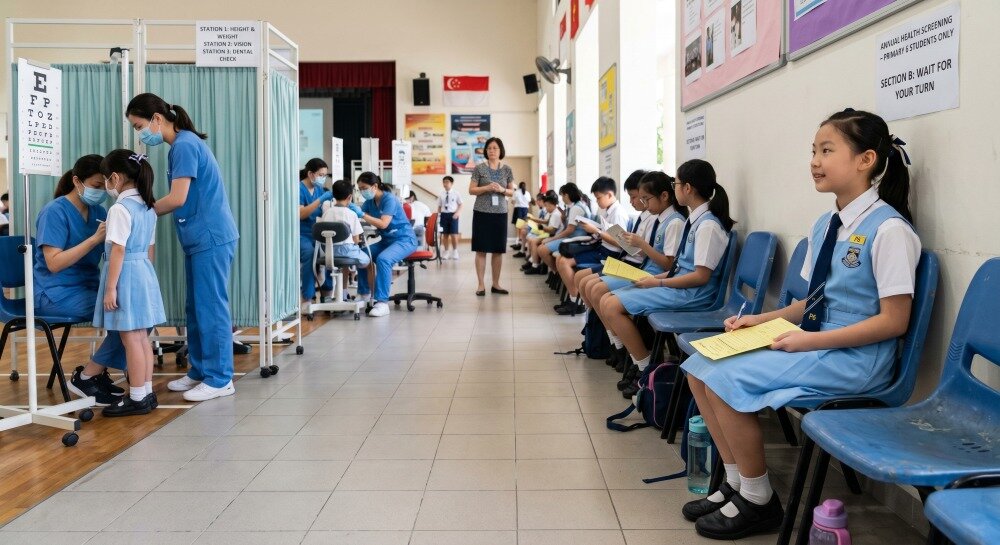
Health and well-being is one of the most multi-dimensional themes an upper-primary student can encounter in an English composition paper. The setting feels immediate and personal — every Singapore student experiences their own body, energy, and stress levels daily — yet composing well on this theme demands control that many children lack. A 2024 National Population Health Survey found that 13% of children across primary, secondary, and pre-university levels are overweight or severely overweight, whilst one in three young people reports severe symptoms of depression, anxiety, or stress. That statistic lands differently when you write it as a composition marker: every classroom contains children living inside those numbers.
This guide gives parents a practical picture of the vocabulary, phrases, and craft moves a P5 or P6 child needs to handle this theme with authority.
Markers reward grounded Singapore scenarios over generic wellness platitudes. Stronger compositions are anchored in places upper-primary students genuinely know: a cross-country run around Bedok Reservoir in the heat, a dengue fever diagnosis that confines a child to a single HDB bedroom, a classmate collapsing during PE because of inadequate sleep, a family argument about screen time, a school assembly on mental health that opens a conversation a student has never heard aloud before. The theme also stretches across personal resilience — building a habit that is difficult, pushing through discomfort, noticing the moment when something shifts — and intersects naturally with other top 10 PSLE composition themes. Children who can write health-and-well-being compositions well usually handle reflective, growth-arc, and dilemma-driven prompts across other themes too.
Strong verbs do most of the work. Instead of “felt sick”, a P6 child should be able to choose between collapsed, exhausted, persevered, recuperated, wheezed, succumbed, or revitalised depending on whether the scene is acute illness, effort, or recovery.
Vivid adjectives — feverish, sluggish, breathless, weary, debilitating, lethargic, aching, frail — name the sensation rather than labelling it as “very ill”.
Collocations such as balanced diet, physical activity, mental health, adequate sleep, dengue fever, healthy habits, seek help, nutritious meal, and well-being give compositions the polished, idiomatic feel that examiners reward in higher Content and Language bands.
We have laid out the full bank — strong verbs, vivid adjectives, thematic nouns, idioms, collocations, and Singapore-context example sentences — in a downloadable companion Word document, Health and Well-Being: Full Vocabulary and Phrase Bank. Pull three to five new items into each practice composition rather than memorising everything; this is the same approach we recommend in our broader guide to expanding your child’s vocabulary bank.
A handful of well-rehearsed phrase patterns help a child structure a health or well-being scene under exam pressure.
These belong to the same family of usable phrases we teach in our general guide on good phrases for P5 and P6 composition writing, and pair naturally with physical description — see how to use the five senses in your writing for ideas on grounding a health scene.
For more detail, see our composition conclusion tips and PSLE composition mistakes to avoid.
Set this 10-minute prompt: “Wei Jie pressed his hand to his chest and felt his heart racing in the heat. Write what happened next.” Ask your child to use at least three vocabulary items from the Word doc bank, one collocation, and one of the sentence starters above. After writing, ask them to highlight every strong verb in their own draft. If there are fewer than five, that is the rewrite focus. The Band 4 challenge is to end with a sentence that shows what Wei Jie learnt — not by telling (“He learnt that…”) but through a single quiet action. This drill mirrors the planning rhythm we cover in our PSLE composition planning tips, and pairs well with our guides on how to start a composition and building emotional resilience.
If your child needs help building this vocabulary base and the planning rhythm to deploy it, WRITERS AT WORK runs Primary 5 and Primary 6 composition programmes throughout the year. Our STORYBANKING® approach builds the small bank of well-understood phrases and flexible story skeletons children need on exam day. Start with our practical guide on writing good introductions, then get in touch to find the right class for your child.
Yes. Health and well-being is one of Singapore’s most current compositional themes, anchored in national strategies like Grow Well SG (launched January 2025 by MOH, MOE, and MSF) and expanded to Primary 4 and Primary 5 students in 2026. MOE’s EdTech Masterplan 2030 makes health literacy a core competency for every primary student. A child who can write this theme well usually handles reflective, growth-arc, and dilemma-driven prompts across other themes too.
Both hospital and clinic settings are entirely appropriate, provided the composition focuses on the child’s internal experience rather than medical procedure details. A marker reading “My mother was waiting outside the examination room” reads differently from “The doctor inserted the needle into the vein.” The former is a moment; the latter is gratuitous. Stick to what the child witnesses, feels, or realises — not what the medical system does to their body.
Yes, and this is increasingly common in upper-primary PSLE prompts. The caution is this: the composition is not a therapy session, and your child should not be asked to disclose personal struggles in assessed work. Instead, frame the scenario as a character seeking help — talking to a parent, a counsellor, a friend — and receiving it. A composition where a character recognises they are struggling and takes action to get support teaches both self-awareness and help-seeking as strengths.

Agnes Ng, Co-Founder and Teaching & Curriculum Director of WRITERS AT WORK. An NUS Honours graduate and published author with over 30 years of experience, Agnes has been the architect of the organization’s student-centric curricula since 2012.
Dedicated to teacher mentorship and academic excellence, she has guided hundreds of students to achieve outstanding results. Her expertise and commitment to high-quality education remain the cornerstone of WRITERS AT WORK’s success in empowering every learner.



Start practising and learning

