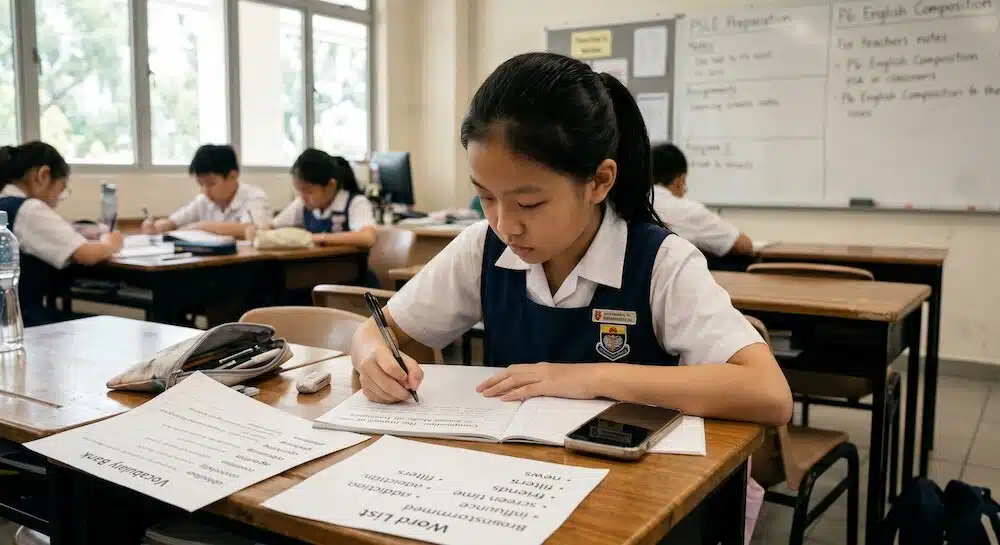
Technology and social media is one of the most contemporary themes in PSLE English composition, and one of the trickiest to write well. The setting feels familiar, every Singapore upper-primary student lives this material daily — but that familiarity is exactly what tips compositions into Singlish, vague description, and tired storylines. A 2025 MDDI Digital Parenting Survey found nearly half of children aged 10 to 12 exceed the Ministry of Health’s two-hour weekday screen time guideline, with only 37% of parents feeling confident guiding their child’s digital habits. Markers know your child is reading those numbers from the inside.
This guide gives parents a practical picture of the vocabulary, phrases, and craft moves a P5 or P6 child needs to handle this theme with control.
Markers reward grounded Singapore scenarios over imaginary global ones. Stronger compositions are anchored in places upper-primary students genuinely know: a class WhatsApp group where one wrong forward goes everywhere, a Sunday video call to a grandmother in Chennai or Johor Bahru, a Student Learning Space (SLS) login that fails on the morning of a test, a phone left face-down at the dinner table because of a Grow Well SG family rule. The theme also stretches across mishaps with cyberbullying, miscommunication, suspicious links, and AI use — all scenarios that fit naturally inside the wider top 10 PSLE composition themes. Children who can write technology compositions well usually handle other reflective, dilemma-driven prompts as a result.
Strong verbs do most of the work. Instead of “use the phone”, a P6 child should be able to choose between scrolled, swiped, streamed, navigated, bombarded, illuminated, infiltrated, or reverberated depending on what is happening.
Vivid adjectives — addictive, glowing, overwhelming, relentless, oblivious, hollow — name the sensation rather than label it as “very interesting”.
Collocations such as post a comment, manage screen time, online safety, harmful content, digital literacy, lose sleep, screen addiction, share a video, and digital footprint give compositions the polished, idiomatic feel that examiners reward in the higher Content and Language bands.
We have laid out the full bank — strong verbs, vivid adjectives, thematic nouns, idioms, collocations, and Singapore-context example sentences for each — in a downloadable companion Word document, Technology and Social Media: Full Vocabulary and Phrase Bank. Pull three to five new items into each practice composition rather than memorising everything; this is the same approach we recommend in our broader guide to expanding your child’s vocabulary bank.
A handful of well-rehearsed phrase patterns help a child structure a digital-life scene under exam pressure.
These belong to the same family of usable phrases we teach in our general guide on good phrases for P5 and P6 composition writing, and pair well with sensory writing — see how to use the five senses in your writing for ideas on grounding a screen scene physically.
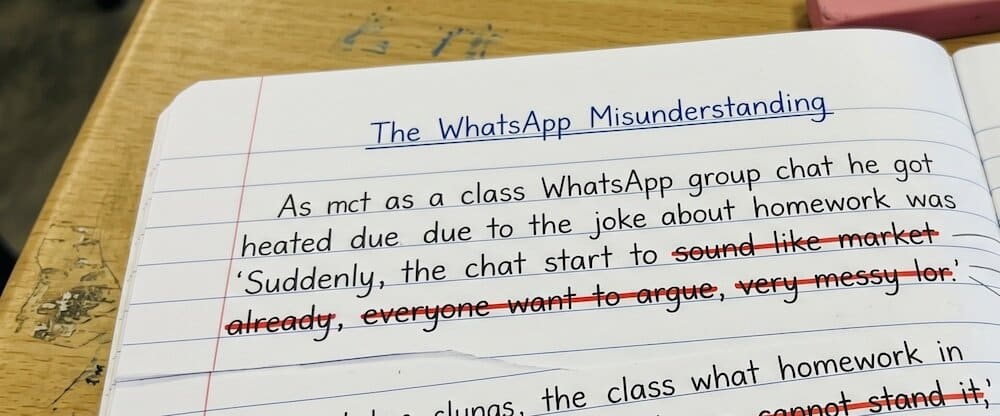
For a deeper look at endings, see our composition conclusion tips, and for the wider list of mistakes, our PSLE composition mistakes to avoid. For the bigger picture on this whole theme, our piece on writing tips for a social media essay is a useful companion.
Set this 10-minute prompt: “Kai Wen pressed ‘send’ before he had finished reading the message. Write what happened next.” Ask your child to use at least three vocabulary items from the Word doc bank, one collocation, and one of the sentence starters above. After writing, ask them to highlight every strong verb in their own draft. If there are fewer than five, that is the rewrite focus. The Band 4 challenge is to end with a sentence that shows what Kai Wen learnt — not by telling (“He learnt that…”) but through a single quiet action. This drill mirrors the planning rhythm we cover in our PSLE composition planning tips, and pairs well with our guides on how to start a composition and media literacy for primary school students.
If your child needs help building this vocabulary base and the planning rhythm to deploy it under exam pressure, WRITERS AT WORK runs Primary 5 and Primary 6 composition programmes throughout the year. Our STORYBANKING® approach builds the small bank of well-understood phrases and flexible story skeletons children need on exam day. Start with our practical guide on writing good introductions, then get in touch to find the right class for your child.
Yes. Technology is one of the fastest-growing themes in PSLE-level prompts, both as a setting (a phone-related mishap) and as a reflective subject (a moment of online conflict, a digital lesson learnt). MOE’s EdTech Masterplan 2030 makes digital and AI literacy a core competency for every primary student, which means the theme is only going to feature more prominently. A child who can write this theme well usually handles dilemma-driven and reflective prompts across other themes too.
There is no rule against naming platforms, but two cautions are worth flagging. First, most major social media platforms set a minimum age of 13, so a P5 narrator with a personal TikTok account immediately reads as implausible to a marker. Safer framings: a parent’s device, a school-sanctioned platform like Student Learning Space (SLS), an age-appropriate game, or a class WhatsApp group on a parent’s phone. Second, brand names date quickly. “Posting a short video on her phone” travels better than “scrolling TikTok” if the prompt is reused across years.
The fastest fix is reading aloud. Ask your child to read their draft aloud to you; the Singlish constructions (“use the handphone”, “until very late”, “got a lot of information”) will jump out far more in the ear than on the page. Then have them substitute the standard British English equivalent and re-read. This works because Singlish patterns are aural and habitual; surfacing them aurally is the most natural way to retrain the writing voice. Three or four supervised read-aloud sessions usually move the needle.
Yes, and these endings can be very effective if they avoid the two common traps. First, do not preach. “She realised that social media is bad and decided to delete her account” tells the marker the lesson; it does not earn it. Second, do not over-resolve. A more mature ending shows a small, specific change — setting the phone face-down, choosing to call a friend instead of message, putting the device in another room overnight — without claiming the problem is solved forever. The narrator who learns one quiet thing scores higher than the narrator who has a grand revelation.

Agnes Ng, Co-Founder and Teaching & Curriculum Director of WRITERS AT WORK. An NUS Honours graduate and published author with over 30 years of experience, Agnes has been the architect of the organization’s student-centric curricula since 2012.
Dedicated to teacher mentorship and academic excellence, she has guided hundreds of students to achieve outstanding results. Her expertise and commitment to high-quality education remain the cornerstone of WRITERS AT WORK’s success in empowering every learner.



Start practising and learning

