Have you ever written a sentence that was grammatically correct, yet it still sounded slightly awkward? That often happens when the words do not naturally go together. In English, certain words are commonly paired in ways that fluent speakers expect. These combinations are called collocations.
Strong collocations can lift your vocabulary, improve your sentence flow, and make your writing feel more polished in school assignments and exams.
A collocation is a pair or group of words that are often used together. For example, we say make a mistake, not do a mistake. We say heavy rain, not strong rain. Both words may make sense on their own, but only one combination sounds natural in English.
Here are some simple examples:
When writing compositions, students often need to describe emotions clearly. These collocations can help:
Example:
She was deeply worried when her brother did not return home on time.
These are useful when describing what characters do or what happens in a story:
Example:
He finally made a decision to apologise for his careless behaviour.
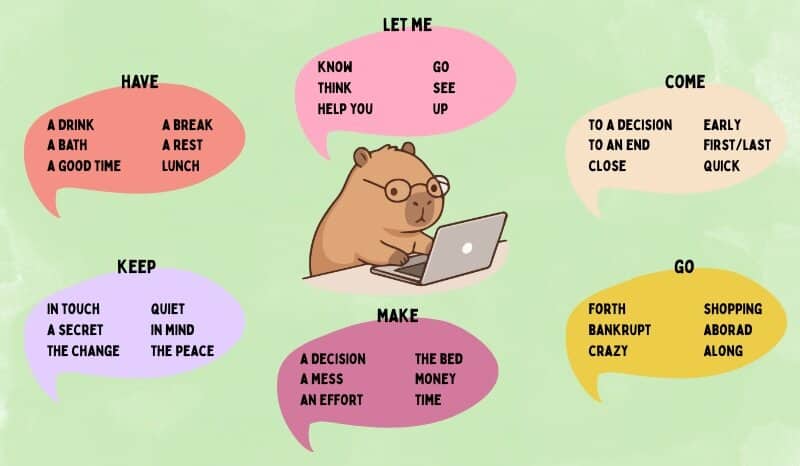
Students often write about school, friendships, responsibility, and personal experiences. These collocations fit those topics well:
Example:
Joining the storytelling competition helped her build confidence and speak more clearly in front of others.
In reflective or expository writing, students need to express thoughts clearly. These collocations are useful:
Example:
I came to realise that success depends not only on talent, but also on discipline.
A common mistake is translating directly from another language or choosing words based only on meaning. English does not always work that way.
For example:
At WRITERS AT WORK, our programmes are designed to meet students where they are and help them progress with confidence.
For primary students, our PURE Composition Writing Programmes help children build creativity, develop stronger ideas, and learn how to write vivid, well-structured compositions. Our Comprehensive English Programmes support students in key areas such as grammar, comprehension, oral communication, and writing, giving them a strong all-round foundation for school and national exam success.
For secondary students, our Secondary Programmes are designed to sharpen critical reading, strengthen essay and situational writing skills, and build the exam strategies needed for lower secondary assessments, upper secondary demands, and the O-Level English papers.
Beyond the classroom, students and parents can also tap into our wider learning resources through W@W eSeries, and stay updated with tips, insights, and student support on TikTok and Facebook.
Collocations are words that naturally go together, such as “make a decision” or “deeply worried.” Learning them helps students write in a way that sounds more fluent and natural. In composition writing, strong collocations can also make descriptions clearer and improve the overall quality of a student’s expression.
Collocations give students ready-to-use word combinations that make writing more precise and engaging. Instead of using basic or awkward phrases, students can choose expressions that sound more polished and accurate. This is especially useful for students who want to build a bank of good phrases for composition writing and apply them confidently in exams.
The best way is through repeated exposure; reading books, guided practice, and regular writing. Students need to see collocations in context, understand their meanings, and practise using them in sentences and compositions.

Agnes Ng, Co-Founder and Teaching & Curriculum Director of WRITERS AT WORK. An NUS Honours graduate and published author with over 30 years of experience, Agnes has been the architect of the organization’s student-centric curricula since 2012.
Dedicated to teacher mentorship and academic excellence, she has guided hundreds of students to achieve outstanding results. Her expertise and commitment to high-quality education remain the cornerstone of WRITERS AT WORK’s success in empowering every learner.



Start practising and learning

