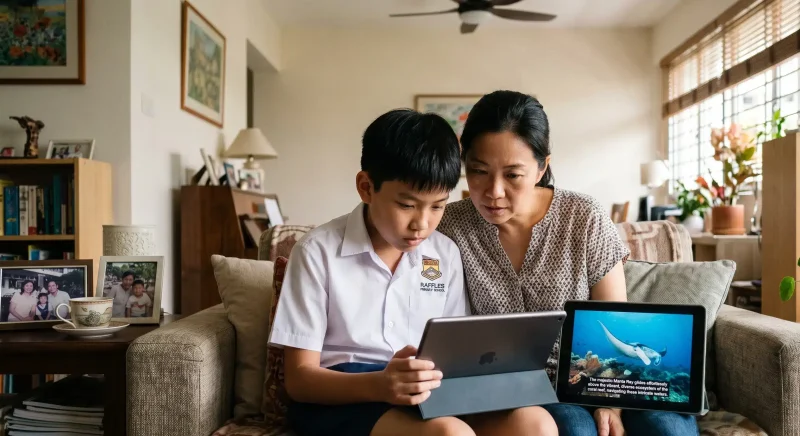
The first thing examiners hear in a Singapore oral exam is not your child’s accent and not their pace. It is whether your child has something to say. The students who freeze in the PSLE Oral examination, or who give one-line answers and then run out of thoughts, are almost never the ones with weak English. They are the ones who have spent months practising how to speak without spending any time on what to speak about.
That gap has a name. Teachers call it content poverty, and it is the single biggest reason capable children sound thin in oral assessments. The fix is not more drills. It is a steady, low-effort habit of building up the bank of things your child can talk about with conviction. Documentaries are one of the cleanest ways to do that, and most Singapore parents are sitting on the resource without realising it.
For broader context on the oral exam, our PSLE Oral Topics 2025 Guide is a good place to start. This post explains why the documentary approach works and how to turn a 20-minute viewing session into a real speaking habit at home.
If you have ever sat your child down to practise oral and watched them answer in three short sentences before going quiet, you have seen the content gap up close. The questions in the Stimulus-Based Conversation are not difficult. They are designed to invite a child into a conversation. What stops most students is not the language. It is that they cannot find the next thing to say.
Examiners notice this almost immediately. A child who knows three facts about recycling can describe a real moment and answer a follow-up question with detail to spare. A child who knows none of those facts will repeat the same general line three different ways. The same is true at secondary level, where the O-Level Planned Response, introduced in 2023, gives candidates ten minutes to watch a video clip and then deliver a two-minute structured response. A student with a deep bank of real-world content walks into that ten-minute window and gets to work. A student without one stares at the screen.
Building the content bank is the part of oral preparation that almost no one talks about, and it is the part that quietly decides how confident your child sounds in the exam room.
Vocabulary lists work for spelling tests. They do not work for speaking. A child can memorise the word biodiversity for a Friday paper and still not use it the following Monday when asked about the environment. The reason is that words live in stories. A child who has watched a 15-minute documentary about coral bleaching in the South China Sea has a picture of a reef, the sound of a marine biologist explaining what they are seeing, and a real emotional moment to attach the word to. The next time biodiversity comes up in a conversation, it arrives with all of that texture intact.
Cognitive science calls this multimodal learning, and the research on it is consistent. A 2025 study in the International Journal of Education, Humanities and Social Sciences found that multimodal teaching improved primary ESL students’ comprehension and critical thinking in measurable ways. Harvard’s Graduate School of Education has repeatedly shown that background knowledge is the single strongest predictor of how well students understand and explain new material. Watching a good documentary is one of the most efficient ways to build that background knowledge, because it gives your child both the facts and the feeling at the same time.
This matters for speaking because a confident speaker is not someone who has memorised the right sentence. It is someone who has internalised the topic deeply enough that the sentence comes naturally. Documentaries help your child get there in a way that no flashcard set can.
The shift to video-based prompts is not an accident. It is now the dominant format across Singapore’s English oral assessments. The PSLE Oral examination’s Stimulus-Based Conversation uses a real-life photograph as the prompt, with three questions that move from observation to personal experience to opinion. The O-Level Planned Response, introduced in 2023, uses a short video clip and asks students to organise and deliver a structured spoken response. Both formats reward students who can speak from real understanding of a topic, not from memorised templates.
This blog: PSLE Oral: Guide to ace Stimulus-Based Conversation go into more detail on the SBC structure. The takeaway for parents is this. A child who has watched ten documentaries across ten different themes over the school year walks into either exam carrying ten reservoirs of real content to draw from. That is what gives them the breathing room to think under pressure, instead of scrambling for the next sentence.
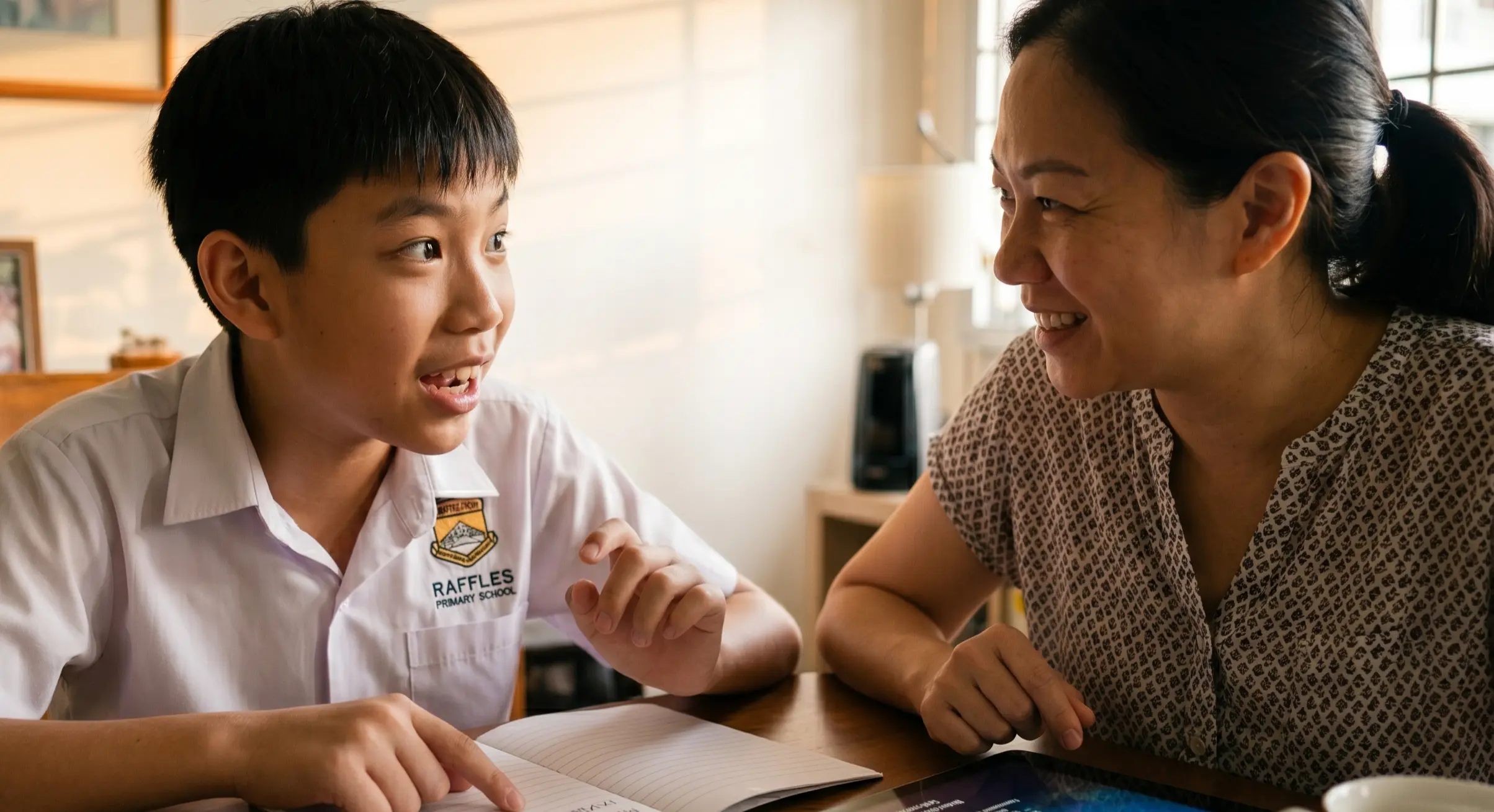
Documentaries only build speaking content if you turn the watching into talking. Passive viewing is just television. The good news is that the routine you need is small. Twenty minutes, twice a week, is enough to make a real difference over a school term.
Here is the shape of a session that works:
The whole routine takes twenty to thirty minutes. The discussion is the work. The watching is the setup.
For Primary 1 to Primary 3, look for short factual clips of five to eight minutes. Nature documentaries about animals and daily life in different countries land well at this age. National Geographic Kids has well-paced clips on everything from how bees pollinate flowers to how chocolate is made. BBC Bitesize is free and has primary-level documentaries grouped by curriculum topic.
For Primary 4 to Primary 6, your child is ready for longer pieces of ten to fifteen minutes on slightly more abstract topics. CNA Insider has accessible Singapore-focused documentaries on hawker centres, ageing, recycling and the lives of migrant workers in the city. The BBC’s Newsround offers short current-affairs documentaries pitched at this age. Planet Earth and Blue Planet clips work especially well for upper primary because they combine vivid imagery with clear, expressive narration that your child can also learn to imitate.
A few specific topic areas that map directly to PSLE Oral conversation themes:
Our post on media literacy for primary school students covers how to help your child think critically about what they watch, which is a useful companion to this habit.
For Secondary 1 to Secondary 4, your child can handle full-length documentaries of twenty to forty minutes. CNA’s Insight is built for this age group and explores Singapore policy issues with depth. The Straits Times video team produces short documentaries on topics that map directly to O-Level oral themes: housing, employment, social cohesion. International documentaries from the BBC and the New York Times’s Op-Doc series introduce wider perspectives that secondary students can practise weighing against their own.
The shift at this level is from absorbing content to forming opinions. After watching a documentary about urban farming or generative AI or social media regulation, the most useful question to ask is not “what did you learn.” It is “what do you think and why.” That is the question the Planned Response format will ask, and it is the question every secondary teacher will ask in class. A child who has had practice answering it at home will sound steadier when it comes up in a formal setting.
This part is optional, but it produces the most striking gains. Several secondary schools across the world have started using student-made mini-documentaries as oral assessment projects, and the results in the research are remarkable. Students who plan, interview, script and narrate a five-minute documentary on a topic of their choosing develop a level of oral fluency that no amount of timed practice can match.
The skills come from the work itself. Approaching an interview subject and asking the first question. Listening carefully enough to ask a useful follow-up. Adjusting language register for different audiences. Speaking clearly to a camera. These are exactly the skills the Spoken Interaction component of the O-Level oral examination assesses. For ambitious secondary students, even a single school-holiday project where they make a short documentary about their grandparent’s life, or their estate, or a community group, can lift their oral confidence noticeably by the next term.
The reason documentaries work is the same reason our teaching method works. The disciplined approach that powers our composition programmes through STORYBANKING® is built on the same principle: a confident performance comes from a deep bank of content, not from memorised lines. We apply this thinking to oral as well, and our Primary 5 and Primary 6 English programmes give students weekly speaking practice with feedback, on topics that connect to the world they actually live in.
If you would like your child to practise oral with structure every week, with a real listener who can give honest feedback, get in touch through our website. The documentary habit at home and the structured practice in class work best together, and the parents who set both up tend to see the biggest jump in their child’s oral confidence by the end of the term. Follow us on Instagram, Facebook and YouTube for weekly tips.
Twenty minutes, twice a week, is plenty. The discussion afterwards matters more than the watching itself, and overdoing it tends to turn the habit into a chore. Two short sessions a week across a school term will build a real content bank without crowding out the rest of the homework load.
Start with a topic they already care about. Football, K-pop, cooking, video games, the natural world. There are good documentaries on every one of these subjects. CNA Insider has profiled hawker stalls and street food. BBC has shown the science behind the Premier League. National Geographic has made dozens of documentaries about animals your child has met at the Singapore Zoo. The trick is to let the first three documentaries be on subjects your child chose, not the subjects you wish they would care about.
Use them. Research on captioned video consistently shows that subtitles improve vocabulary acquisition and comprehension, especially for English-language learners. Subtitles are not a crutch and they do not slow down comprehension. They are a free upgrade.
Yes, and possibly more than for any other family. Documentaries give a child consistent, high-quality exposure to natural English narration and vocabulary in context, which is exactly what a child who does not get that input at home needs most. Pair the documentary with the same three-question discussion routine in whichever language is most comfortable at home. The point is the content building, not the language of the discussion.

Jemmies Siew, Managing Director and Co-Founder of WRITERS AT WORK Enrichment Centre. With over 15 years of experience in education, entrepreneurship, and marketing, Jemmies has helped shape Singapore’s English enrichment landscape through her vision for transformative learning.
She is passionate about connecting real-world issues with language learning, helping students think critically and express themselves clearly. Connect with her on LinkedIn to follow her insights on education, content marketing, and thought leadership.



Start practising and learning

