Many parents want their children to improve their English vocabulary, but the process can feel overwhelming. Should children memorise long word lists, copy definitions from the dictionary, or learn impressive words for compositions and oral examinations? The answer is simpler than it seems: a useful vocabulary bank is not just a list of difficult words, but a collection of words, phrases, examples, and ideas that a child can actually understand and use. For primary school students, especially those preparing for PSLE English and PSLE Oral, vocabulary is not about sounding complicated but about expressing ideas clearly, accurately, and confidently. A good vocabulary bank helps children move beyond basic words and gives them better language tools for writing, speaking, and comprehension.
A vocabulary bank is a personal collection of useful words and phrases that a child can return to regularly. It may include descriptive words, powerful verbs, connectors, idioms, topic-related vocabulary, oral discussion phrases, and sentence examples. However, it should not be a random notebook filled with words copied from the dictionary. If a child writes down words but never uses them, the vocabulary bank becomes a storage space instead of a learning tool. A useful vocabulary bank helps children understand how words work in context, meaning they know the meaning of the word, how to use it in a sentence, when to use it, and what kind of topic it is suitable for.
Vocabulary affects almost every part of English learning. In composition writing, students need precise words to describe characters, settings, emotions, and actions. In comprehension, they need to understand vocabulary clues in passages and questions, while in PSLE Oral, they need topic-related words to explain their opinions clearly. Many students rely on basic words such as “good”, “bad”, “happy”, “sad”, “nice”, “interesting”, and “important”. While these are not wrong, they can make answers sound general. For example, instead of saying a person is “very happy”, a student might say the person is delighted, relieved, excited, or proud, each giving a slightly different meaning. A wider vocabulary helps students become more accurate and express exactly what they mean.
One of the best ways to build a vocabulary bank at home is to organise it by themes, which is especially helpful for primary school students since compositions, comprehension passages, and oral topics often revolve around familiar real-world themes. A child can create sections for themes such as school, family, friendship, the environment, technology, public transport, sports, healthy living, community, kindness, safety, and responsibility. Under each theme, the child can collect useful words and phrases. For example, under “environment”, they might include words such as pollution, conservation, reusable, wasteful, sustainable, littering, recycling, and responsibility, along with phrases like “reduce plastic waste”, “protect the environment”, “develop eco-friendly habits”, and “play a part in keeping public spaces clean”. This approach makes vocabulary easier to remember because the words are connected to meaningful topics.
Many children collect single words but still struggle to use them correctly, which is why phrases are important. Instead of simply writing the word “considerate”, students can record phrases such as “be considerate towards others”, “show considerate behaviour”, “a considerate act”, and “considerate commuters who give up their seats”. These phrases show how the word is used naturally and help students apply it in writing and oral responses. For PSLE Oral, phrase banks are especially helpful, with expressions such as “In my opinion”, “This shows that”, “One possible reason is”, “For example”, “This can affect”, and “A good way to solve this problem is” helping students organise their thoughts and speak more smoothly.
A vocabulary bank should always include example sentences because without them, children may know the meaning of a word but still use it awkwardly. For instance, if the word is “frustrated”, the child can write, “Tom felt frustrated when he could not solve the maths problem despite trying many times.” If the phrase is “show initiative”, they can write, “Sarah showed initiative by helping her teacher arrange the chairs before the class arrived.” Example sentences help children see the word in action and provide sentence patterns they can adapt in their own writing and speaking.
Another helpful method is to sort vocabulary by purpose, which helps children choose the right words more quickly when writing or preparing for oral practice. For composition writing, students may create categories such as emotions, actions, movement, speech, weather, settings, conflict, and resolution. For example, under “emotions”, they can collect words like anxious, embarrassed, relieved, disappointed, grateful, and determined, while under “speech”, they can include whispered, muttered, exclaimed, replied, complained, and admitted. For oral practice, students can sort words by topic, such as “public transport”, where they might include commuters, crowded, accessibility, priority seats, peak hours, elderly passengers, and gracious behaviour. This makes the vocabulary bank more practical because children can find the words they need based on the task.
Reading is one of the most natural ways to build vocabulary, as children are exposed to words used in context through storybooks, news articles, school passages, or model compositions. Parents can encourage children to highlight or write down useful words while reading, but children should not record every unfamiliar word. The goal is not to collect as many words as possible, but to collect words that are useful and likely to appear again. A helpful question to ask is, “Can I use this word in my own writing or speaking?” If the answer is yes, it belongs in the vocabulary bank.
Vocabulary becomes more memorable when children connect it to everyday experiences. For example, after taking the MRT, parents can discuss words like commuters, crowded, considerate, priority seats, and public transport etiquette, while after visiting a hawker centre, they can discuss cleanliness, tray return, shared spaces, hygiene, and responsibility. These simple conversations help children understand that vocabulary is not just for worksheets but part of how we describe the world around us, which is especially useful for PSLE Oral where students are expected to discuss real-world topics and give opinions based on everyday situations.
A vocabulary bank is only useful if children return to it regularly. Instead of constantly adding new words, students should spend time reviewing and using the words they already have. Parents can help by asking their child to choose three words from the vocabulary bank and use them in sentences, or to use selected vocabulary in a short paragraph, composition plan, or oral response. For example, if the theme is “kindness”, the child can practise using words like thoughtful, considerate, grateful, helpful, and compassionate in a short oral answer. Regular use helps vocabulary move from memory into active language, meaning the child is not just recognising the word but learning to use it naturally.
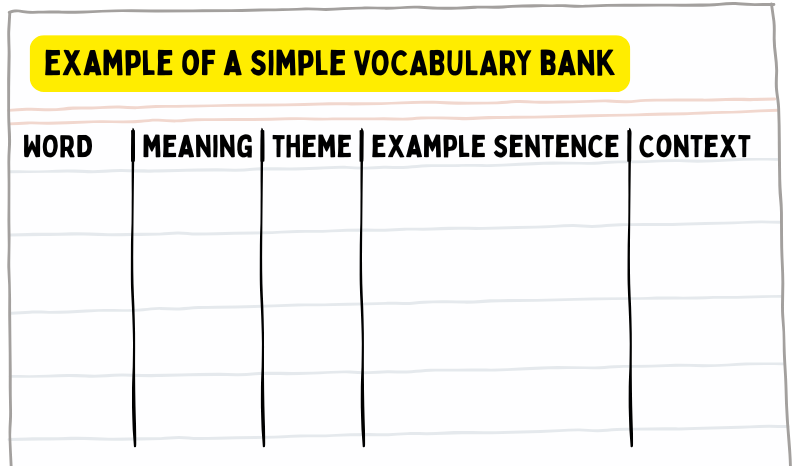
A vocabulary bank does not need to be beautifully decorated or overly complicated; it should be simple enough for the child to maintain. Some children prefer a physical notebook, while others may prefer a digital document or spreadsheet, and either format can work as long as the vocabulary is organised clearly. A simple vocabulary bank can include columns such as word or phrase, meaning, theme, example sentence, and where it can be used. This structure helps children understand the word and apply it in the right context.
One common mistake is asking children to memorise many advanced words without understanding how to use them, which can lead to unnatural writing or oral responses. For example, a student may memorise a difficult word but use it in the wrong situation, making the sentence sound awkward or unclear. It is better for a child to use a simpler word accurately than to use a difficult word incorrectly. The goal is not to fill the vocabulary bank with impressive words, but to build a bank of useful words that help the child communicate better.
Vocabulary practice does not have to feel like extra homework, as parents can make it part of daily life by asking simple questions during conversations, such as “What word can we use to describe how the character felt?”, “Can you think of a stronger word than ‘happy’?”, “What phrase can we use to describe this situation?”, and “Where else can we use this word?” Parents can also encourage children to keep a “word of the week” and try to use it in writing or speaking, as small, consistent habits are more effective than occasional memorisation sessions.
Ready to help your child grow in English with the right support at every stage?
At WRITERS AT WORK, our programmes are designed to meet students where they are and help them progress with confidence.
For primary students, our PURE Composition Writing Programmes help children build creativity, develop stronger ideas, and learn how to write vivid, well-structured compositions. Our Comprehensive English Programmes support students in key areas such as grammar, comprehension, oral communication, and writing, giving them a strong all-round foundation for school and national exam success.
For secondary students, our Secondary Programmes are designed to sharpen critical reading, strengthen essay and situational writing skills, and build the exam strategies needed for lower secondary assessments, upper secondary demands, and the O-Level English papers.
Beyond the classroom, students and parents can also tap into our wider learning resources through W@W eSeries, and stay updated with tips, insights, and student support on TikTok and Facebook.

A useful vocabulary bank should include words, phrases, meanings, themes, example sentences, and notes on where the vocabulary can be used, such as composition writing or oral responses.
No. Children need to understand how words are used in context. It is more effective to learn vocabulary through themes, phrases, examples, reading, and regular practice.
A few short review sessions each week can be helpful. Children should practise using selected words in sentences, paragraphs, oral answers, or composition plans.
No. Examiners are not looking for a dramatic performance. They simply want your reading to sound natural, engaging, and appropriate to the passage.

Agnes Ng, Co-Founder and Teaching & Curriculum Director of WRITERS AT WORK. An NUS Honours graduate and published author with over 30 years of experience, Agnes has been the architect of the organization’s student-centric curricula since 2012.
Dedicated to teacher mentorship and academic excellence, she has guided hundreds of students to achieve outstanding results. Her expertise and commitment to high-quality education remain the cornerstone of WRITERS AT WORK’s success in empowering every learner.



Start practising and learning

