When your child brings home an English paper, it can be tempting to look straight at the marks. Many parents naturally ask, “How much did you score?” or “Why did you lose these marks?” However, a paper review should not only be about the final score. The real value lies in understanding why marks were lost and what your child can do differently next time. A good review helps your child notice patterns, correct mistakes, and build better exam habits. Instead of simply feeling disappointed or relieved, your child learns how to improve.
Here is a step-by-step method parents can use to review an English paper at home.
Before going into the mistakes, look at the paper as a whole. Ask your child:
This helps your child reflect before correction and gives you a better sense of whether the issue was content knowledge, question understanding, careless mistakes, time management, or confidence. The aim is not to scold, but to understand the starting point.
Not all mistakes are the same. Some are careless errors, some show weak understanding, and others happen because the child misread the question. When reviewing the paper, group the errors into categories.
|
Type of Mistake |
What It Means |
|
Careless mistake |
Your child knew the answer but made a slip |
|
Concept mistake |
Your child did not understand the grammar rule, word meaning, or question type |
|
Question analysis mistake |
Your child missed a keyword or misunderstood what was required |
|
Expression mistake |
Your child had the idea but did not phrase the answer clearly |
|
Time management mistake |
Your child rushed, skipped, or left questions incomplete |
This is important because different mistakes need different solutions. When parents and children can identify the type of mistake, revision becomes more focused and effective.
For grammar and vocabulary sections, do not simply give the correct answer. Ask your child to explain why their answer was wrong and why the correct answer works. Check whether your child understands key grammar rules such as tense, subject-verb agreement, and connectors, and whether they understand vocabulary in context.
Parents can guide the review with questions such as:
|
Parent Question |
What It Helps Your Child Do |
|
What clue in the sentence helps you choose the answer? |
Encourages careful reading |
|
Which word tells you the tense? |
Builds grammar awareness |
|
Does this answer fit the meaning of the sentence? |
Strengthens vocabulary in context |
|
Why is the other option wrong? |
Helps prevent guessing |
The goal is to train your child to think through answers, not rely on instinct.
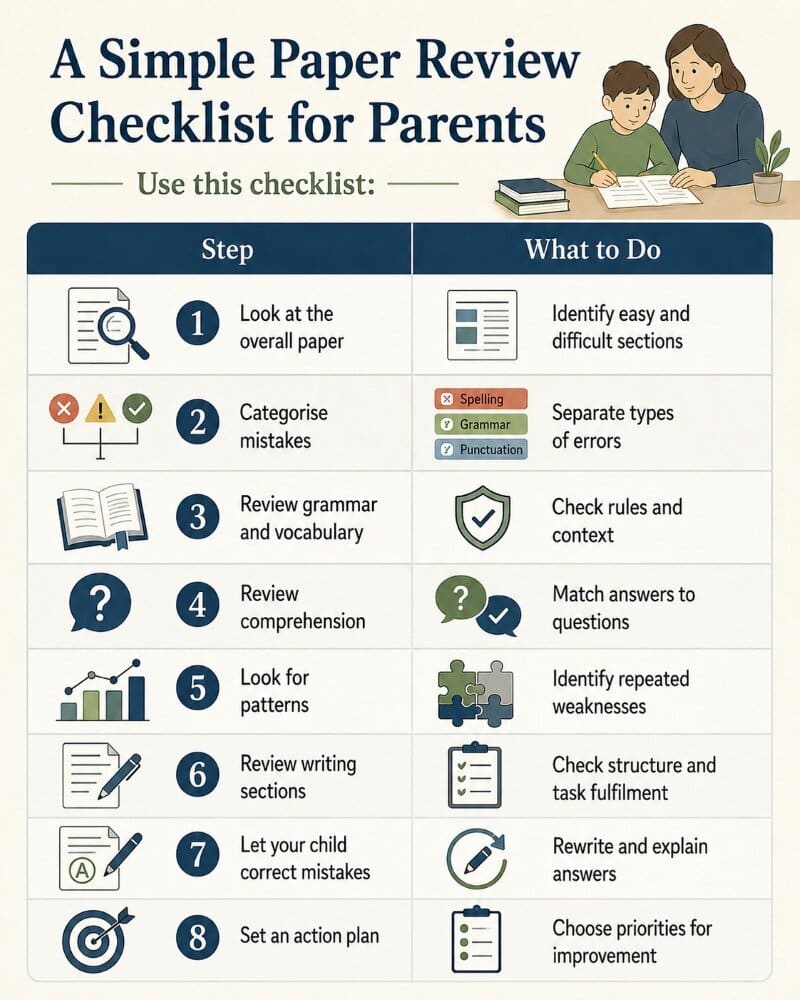
Comprehension is an area where students often lose marks even when they understand the passage. This usually happens because answers are too vague, incomplete, or not directly linked to the question. Ask your child to underline key words and identify what the question is really asking.
For example:
|
Question Type |
What to Check |
|
“Why” questions |
Did your child give a clear reason? |
|
“How” questions |
Did your child explain the method, manner, or effect? |
|
Inference questions |
Did your child use clues from the passage? |
|
Vocabulary-in-context questions |
Did your child consider how the word is used in the sentence? |
|
Evidence questions |
Did your child choose the most relevant part of the passage? |
A useful method is to ask: Does the answer fully answer the question? This helps your child become more precise and accurate.
After reviewing several mistakes, look for patterns. Did your child struggle with grammar, inference, vocabulary, or time management? One mistake may not matter, but repeated mistakes show what needs improvement.
For example:
|
Pattern Noticed |
What to Work On |
|
Repeated tense errors |
Revise tenses and practise sentence correction |
|
Weak vocabulary choices |
Build a vocabulary bank and practise usage |
|
Vague comprehension answers |
Practise answer precision |
|
Missing keywords in questions |
Train question annotation |
|
Rushed final questions |
Work on time management |
This helps revision become strategic and targeted.
Writing should not be marked only by counting mistakes. Parents should look at structure, content, language, and task fulfilment.
For composition, check:
|
Area |
What to Look For |
|
Plot |
Is the story clear and complete? |
|
Beginning |
Does it introduce the situation effectively? |
|
Development |
Are the events properly built up? |
|
Climax |
Is there a clear problem or turning point? |
|
Ending |
Does the story resolve properly? |
|
Language |
Are vocabulary and sentence structures varied? |
|
Relevance |
Does the story match the topic or pictures? |
For situational writing, check:
|
Area |
What to Look For |
|
Purpose |
Did your child understand why they were writing? |
|
Audience |
Did they write in the correct tone? |
|
Format |
Did they use the correct format? |
|
Required points |
Did they include all task details? |
|
Accuracy |
Did they copy details correctly? |
Focus on two or three key areas so your child is not overwhelmed.
Your child should actively correct their own mistakes. This helps learning stick and deepen understanding.
A simple correction format can be:
|
Mistake |
Correct Answer |
Why It Is Correct |
|
Wrong grammar choice |
Correct option |
The sentence is in past tense |
|
Vague comprehension answer |
Improved answer |
It answers the “why” question clearly |
|
Weak sentence |
Better sentence |
It uses a stronger verb and clearer detail |
This trains your child to understand mistakes instead of memorising answers.
Your child should actively correct their own mistakes. This helps learning stick and deepen understanding.
A paper review should end with a clear action plan. Choose one to three priorities for improvement.
For example:
This gives your child direction and focus.
A paper review can become stressful if it focuses only on blame or marks. Avoid discouraging phrases and instead use constructive language.
|
Avoid Saying |
Try Saying Instead |
|
“Why are you so careless?” |
“Let’s find out what caused this mistake.” |
|
“You should know this already.” |
“Which part confused you?” |
|
“This is not good enough.” |
“What can we improve for the next paper?” |
|
“You lost so many marks here.” |
“Let’s group these mistakes and see the pattern.” |
The goal is to build confidence and ownership of learning.
At WRITERS AT WORK, we believe that mistakes are valuable learning opportunities. Our programmes help students build strong foundations in grammar, vocabulary, comprehension, writing, and oral communication. Students learn to analyse questions, express ideas clearly, and apply feedback effectively. With the right guidance, they move beyond marks and learn how to improve step by step.
Ready to help your child grow in English with the right support at every stage?
At WRITERS AT WORK, our programmes are designed to meet students where they are and help them progress with confidence.
For primary students, our PURE Composition Writing Programmes help children build creativity, develop stronger ideas, and learn how to write vivid, well-structured compositions. Our Comprehensive English Programmes support students in key areas such as grammar, comprehension, oral communication, and writing, giving them a strong all-round foundation for school and national exam success.
For secondary students, our Secondary Programmes are designed to sharpen critical reading, strengthen essay and situational writing skills, and build the exam strategies needed for lower secondary assessments, upper secondary demands, and the O-Level English papers.
Beyond the classroom, students and parents can also tap into our wider learning resources through W@W eSeries, and stay updated with tips, insights, and student support on TikTok and Facebook.
Start by looking at the overall paper before focusing on mistakes. Ask your child which sections were easy or difficult, whether they had enough time, and which questions they felt unsure about. This helps you understand the reason behind the mistakes.
Look for patterns instead of only individual errors. Check whether the mistakes are due to carelessness, weak grammar understanding, poor question analysis, unclear expression, or time management. This makes revision more focused.
Ask your child to correct the mistakes and explain why the corrected answer is better. Then, set one to three clear action points, such as practising inference questions, revising tenses, improving vocabulary, or checking answers more carefully.

Agnes Ng, Co-Founder and Teaching & Curriculum Director of WRITERS AT WORK. An NUS Honours graduate and published author with over 30 years of experience, Agnes has been the architect of the organization’s student-centric curricula since 2012.
Dedicated to teacher mentorship and academic excellence, she has guided hundreds of students to achieve outstanding results. Her expertise and commitment to high-quality education remain the cornerstone of WRITERS AT WORK’s success in empowering every learner.




Start practising and learning

