After Term 1, many parents begin to notice patterns in their child’s English learning.
Some children struggle with idea generation during composition.
Some write long passages but lack structure.
Some understand content well, yet find it difficult to express themselves clearly.
Term 1 often acts as a natural diagnostic phase. It reveals where a child is progressing, and where targeted support may be needed.
The March break is short, but powerful when used strategically.
When focused on strengthening core skills, even a brief holiday can reset learning habits and build stronger foundations.
This is where a focused March Holiday English programme can make a difference.
The March holiday is not about preparing for an exam. It is about responding to feedback.
Term 1 gives clarity. Teachers observe patterns. Parents see results. Students begin to understand their own challenges. March offers a natural reset.
Unlike the regular school term, where pacing is fixed and content moves quickly, a holiday programme allows for:
Instead of simply keeping up with school pacing, students can slow down, reflect, and strengthen specific areas of weakness.
Strong English performance depends on transferable skills, not memorised answers. These are the core skills that make the biggest difference over time.
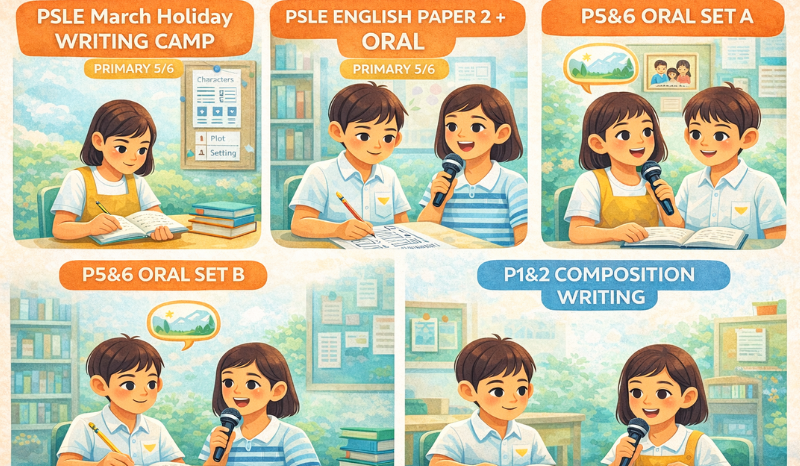
PSLE March Holiday Writing Camp & Primary 1/2 Composition Writing

Strong compositions are planned, not rushed.
Many students begin writing immediately without organising their ideas. This often leads to repetitive paragraphs, unclear progression, and rushed endings.
Students need to learn how to:
Clarity matters more than word count.
Structure determines impact.
Primary 5/6 Oral – Set A & Set B
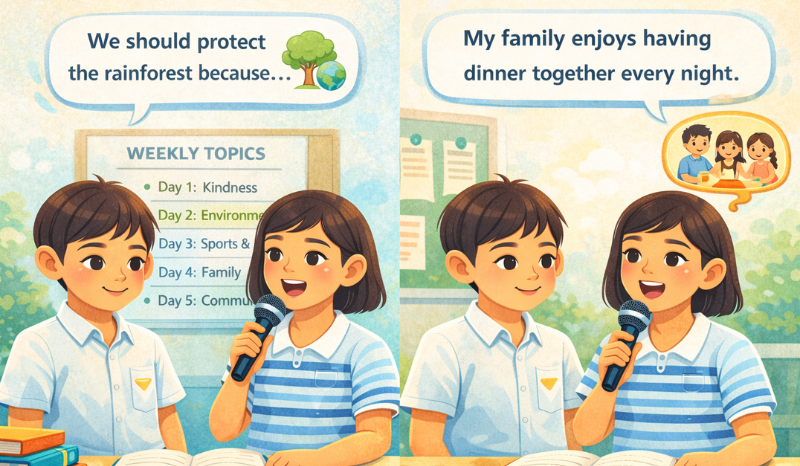
Many students know what they want to say but struggle to structure their answers under time pressure.
Effective oral performance requires:
Our Oral Set A and Set B cover different thematic areas. This broadens exposure and reduces over-reliance on familiar topics. Structured practice builds fluency and confidence.
Discover the 2025 PSLE Oral Format Changes
PSLE English Paper 2 + Oral

Paper 2 performance often comes down to technique.
Students need to understand:
Answering precision is a skill that can be trained.
Technique matters.
Each programme is designed to target specific skill gaps identified after Term 1.
Students will:
Students will:
Students will:
Students will:
Skills compound over time. A focused 5-day programme can:
When habits improve early, progress becomes more consistent throughout the year. The March holiday may be short, but when used strategically, its impact extends beyond the break itself.
📅 16–20 March 2026
📍 Multiple locations available
Early Bird Period: 9–23 February 2026
Early Bird Perks:
Whether your child needs support in writing structure, oral confidence, or Paper 2 precision, the March holiday provides a timely opportunity to address the most urgent skill gaps.
Choose a programme that targets your child’s current needs.
Limited slots are available for each programme. If you would like to learn more, visit our website or contact us directly for guidance.
Our March Holiday English Programmes are designed for Primary 1 to Primary 6 students.
Each course targets specific skill gaps, whether in composition writing, oral communication, or Paper 2 answering precision. Parents can choose the programme that best addresses their child’s current needs after Term 1.
The PSLE Holiday Writing Camp focuses specifically on composition planning, structure, and clarity. Students study model compositions and learn how strong PSLE stories are developed before writing. The emphasis is on direction and organisation rather than simply writing more essays.
After Term 1, students and parents usually have clearer feedback on strengths and weaknesses. The March holiday provides a short but focused window to correct habits, strengthen core skills, and build confidence before the academic pace increases in the following term.

Jemmies Siew, Managing Director and Co-Founder of WRITERS AT WORK Enrichment Centre. With over 15 years of experience in education, entrepreneurship, and marketing, Jemmies has helped shape Singapore’s English enrichment landscape through her vision for transformative learning.
She is passionate about connecting real-world issues with language learning, helping students think critically and express themselves clearly. Connect with her on LinkedIn to follow her insights on education, content marketing, and thought leadership.



Start practising and learning

