
The first assessment of the school year—usually the Weighted Assessment 1 (WA1)—often arrives faster than expected. For many students, especially those in Secondary 4, the pressure of the O Level English Paper begins to feel real. According to our research into 2026 WA1 dates and topics tested across various schools, these assessments can cover any component from Paper 1 to Paper 4. However, testing for Listening Comprehension remains a rare component for WA1.
While the urge to “cram” is strong, overstudying often leads to burnout rather than better grades. English is a skill that requires a strategic approach. Here is how you can prepare effectively for your first assessment without the stress of overstudying.

The most common cause of overstudying is trying to revise everything at once. To be efficient, you must note exactly which components your teacher has specified for the WA1.
Is your school testing Situational Writing only? Or are they focusing on Comprehension? In some cases, assessments might even be project-based, though this is increasingly rare at the Secondary 4 level where the focus is strictly on preparing you for the O Level English national exams.
Pro Tip: Always confirm the tested components with your classmates or check your school’s online portal. There is no point mastering O Level essay questions if your assessment is strictly a Paper 2 comprehension test. Focusing only on the relevant components ensures you save time and energy.

To score well, you must understand the “rules of the game.” Many students write beautiful essays but fail to score because they do not meet the marking criteria.
Refer to the official O Level English rubric from SEAB (which you can find in the 1184 Syllabus document here). By understanding what examiners look for in terms of Task Fulfilment, Language, and Organisation, you can tailor your answers to meet those requirements. Instead of writing blindly, you are writing with a goal in mind.

If you still have your notes and exam papers from Secondary 3, do not throw them away! Notes on essay formats and structures are timeless. If your WA1 involves Situational Writing (SW) or Continuous Writing (CW), these structures are exactly what you need.
More importantly, review your old mistakes. Look at the feedback your teachers gave you last year. Did you consistently struggle with tense consistency or weak elaborations? By reviewing your Secondary 3 errors, you ensure that you do not repeat them in Secondary 4. This “error analysis” is a much more effective use of time than simply reading a textbook.

Many students believe that writing ten essays a week is the best way to prepare for the O Level English Paper. However, if you are making the same mistakes in every essay, you are simply practising bad habits.
One single draft with high-quality, detailed feedback is worth more than five uncorrected ones. Focus on the quality of your practice. After receiving feedback, take the time to rewrite specific paragraphs or fix sentence structures. This targeted practice is a cornerstone of effective English Enrichment for Secondary School, as it builds the stylistic control needed for an A1.

To handle O Level essay or oral questions, you need a strong grasp of current affairs. However, you don’t need to read an entire library to stay informed.
Practise “Strategic Reading.” Spend 15 minutes a day reading reputable news outlets. Look for recurring themes such as technology, environment, or social issues in Singapore. Pay attention to how the journalists structure their arguments and the precise vocabulary they use. This naturally builds your “content bank” for the exam without the need for rote memorisation.
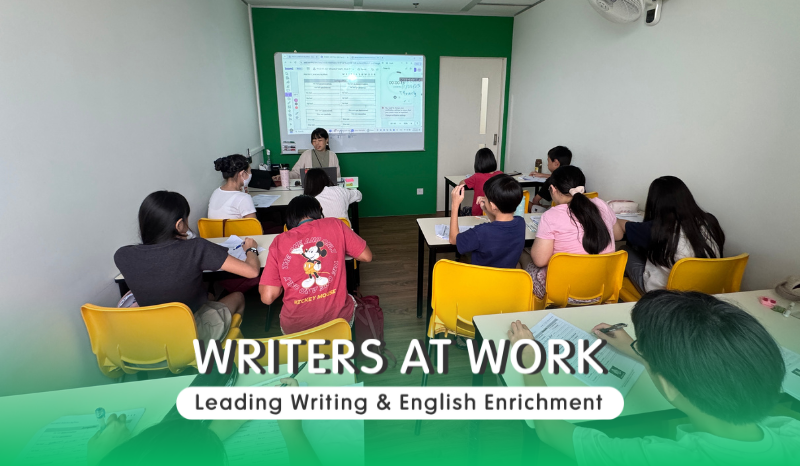
Preparation does not have to be a lonely or overwhelming process. Joining a specialised secondary english tuition singapore can provide the structure you need to succeed. At WRITERS AT WORK, our Secondary English Tuition in Singapore focuses on teaching students how to work smarter. We provide the exam-ready phrases, the structural frameworks, and the personalised feedback that help you excel without the need for overstudying.
Looking for more quick study tips? Explore our blog for handy strategies you can apply in your upcoming assessments!
Reading is essential, but it is only half the battle. You must also practise applying the structures and vocabulary you see in your reading. Active revision, like outlining or rewriting paragraphs, is necessary to bridge the gap between “understanding” and “performing.”
Consistency is better than intensity. Spending 30 minutes every day on varied tasks (10 mins reading, 10 mins vocabulary, 10 mins planning) is far more effective than a 4-hour “cram session” once a week.
Grammar worksheets are a good start, but the best way to improve grammar is to see it in context. Pay attention to how sentences are constructed in the books you read, and always double-check your own writing for “tense consistency”—a common pitfall in the O Level English Paper.
A specialised Secondary English tuition in Singapore provides a structured path. Instead of guessing what to study, you are given the exact tools and feedback needed for your specific level. This “targeted” approach saves hours of wasted effort and prevents overstudying.

Jemmies Siew, Managing Director and Co-Founder of WRITERS AT WORK Enrichment Centre. With over 15 years of experience in education, entrepreneurship, and marketing, Jemmies has helped shape Singapore’s English enrichment landscape through her vision for transformative learning.
She is passionate about connecting real-world issues with language learning, helping students think critically and express themselves clearly. Connect with her on LinkedIn to follow her insights on education, content marketing, and thought leadership.



Start practising and learning

