For many O-Level students, essay writing is one of the most challenging components of the English paper. Understanding common themes and preparing useful phrases in advance can make a significant difference. School-based essay topics appear frequently in O-Level examinations because they are familiar to students and allow examiners to assess critical thinking, maturity, and language use.
Below are some of the most common school-based essay themes, along with real exam-style questions and adaptable phrases students can confidently use.
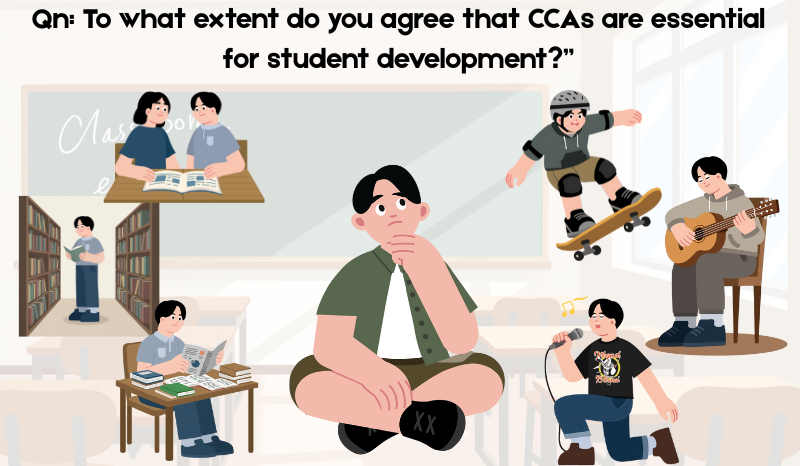
‘Co-Curricular Activities (CCAs) and Student Development’ Questions
- “Some educators argue that participation in co-curricular activities contributes more to a student’s personal growth than academic results alone. To what extent do you agree that CCAs are essential for student development?”
- “Describe how involvement in co-curricular activities can benefit a student’s school life. In your view, should all secondary students be required to take part in CCAs? Explain your reasons with examples.”
- “Co-curricular commitments can sometimes clash with academic workload. Discuss the advantages and disadvantages of compulsory CCAs in shaping a well-rounded student.”
Argumentative Useful Phrases:
- “While academic achievement remains important, it is through sustained participation in co-curricular activities that students often acquire resilience, leadership, and interpersonal skills that cannot be taught in textbooks.”
- “The true value of CCAs lies not in medals or titles, but in the discipline and perseverance cultivated through long-term commitment.”
- “When structured thoughtfully, co-curricular activities do not detract from academic learning but instead reinforce essential life skills that support it.”
Discursive Useful Phrases:
- “On one hand, co-curricular activities provide students with opportunities to develop holistically beyond the classroom.”
- “However, the demands of intensive CCA involvement may pose challenges for students who already struggle to manage academic workload.”
- “Ultimately, the effectiveness of CCAs depends on how well schools support students in balancing both academic and non-academic commitments.
‘Examinations and Alternative Assessments’ Questions
- “Examinations have traditionally been the main way schools assess student learning. In your opinion, how far should schools move towards alternative forms of assessment such as portfolios, projects, and teacher evaluations?”
- “In recent years, some educators have suggested that continuous assessment better reflects a student’s abilities than high-stakes exams. To what extent do you agree that examinations should be reduced or replaced in schools?”
- “Assessment in education is evolving beyond written examinations. Discuss the strengths and limitations of examinations compared with alternative assessment methods in preparing students for future challenges.”
Argumentative Useful Phrases:
- “Relying heavily on examinations risks reducing learning to short-term memorisation rather than meaningful understanding.”
- “Alternative assessments, such as projects and coursework, allow students to demonstrate their abilities more consistently and authentically over time.”
- “A system that values continuous assessment acknowledges that learning is a process, not a single performance under pressure.”
Discursive Useful Phrases:
- “Examinations offer a standardised and efficient means of assessing large numbers of students.”
- “Nevertheless, they may not fully capture a student’s creativity, critical thinking, or practical skills.”
- “A balanced assessment approach can combine the structure of examinations with the flexibility of alternative evaluations.”
At WRITERS@WORK, students are guided to understand why certain phrases work and how to modify them naturally within their own writing style. Through structured programmes, students learn how to brainstorm ideas quickly, plan effectively, and write essays that are both coherent and engaging.
‘Technology and Students’ Questions
- “With advancements in technology, online learning has become increasingly common. In what ways can online learning be more effective than traditional classroom lessons, and what limitations should schools consider?”
- “Some students believe that online learning provides greater flexibility and independence, while others feel that classroom learning is more effective. Discuss both views and give your opinion.”
- “As schools adopt more digital learning platforms, the role of face-to-face teaching is being questioned. To what extent do you agree that online learning can replace classroom learning for students?”
Argumentative Useful Phrases:
- “Online learning empowers students to take greater ownership of their learning by offering flexibility and self-paced study.”
- “However, without direct teacher guidance, online platforms may fall short in fostering deep understanding and engagement.”
- “Technology should be viewed as a complement to, rather than a replacement for, meaningful classroom interaction.”
Discursive Useful Phrases:
- “Online learning offers convenience and accessibility, particularly for students who benefit from independent study.”
- “In contrast, classroom learning provides immediate feedback and social interaction that technology cannot fully replicate.”
- “The effectiveness of any learning mode ultimately depends on how thoughtfully it is implemented and supported.”
Students preparing for major examinations may benefit from exploring WRITERS@WORK’s English Programmes, which focus on critical thinking, language precision, and exam readiness. Our O-Level Model Composition Book also provides structured examples that demonstrate how strong essays are developed, making expectations clearer and practice more purposeful.
With consistent practice and the right support, O-Level essay writing becomes less intimidating and far more manageable for both students and parents.

Frequently Asked Questions
1. Do students need to memorise these useful phrases for O-Level essays?
2. How can students improve their essay writing for common school-based topics?
3. Are school-based essay topics really that important for O-Level English?
Yes. School-based topics appear frequently in O-Level English papers because they allow examiners to assess a student’s ability to think critically, express opinions, and use language accurately. Performing well in these essays can significantly impact overall English results, making focused preparation both practical and worthwhile.