
The O Level English Paper is more than just a test of your vocabulary or grammar. It is a test of your ability to think critically and organise your thoughts under pressure. One of the most frequent critiques from examiners is that students often provide “scattered” ideas that lack a cohesive “logical thread”. Even with a brilliant vocabulary, an essay that lacks structural control will struggle to reach the highest bands for “Organisation.”
In any high-level English writing class for secondary school, logic is treated as the bridge between a cluttered response and a persuasive argument. Whether you are facing argumentative or discursive essay writing topics in English, mastering these structural tips is essential for your success in 2026 and beyond.

The foundation of a strong argument is laid in the introduction. Instead of a simple “I agree” statement, use a nuanced thesis structure to show the examiner that you have considered multiple perspectives.
Use this formula:
“While (counter-argument), I believe (stand) because (supporting argument 1 and 2).”
For example, if the topic is about the necessity of technology in schools, your thesis might look like this: “While some argue that technology is a distraction in the classroom, I believe it is indispensable for modern education because it provides access to global resources and fosters essential digital literacy.” This structure immediately signals to the examiner that your O Level English essay will be balanced and deeply researched.

At our Secondary English tuition in Singapore, we emphasise the PEEL framework as the gold standard for paragraphing. Each body paragraph should act as a self-contained unit of logic:

To secure an A1 in the O Level English Paper, you must demonstrate “evaluative” thinking. This means acknowledging the “other side” before proving why your argument is stronger.
Dedicate one paragraph to a counter-argument. By identifying a potential weakness in your stance and then “rebutting” it with stronger logic, you prove to the examiner that your argument can withstand scrutiny. This level of critical thinking is what separates average essays from distinction-grade work.

Logic is not just about the points you make, but how you move from one idea to the next. Transition signals, or discourse markers, act as signposts that guide the examiner through your thought process.
Using these markers ensures your essay flows seamlessly and demonstrates a mature command of the O Level English syllabus.
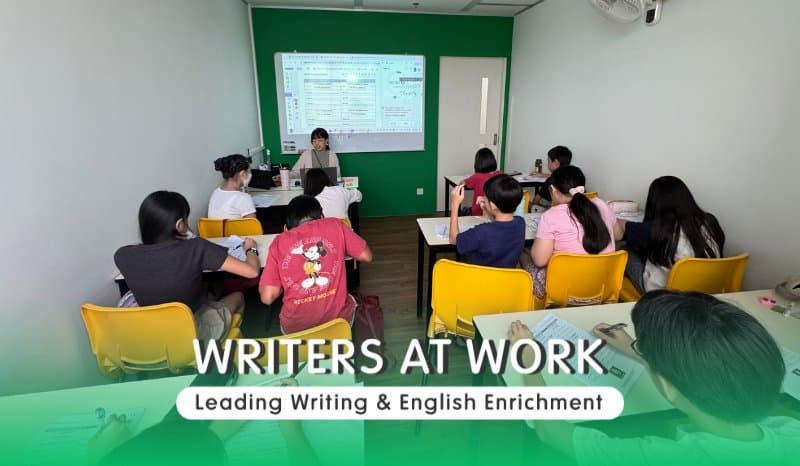
Mastering the structural nuances of the O Level English Paper requires consistent, expert feedback. At WRITERS AT WORK, our English writing class for secondary school focuses on the “Thinking Frameworks” needed to deconstruct even the most difficult essay writing topics in english.
If you want to move beyond basic structures and master the art of the persuasive essay, explore our Secondary Programmes to find the right fit for your academic goals. You can also sharpen your skills by practising with our collection of O-Level Past Year Essay Questions or learn more about Writing Good Hybrid Essays to prepare for any “curveball” prompts. Secure your distinction today!
Your thesis statement should ideally be the final sentence of your introductory paragraph. This ensures that the examiner has a clear “roadmap” of your entire argument before they begin reading your body paragraphs.
While essential for argumentative essays, a counter-argument is also highly beneficial for discursive essays where a “balanced view” is required. It shows the examiner that you are capable of multifaceted analysis, which is a hallmark of O Level English excellence.
Choose the topic where you have the strongest “Evidence” for your PEEL structure. It is better to write a logically sound essay on a “boring” topic than a disorganised one on an “exciting” topic. Practise with our past-year prompts to see which themes you handle best!

Jemmies Siew, Managing Director and Co-Founder of WRITERS AT WORK Enrichment Centre. With over 15 years of experience in education, entrepreneurship, and marketing, Jemmies has helped shape Singapore’s English enrichment landscape through her vision for transformative learning.
She is passionate about connecting real-world issues with language learning, helping students think critically and express themselves clearly. Connect with her on LinkedIn to follow her insights on education, content marketing, and thought leadership.



Start practising and learning

