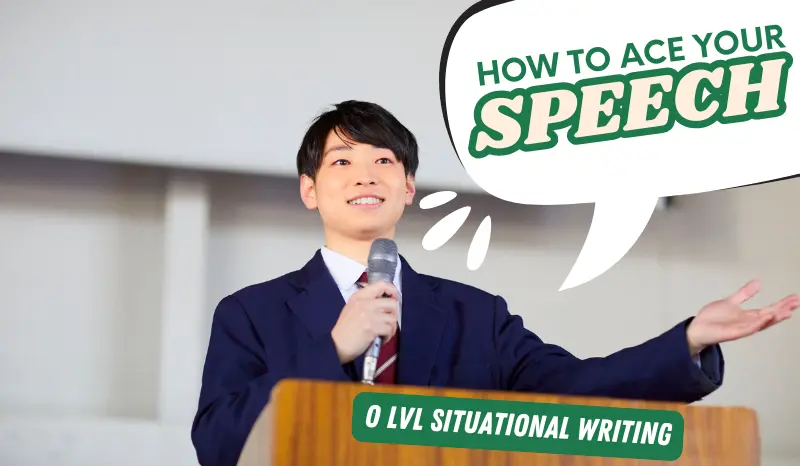
In the O Level English paper, Situational Writing is often where students feel the most pressure to be “perfectly formal.” While you might already know how to write a formal email or a report, a speech is a completely different beast. A speech is not just a collection of facts; it is a performance on paper.
To score well in this section of the O Level English exam, you must move beyond simply “reporting” information. You need to grab your audience’s attention and hold it until the very last word. At our English writing class for secondary school, we teach students that the “Situation” isn’t just a prompt, but an opportunity to showcase your voice and maturity.
Here are our top Secondary Situational Writing tips to help you transform a standard script into a distinction-grade speech.
The first few seconds of a speech are the most critical. If you start with a boring “Good morning everyone, I am here to talk about…“, you have already lost half your audience. Instead, use a “Hook” to grab attention immediately.
Rhetorical Questions: Ask something that makes your audience think. For example: “Have you ever wondered what our school would look like if we all took one small step toward sustainability?”
A Compelling Anecdote: Share a brief, relatable story that leads into your main topic. This creates an immediate emotional connection. For example: “When I was in primary school, I witnessed an act of kindness that changed my life.”
The Power of Stats: Use a startling fact (provided in your situational writing prompt) to highlight the urgency of your message. For example: “By 2030, around 1 in 4 Singaporeans will be aged 65 or above, up from 1 in 10 in 2010.”
In a formal report, you might stay detached. In a speech, you must be inclusive. A common mistake in the O Level English paper is focusing too much on what “I” think rather than what “we” can do together.
Inclusive Pronouns: Use words like “we,” “us,” and “our” to build rapport. This makes your audience feel like they are part of the solution rather than just being lectured at.
Acknowledge the Audience: Refer specifically to the group you are speaking to, whether it’s “fellow students,” “esteemed teachers,” or “concerned parents”.
Maintain Eye Contact (on paper): Use phrases like “As you can see from the posters around us” or “Many of you might agree that…” to simulate a real-life interaction.

Our brains are wired to remember things in groups of three. This is a classic rhetorical device used by the world’s greatest orators to make their points stick.
Triplets of Action: “We must act boldly, quickly, and together.”
Grouped Ideas: Instead of listing five random points, group them into three clear pillars of your argument. This follows the same logic as the PEEL framework we use for essay writing in English.
Rhythmic Repetition: Repeating a phrase three times (Anaphora) can add a sense of passion and conviction to your speech.
Active Voice: Instead of saying “A decision was made by the committee,” say “The committee decided.” It sounds more direct and energetic.
Persuasive Modal Verbs: Use “must,” “shall,” and “will” to show certainty. Avoid “weak” words like “might” or “maybe” when you are trying to inspire your audience to take action.
Imperative Verbs: Use command words like “Join,” “Support,” or “Commit.” These act as a clear call to action that tells your audience exactly what to do next.
Mastering the art of the speech isn’t just about clearing the O Level English hurdle. It is a fundamental “Survival Skill” for your future.
Whether you are heading into a university interview, leading a team at work, or pitching a new idea to a client, the ability to engage an audience is what defines a leader. Speech writing teaches you how to read a room, adapt your tone, and persuade people to believe in your vision. When you learn to write an engaging speech today, you are actually learning how to command a room tomorrow.
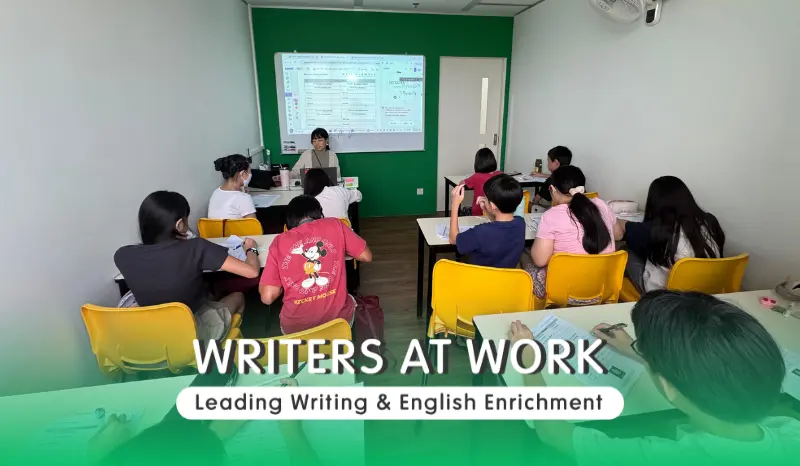
If you are looking for an English writing class for secondary school that goes beyond the basics, we invite you to explore our Secondary Programmes. You can also read our Cheat Sheet for Situational Writing Format to ensure your layout is always perfect, or browse the W@W Blog for more expert advice.
Yes! Idioms like “hit the nail on the head” or “once in a blue moon” can make your speech sound more natural and engaging, provided they are used correctly.

Jemmies Siew, Managing Director and Co-Founder of WRITERS AT WORK Enrichment Centre. With over 15 years of experience in education, entrepreneurship, and marketing, Jemmies has helped shape Singapore’s English enrichment landscape through her vision for transformative learning.
She is passionate about connecting real-world issues with language learning, helping students think critically and express themselves clearly. Connect with her on LinkedIn to follow her insights on education, content marketing, and thought leadership.



Start practising and learning

