Section A of the O Level English Paper 2, the Visual Text Comprehension, is often viewed by students as the “low-hanging fruit.” With only five marks at stake and a colourful flyer or advertisement to look at, many approach it with a sense of complacency.
However, in the world of O Level English, “easy” can be a trap. Because the margin for error is so slim, losing even one or two marks here due to a lack of precision can be the difference between an A1 and a B3. These marks are meant to be secured, yet year after year, students fall into the same predictable traps.
To help you protect your score, we’ve identified the five most common pitfalls in Visual Text questions and how you can avoid them.
The very first question in Section A often asks you to tick the most effective title for a specific component of the text. This sounds simple, but it is a frequent stumbling block for students who rush.
This is another frequent error. A question might ask: “What is the main purpose of this flyer?” and a student will answer: “To target parents who are interested in healthy eating.” That is an audience, not a purpose.
Correct: “To persuade parents to sign up for the nutritional workshop.”
Precision is the hallmark of a distinction student. Many lose marks because their explanations are too surface-level and do not provide the “complete” thought required by the examiner.
The Pitfall: Giving a “half-answer.” For example, if a question asks, “What does ‘reverse the fate of ugly food’ urge readers to do?”, a student might simply say, “It urges readers to not throw the food away.”
The Solution: Go the extra mile to explain the objective.
Correct: “It urges readers to not throw the food away and instead consume it, as the food is still edible and nutritious.”
Visual texts are designed to make you feel something. Sometimes the tone is urgent (to make you buy now), and sometimes it is ironic or humorous.
The distinction between a “phrase” and a “sentence” is a technicality that often costs students marks in the O Level English Paper.
The Pitfall: Lifting a whole sentence when the question specifically asks for a phrase, or only giving a phrase when they ask for a sentence. If you include the full sentence (with the capital letter and full stop) when asked for a phrase, you have provided too much information, and the examiner may penalise you for lack of precision.
The Solution: Remember that a sentence starts with a capital letter and ends with a punctuation mark, while a phrase is just a short group of words. If you aren’t sure, pick out only the most important words that directly answer the question and write those down.
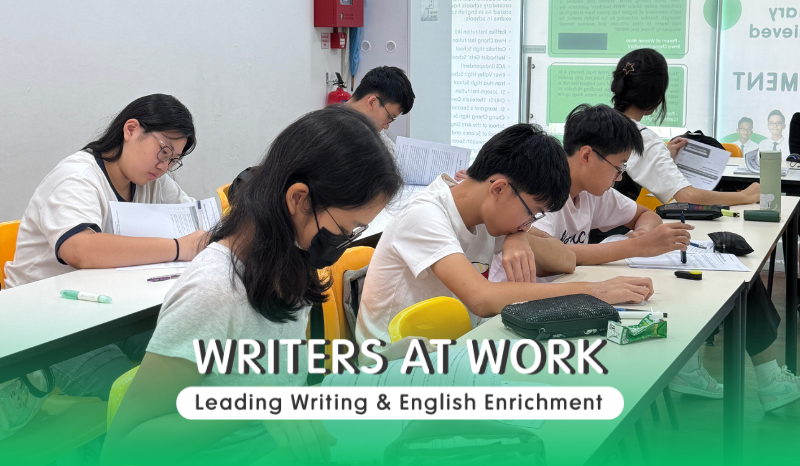
At WRITERS AT WORK, we believe that Section A should be a guaranteed 5/5. Our Secondary English Tuition in Singapore provides students with a systematic way to deconstruct visual stimuli. We teach you to look for the “Focal Point” and the “Information Hierarchy” so that you aren’t just guessing, but analysing.
Choosing the right secondary English tuition in Singapore means moving beyond “doing more papers” and instead mastering the specific techniques that examiners look for.
Ready to sharpen your exam techniques? Access our expert study blog or practise with a decade of O-Level essay questions to secure your distinction.
Since it is only worth 5 marks, you should aim to finish it in 10 minutes or less. This gives you more time for the heavier Section B (Narrative) and Section C (Expository) texts.
The Question Stem. Always look at the specific instructions (e.g., “identify a word,” “with reference to the image,” “in your own words”) before you look at the flyer.
The O-Level marking scheme for Visual Text is quite strict on intent and precision. This is why joining a specialised Secondary English tuition in Singapore helps. You will learn the specific “keywords” that examiners are trained to look for. Contact us if you would like to find out more!

Agnes Ng, Co-Founder and Teaching & Curriculum Director of WRITERS AT WORK. An NUS Honours graduate and published author with over 30 years of experience, Agnes has been the architect of the organization’s student-centric curricula since 2012.
Dedicated to teacher mentorship and academic excellence, she has guided hundreds of students to achieve outstanding results. Her expertise and commitment to high-quality education remain the cornerstone of WRITERS AT WORK’s success in empowering every learner.



Start practising and learning

