Many parents assume that English comprehension in secondary school is simply a harder version of PSLE comprehension. In reality, the shift is bigger than that. At PSLE, comprehension is part of Paper 2: Language Use and Comprehension, which tests grammar, vocabulary, cloze passages, synthesis and transformation, visual text comprehension, and open-ended comprehension. The full paper carries 90 marks and makes up 45% of the PSLE English grade. At O Level, comprehension becomes a dedicated Paper 2: Comprehension paper worth 50 marks. Students respond to visual texts, narrative or recount passages, non-narrative texts, vocabulary questions, language-for-effect questions, and summary writing. This means Seconday students need more than basic understanding. They must learn to analyse, explain, and write precise answers.
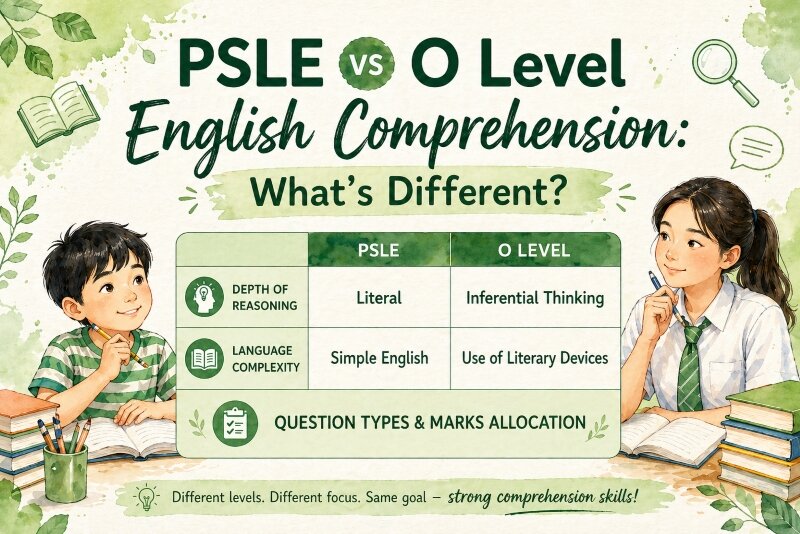
At PSLE, students are tested on literal, inferential and evaluative understanding. They must locate information, infer meaning, and explain character actions or feelings clearly.
Example 1: Literal Question
This tests whether the student can locate the correct information in the passage.
Example 2: Inferential Question
This requires students to infer emotion, such as fear, anxiety, or guilt, based on clues in the passage. At O Level, the reasoning becomes more layered. Students may need to explain tone, writer’s intention, character development, or the effect of language choices.
O-Level-style question:
A good answer must explain how specific words, imagery, or sentence structures create tension.
PSLE passages are generally more accessible, but students still need strong vocabulary and clear expression. Many students lose marks because their answers are vague, incomplete, or copied without understanding.
Example:
Students must scan the paragraph and identify the exact word. At O Level, students often need to analyse more sophisticated language, including imagery, irony, contrast, tone, and figurative language.
O-Level-style language question:
A strong answer might explain that “swallowed” makes the silence seem powerful and overwhelming, creating a tense or uncomfortable mood. This is where many students struggle. They may understand the general meaning, but they find it hard to explain the writer’s craft.
At PSLE, comprehension is part of a broader language paper. Students encounter grammar MCQs, vocabulary questions, cloze passages, visual text comprehension, comprehension cloze, synthesis and transformation, and open-ended comprehension. The open-ended comprehension section carries 20 marks.
At O Level, Paper 2 is entirely focused on comprehension. It includes three sections: visual text comprehension, narrative or recount comprehension, non-narrative comprehension, and a summary task.
Visual Text Question
Narrative Comprehension Question
Language-for-Effect Question
Summary Question
These question types require students to read carefully, select relevant evidence, and express ideas clearly.
The best Primary English Comprehension Tips are not just about exam tricks. Students need to build habits that will support them beyond PSLE.
First, they should always identify the question type. Is it asking for a fact, an inference, a word, a reason, or an explanation? Second, they should learn to support answers with evidence. For inference questions, students can practise saying, “IThis is so because…”Third, students should build vocabulary in context. Instead of memorising word lists, they should learn how words behave inside sentences and paragraphs. Finally, they should practise explaining language effects early. Even simple questions like “Why is this word effective?” can prepare students for O Level comprehension.
At WRITERS AT WORK, we help students build comprehension skills progressively from primary to secondary school. Our lessons train students to identify question types, locate clues, infer accurately, analyse language, and write clear answers.
Parents looking for English tuition for primary students can explore our comprehensive English programmes.
For secondary students, our English programme develops the analytical skills needed for O Level English comprehension, including language analysis, summary writing, and precise answering techniques.
Beyond the classroom, students and parents can also tap into our wider learning resources through W@W eSeries, and stay updated with tips, insights, and student support on TikTok and Facebook
Students should read the question carefully, identify the question type, find evidence in the passage, and answer clearly. For inference questions, they should always support their answer with clues from the text.
Yes, because O Level comprehension requires more language analysis. Students must explain tone, writer’s purpose, imagery, and language effects, not just locate answers.
WRITERS AT WORK teaches students how to break down question types, identify textual clues, infer meaning, analyse language, and craft precise answers for both primary and secondary English comprehension.

Jemmies Siew, Managing Director and Co-Founder of WRITERS AT WORK Enrichment Centre. With over 15 years of experience in education, entrepreneurship, and marketing, Jemmies has helped shape Singapore’s English enrichment landscape through her vision for transformative learning.
She is passionate about connecting real-world issues with language learning, helping students think critically and express themselves clearly. Connect with her on LinkedIn to follow her insights on education, content marketing, and thought leadership.



Start practising and learning

