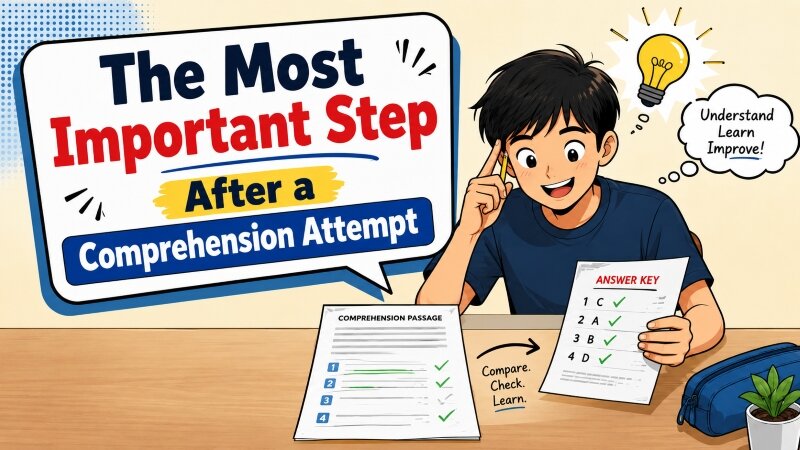
Your child attempted the comprehension passage. They read the text, answered the questions, checked the score, and moved on. For many students, this feels like revision. They completed the work. They saw what they got right or wrong. They may even have corrected a few answers. But the most important part of comprehension practice often happens after the first attempt.
Real improvement does not come from simply doing more passages. It comes from learning how to review each attempt properly. In comprehension open-ended questions, especially at the secondary level, students need to understand not just whether their answers were right or wrong, but why a stronger answer scores.
This is where many students miss out. They use the answer key only to check. But the answer key can do much more than that. Used well, it can show students what precise, complete, exam-ready answering actually looks like.
A mark tells a student the result of their attempt. It can show whether an answer was accepted, partially correct, or inaccurate. It can tell your child how many marks they received. But a score alone does not fully explain the standard they were expected to meet. This is why some students keep practising comprehension but do not improve much. They finish a passage, see the score, feel disappointed, and move on to the next exercise. The process repeats, but their answering habits remain the same. The mark tells them they were wrong. It does not always show them how to be right.
To improve, students need to study the gap between what they wrote and what the examiner expected.
Many students have a rough sense of what a reasonable comprehension answer sounds like. They may write something that feels logical. They may include an idea from the passage. They may even phrase it in a way that sounds fluent. But in comprehension open-ended questions, sounding right is not always enough.
A scoring answer often depends on:
This is why students sometimes feel confused when their answers are marked wrong. To them, the answer may have seemed acceptable. But to the examiner, it may have been too vague, incomplete, or not closely linked to the question. That difference matters!
Students need to see what a strong answer looks like before they can learn to produce one consistently.
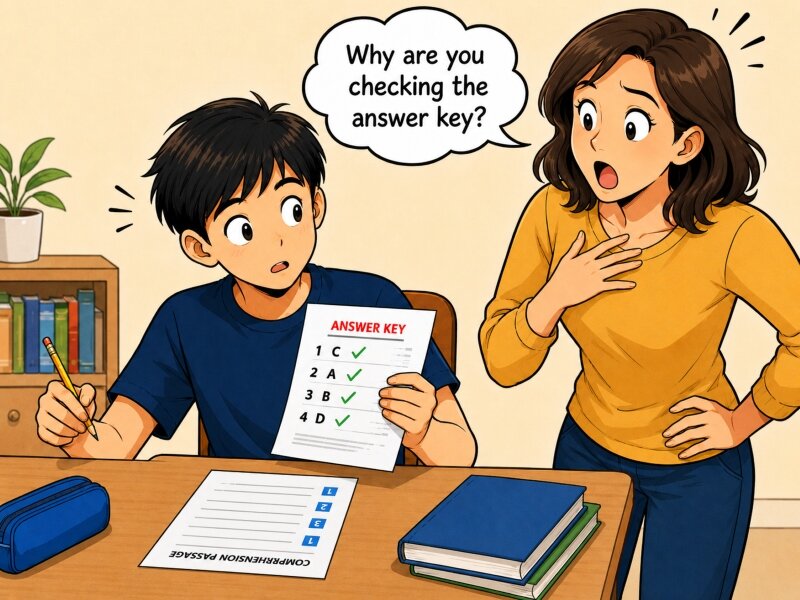
There is a big difference between checking the answer key and studying the answer key. Checking the answer key means looking to see whether an answer was right or wrong. It is quick. It gives a result. But it often stops there.
Studying the answer key means slowing down and asking:
This turns the answer key from a checking tool into a learning tool. When students study the answer key properly, they begin to understand how correct comprehension answers are constructed. They notice the sentence structure, the specific details, and the level of precision needed. That is where the real learning begins.
A model answer can show students much more than the final response. It can reveal how much detail the question required. It can show which phrase from the passage was important. It can also show how the answer needs to be shaped so that it directly addresses the question. For example, a student may have written an answer that captures the general idea, but misses a key word or does not explain the cause clearly enough. Another student may have included too much information, but not the specific point the question was asking for. By comparing their own answer with the model answer, students can see where their thinking was incomplete.
They may realise:
These are valuable discoveries. They help students improve not just that one answer, but their overall answering habits.
One of the most useful habits in comprehension practice is reverse engineering. Instead of only reading the answer key, students work backwards from the model answer. They take the answer apart and ask why it works.
They can ask:
This helps students move beyond guessing. Over time, they begin to think more like an examiner. They stop asking only, “What should I write?” and start asking, “Is my answer precise enough, complete enough, and clear enough to score?” This trains students to become more aware of the standard expected in comprehension open-ended questions.
This does not mean students should look at the answer key before trying the questions.The first attempt still matters. When students attempt the questions first, they experience the struggle honestly. They make decisions. They test their own understanding. They reveal their current instincts. Then, when they study the answer key, they are no longer reading it passively. They are looking at it with specific questions in mind.
They may think:
▶ “I thought this was the answer, but I missed that detail.”
▶ “I understood the idea, but my phrasing was too vague.”
▶ “I answered the question generally, but the model answer was more exact.”
▶ “I did not realise the question was asking for that specific point.”
This makes the learning more active. The student is not simply copying a model answer. They are discovering the difference between their attempt and an exam-ready response.
A simple but powerful comprehension routine is:
Attempt. Study. Rewrite.
First, students should attempt the comprehension questions on their own. This shows them what they can currently do without help. Next, they should study the answer key carefully. They should compare each model answer with their own response and identify what they missed. Finally, they should rewrite their answers. This last step is important. Rewriting gives students the chance to apply what they have learned immediately. It helps them practise clearer phrasing, more accurate details, and more complete responses. Without rewriting, students may understand the correction briefly but fail to change their habits. With rewriting, they actively close the gap between their original answer and the standard expected. This process turns vague effort into deliberate improvement.
When students study answer keys regularly, something begins to change. They become less dependent on guesswork. They become more alert to the exact demand of each question. They start noticing whether their answer is supported by the passage, whether their phrasing is precise, and whether they have included enough information to score. This builds an internal standard. That internal standard is what helps students improve over time. Instead of writing an answer and hoping it is accepted, they begin to review their own responses more carefully before moving on. They ask better questions, spot weaker phrasing, and become more aware of examiner expectations. This is often what separates students who keep repeating the same mistakes from students who make real progress.
Better comprehension practice is not only about doing more passages. It is also about learning how to review each passage properly. A student can complete many comprehension exercises and still struggle if they never pause to study what strong answers look like. On the other hand, a student who learns to analyse model answers carefully can gain much more from each practice. Every comprehension attempt becomes more than a score. It becomes a lesson in how strong answers are made.
For parents, this is an important point to remember. If your child is doing comprehension practice at home, do not only ask, “How many marks did you get?”
Ask:
These questions help shift the focus from marks to learning.
Comprehension improvement does not happen just because a student completes more worksheets. It happens when students learn how to study their mistakes, understand examiner expectations, and rewrite their answers with more clarity and precision.
At WRITERS AT WORK, we teach students not just to attempt comprehension questions, but to study their attempts carefully. Students learn how to understand model answers, identify gaps in their responses, and write with greater accuracy and confidence. Help your child turn every comprehension attempt into real improvement. Book a WRITERS AT WORK Secondary English class today and help your child move beyond guesswork.
For secondary students, our Secondary Programmes are designed to sharpen critical reading, strengthen essay and situational writing skills, and build the exam strategies needed for lower secondary assessments, upper secondary demands, and the O-Level English papers.
Beyond the classroom, students and parents can also tap into our wider learning resources through W@W eSeries, and stay updated with tips, insights, and student support on TikTok and Facebook.
Checking the score only tells students whether they were right or wrong. Studying the answer key helps them understand how a correct answer is built, what details were needed, and how precise their phrasing must be to score well.
No. The first attempt matters because it shows your child where their gaps are. When they study the answer key after trying the questions, they can compare their own answers against the model answers more meaningfully.
Students should follow a simple routine: attempt the questions, study the model answers carefully, identify what they missed, and rewrite their answers. This helps them move from guesswork to clearer, more exam-ready answering.

Jemmies Siew, Managing Director and Co-Founder of WRITERS AT WORK Enrichment Centre. With over 15 years of experience in education, entrepreneurship, and marketing, Jemmies has helped shape Singapore’s English enrichment landscape through her vision for transformative learning.
She is passionate about connecting real-world issues with language learning, helping students think critically and express themselves clearly. Connect with her on LinkedIn to follow her insights on education, content marketing, and thought leadership.



Start practising and learning

