For many students, PSLE Oral feels like a test of “speaking well”, so they focus on pronunciation, fluency, eye contact, and confidence. While these are important, they are only part of the picture. A strong PSLE Oral response does not come from fluent speech alone—it comes from having something meaningful to say, and that is where content knowledge matters.
Content knowledge refers to a student’s understanding of common real-world topics that may appear in the PSLE Oral examination, such as school life, family, the environment, technology, public transport, sports, community issues, healthy living, kindness, and safety. In the new PSLE Oral format, students are expected to respond thoughtfully to prompts, explain their opinions, support their answers with examples, and connect their ideas to everyday experiences. This means they need more than memorised phrases—they need to understand the topic well enough to speak about it naturally. A student who knows more about a topic will usually have more ideas, better examples, and stronger explanations.
One common problem in PSLE Oral is that students give answers that are too brief or general. For example, when asked about environmental responsibility, a student might say, “I think we should protect the environment because it is important. We should recycle and not litter.” While this is not wrong, it lacks depth. A student with stronger content knowledge might instead explain that everyone has a role to play, give examples such as reducing plastic use by bringing reusable bags, and mention how schools can encourage recycling habits. This kind of response is stronger because it includes specific examples, clearer reasoning, and a better connection to real life.
Many students hesitate during oral practice not because they cannot speak, but because they do not know what to say. When they face an unfamiliar topic, they may panic, repeat the same point, or give vague answers, which affects both fluency and confidence. However, when students have been exposed to a wide range of themes, they feel more prepared. They can recognise the topic quickly, recall relevant vocabulary, and organise their ideas more smoothly. Confidence, therefore, does not come only from practice—it also comes from preparation.
Students often struggle to sound mature in PSLE Oral because they rely on basic words such as “good”, “bad”, “nice”, or “important”. Content knowledge helps them use more precise vocabulary. For instance, in a topic about public transport, they can use words like commuters, accessibility, peak hours, and considerate behaviour. In a topic about healthy living, they can talk about balanced diets, physical activity, screen time, and mental well-being. When students understand a theme, vocabulary becomes easier to remember because it is connected to ideas, not just memorised phrases.
PSLE Oral questions often require students to express personal views, such as whether they agree with something or how a problem can be solved. A strong opinion needs support. Instead of saying, “Yes, using devices too much is bad,” a student with better content knowledge can explain how excessive screen time affects sleep, eyesight, and concentration, and suggest solutions like setting limits or managing time better. This shows a deeper understanding of the issue and allows the student to present a more convincing response.
Younger students often answer questions only from their personal experience, but strong responses should also show awareness of others. For example, when discussing helping the elderly, students should consider challenges such as mobility issues, loneliness, or difficulty using technology. This allows them to give more thoughtful answers that show empathy and maturity, rather than simply stating that helping others is kind.
The new PSLE Oral syllabus places greater emphasis on communicating ideas clearly and responding to real-world themes, so students must be prepared for a wide range of topics rather than relying on memorised answers. Thematic preparation is especially useful because it helps students build a bank of ideas, vocabulary, and examples that can be applied across different questions. For instance, a theme like public spaces can connect to cleanliness, safety, and shared responsibility, while technology can link to learning, communication, and online safety. The more connections students can make, the more flexible they become during the examination.
Parents do not need to turn every conversation into an oral exam—simple everyday discussions can help children build content knowledge. Whether watching the news, travelling on public transport, or observing something in the neighbourhood, parents can ask questions like “What do you think about this?”, “Why do you think this happens?”, or “What would you do in this situation?” These conversations help children practise forming opinions and explaining their thoughts, making them more comfortable speaking about real-world issues over time.
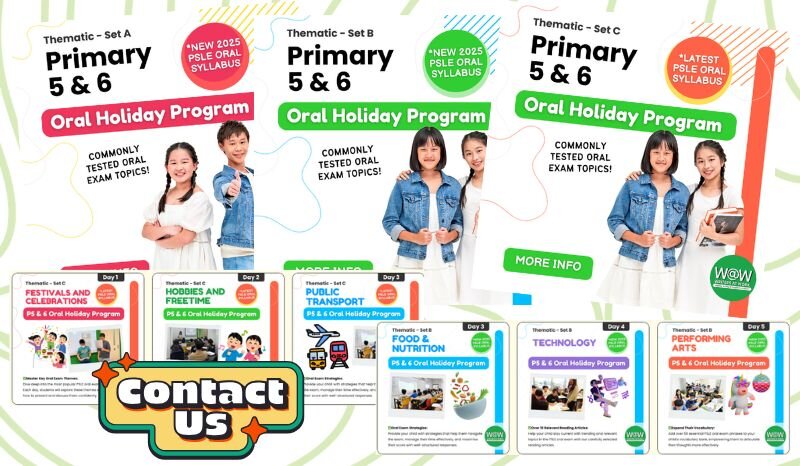
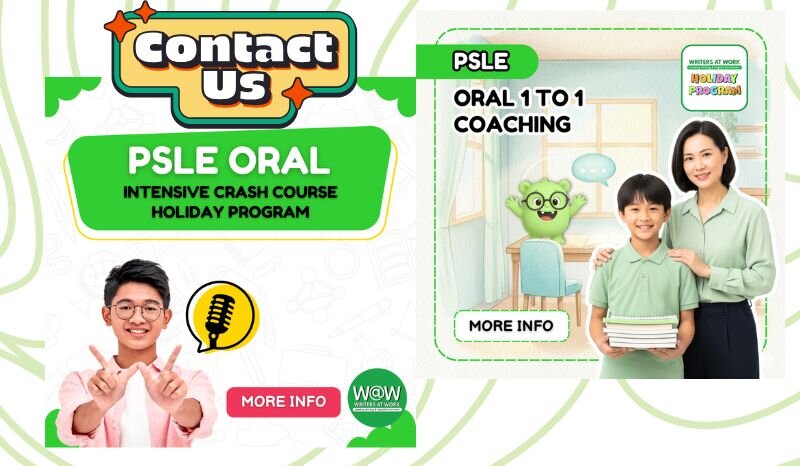
At WRITERS AT WORK, our PSLE Oral holiday programmes are designed to help Primary 5 and 6 students build the content knowledge, vocabulary, confidence, and answering techniques needed for the new PSLE Oral syllabus. Students are exposed to important themes, guided through structured responses, and taught how to express their ideas clearly and thoughtfully.
Whether your child needs broad thematic exposure, personalised coaching, or a focused final boost before the oral examination, WRITERS AT WORK has a programme to support their preparation. Help your child move beyond memorised answers and learn how to speak with confidence, clarity, and content.
Memorising answers may help with structure, but it is not enough. Students need to understand different themes so they can adapt their responses to unfamiliar questions.
Parents can discuss everyday topics such as school, transport, technology, the environment, and community issues. Simple conversations help children practise forming opinions and explaining their ideas.

Agnes Ng, Co-Founder and Teaching & Curriculum Director of WRITERS AT WORK. An NUS Honours graduate and published author with over 30 years of experience, Agnes has been the architect of the organization’s student-centric curricula since 2012.
Dedicated to teacher mentorship and academic excellence, she has guided hundreds of students to achieve outstanding results. Her expertise and commitment to high-quality education remain the cornerstone of WRITERS AT WORK’s success in empowering every learner.



Start practising and learning

