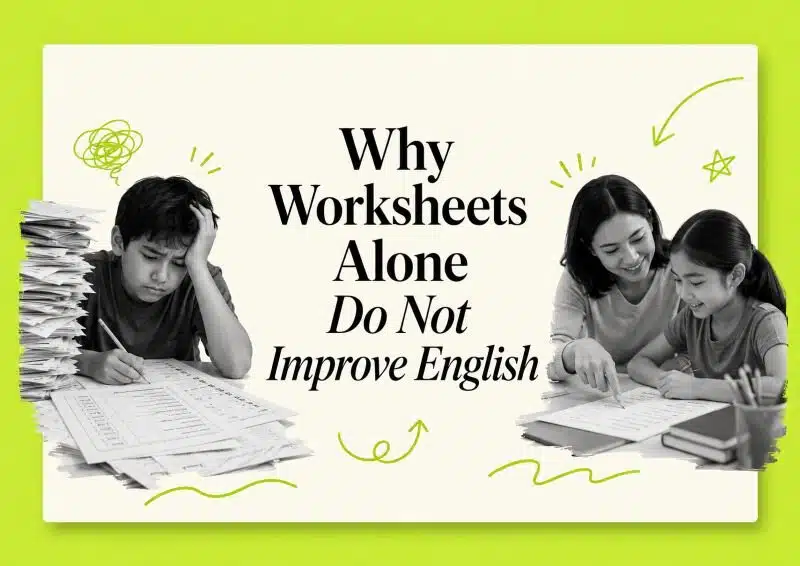
Many parents give their children extra English worksheets because they want them to practise more. This is understandable, as practice is important for strengthening grammar, vocabulary, comprehension, writing, and exam skills. However, worksheets alone do not always lead to real improvement. A child can complete many worksheets and still repeat the same mistakes—finishing pages of grammar questions without understanding errors, giving vague comprehension answers, or writing compositions with weak plots and limited vocabulary. The issue is not that worksheets are useless, but that they work best when supported by correction, feedback, and structure.
It is easy to assume that more worksheets lead to better results, but English improvement is not just about quantity—it is about quality and understanding. When students practise incorrectly, they may reinforce wrong habits. For example, answering comprehension questions without analysing keywords leads to incomplete responses, while writing compositions without feedback results in repeated mistakes in plot and language. Practice becomes meaningful only when students understand what they are doing, recognise their mistakes, and know how to improve. Without this, worksheets become mechanical tasks rather than learning opportunities.
Correction helps students understand what went wrong, while feedback shows them how to improve. A simple tick or cross is not enough—students need to know why an answer is incorrect and what to do differently next time. For instance, in grammar, they must identify clues that determine tense; in comprehension, they must learn to answer precisely and completely. Effective correction explains the reasoning behind answers, while strong feedback provides clear, actionable steps for improvement.
|
Instead of Only Saying |
A Better Approach Explains |
|
“This is wrong.” |
Why the answer is wrong |
|
“Use this answer.” |
Why this answer works |
|
“Be more specific.” |
Which detail is missing |
|
“Your sentence is unclear.” |
How to improve clarity |
Similarly, feedback should guide improvement:
|
Weak Feedback |
Stronger Feedback |
|
“Write better.” |
“Develop the climax with clearer actions and emotions.” |
|
“Use more vocabulary.” |
“Replace repeated words with more precise descriptions.” |
|
“Answer properly.” |
“Use keywords and give a complete reason.” |
Feedback turns practice into progress by showing students exactly what to work on.

Many students struggle because they lack a clear approach. Worksheets provide questions, but structure provides the method to solve them. Students need to know how to plan compositions, analyse comprehension questions, and apply grammar rules systematically. Structure gives them confidence and direction.
|
English Skill |
What Structure Provides |
|
Composition writing |
Planning plot, conflict, and resolution |
|
Comprehension |
Analysing questions and answering precisely |
|
Grammar |
Understanding rules and sentence clues |
|
Vocabulary |
Learning and applying words in context |
|
Situational writing |
Following purpose, audience, and format |
With structure, students move from guessing to applying clear strategies.
Completing many worksheets can sometimes mask recurring errors. Without tracking mistakes, students may repeat the same weaknesses without realising it. Identifying patterns is key to targeted improvement.
|
Repeated Mistake |
What It May Show |
|
Frequent tense errors |
Weak understanding of verb forms |
|
Vague comprehension answers |
Poor question analysis |
|
Repeated spelling mistakes |
Lack of careful checking |
|
Weak composition endings |
Poor planning |
|
Limited vocabulary |
Insufficient exposure |
Once patterns are identified, learning becomes focused. Instead of doing more worksheets, students can work on specific areas such as tense accuracy or answering “why” questions clearly.
Understanding a correction is only the first step—students must apply what they learn to improve. After feedback, they should rewrite sentences, improve paragraphs, or attempt similar questions. This reinforces learning and builds confidence. A simple learning cycle helps:
|
Step |
What Happens |
|
Practice |
Attempt the task |
|
Correction |
Identify mistakes |
|
Feedback |
Understand how to improve |
|
Structure |
Learn the method |
|
Application |
Try again correctly |
Beyond this, English requires guided thinking, not memorisation. Students must learn to analyse meaning, tone, and purpose, and to express ideas clearly. Worksheets provide tasks, but guidance develops the thinking skills needed for real mastery.
Worksheets can be useful, but they are only one part of effective learning. Real improvement comes when students receive correction, meaningful feedback, structured guidance, and opportunities to apply what they learn. When these elements work together, worksheets become more than extra practice—they become a tool for meaningful progress, helping students grow in confidence, clarity, and control of the English language.
Ready to help your child grow in English with the right support at every stage?
At WRITERS AT WORK, our programmes are designed to meet students where they are and help them progress with confidence.
For primary students, our PURE Composition Writing Programmes help children build creativity, develop stronger ideas, and learn how to write vivid, well-structured compositions. Our Comprehensive English Programmes support students in key areas such as grammar, comprehension, oral communication, and writing, giving them a strong all-round foundation for school and national exam success.
For secondary students, our Secondary Programmes are designed to sharpen critical reading, strengthen essay and situational writing skills, and build the exam strategies needed for lower secondary assessments, upper secondary demands, and the O-Level English papers.
Beyond the classroom, students and parents can also tap into our wider learning resources through W@W eSeries, and stay updated with tips, insights, and student support on TikTok and Facebook.
Yes, English worksheets can be useful for practice. However, they are most effective when students receive correction, feedback and guidance so they understand their mistakes and know how to improve.
Your child may be repeating the same mistakes without realising it. If worksheets are completed without proper correction, feedback or structured guidance, practice can become mechanical instead of meaningful.
Students improve when they understand their mistakes, receive clear feedback, learn structured methods, and apply what they have learnt in future tasks. This helps them build stronger grammar, comprehension, writing and vocabulary skills.

Agnes Ng, Co-Founder and Teaching & Curriculum Director of WRITERS AT WORK. An NUS Honours graduate and published author with over 30 years of experience, Agnes has been the architect of the organization’s student-centric curricula since 2012.
Dedicated to teacher mentorship and academic excellence, she has guided hundreds of students to achieve outstanding results. Her expertise and commitment to high-quality education remain the cornerstone of WRITERS AT WORK’s success in empowering every learner.




Start practising and learning

