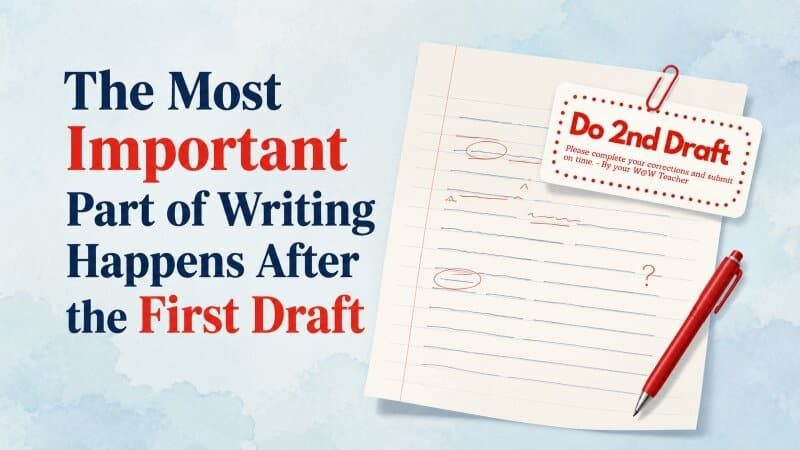
Many parents think the main work is done once a child finishes a composition. After all, the student has planned the story, written the introduction, developed the plot, and completed the ending. The composition has been submitted, so the work looks finished.
However, from a teacher’s and curriculum team’s perspective, that is only the starting point. Real writing improvement often begins after the first draft is submitted. This is when students review their mistakes, receive detailed feedback, and learn how to rewrite with purpose. A first draft shows the student’s current level. Detailed marking and D2 help the student move beyond it.
Many students write one composition, submit it, receive a score, and move on to the next piece of writing too quickly. When this happens, the same problems often appear again and again. A student may keep writing unclear sentences. Another may continue using weak vocabulary. Some students repeat the same grammar mistakes, while others struggle to elaborate on key moments in the story.
Without proper review, these issues do not disappear simply because the student writes another composition. Writing improvement does not come from constantly starting fresh. It comes from learning how to revisit, rethink, and refine what has already been written. This is why the first draft should not be seen as the end of the learning process. It is the point where teachers can see the student’s current habits clearly and guide the student towards better ones
Detailed marking shows students more than just a score. A score tells a student how the composition performed overall, but it does not always show what went wrong or how to improve. This is where detailed marking becomes important. When WRITERS AT WORK teachers mark a composition, they are not only looking for mistakes. They are also looking for patterns.
They may highlight weak sentences, missed opportunities for elaboration, unclear ideas, poor word choices, awkward expression, or recurring grammar problems. They may point out where a scene needs more development, where the emotion is not strong enough, or where the student has rushed through an important part of the story. This kind of marking helps students see their writing more clearly. Instead of thinking, “My composition is not good,” the student begins to understand, “This sentence is unclear,” “This part needs more detail,” or “I keep making the same tense error.” When students know exactly what needs to change, improvement becomes more focused and achievable.
A grade or mark tells students how they performed. Feedback tells them why they performed that way. This is especially important in writing because writing is not improved by memorising one fixed answer. Students need to understand how ideas, language, structure, and expression work together.
For example, a student may receive a lower mark because the story lacks development. But unless the student understands what “lack of development” means, the comment may not help much. Does the student need to describe the character’s thoughts more clearly? Does the conflict need to be built up? Does the climax feel too sudden? Is the ending too rushed? Detailed feedback helps turn a general weakness into a specific next step. This is what makes marking useful for long-term improvement. It does not merely judge the work. It teaches the student what to do differently the next time.
Some students look at corrections briefly, nod, and move on. But seeing a correction does not always mean the student fully understands it. A student may know that a sentence has been changed, but may not understand why the original sentence was weak. Another student may copy a better phrase without learning how to create a similar improvement independently.
This is why teaching should not stop at marking. If students only read corrections passively, the learning may remain shallow. They may recognise that something was wrong, but still be unable to fix a similar problem on their own in the future. Writing improvement requires active thinking. Students need to ask themselves what was weak about the original sentence, why the corrected version is clearer, how the idea can be expressed better, and what they should avoid repeating in the next composition. This is where D2 becomes important.

D2, or the second draft, gives students a chance to apply feedback actively. At WRITERS AT WORK, D2 is not given as punishment. It is not extra homework for the sake of being strict. It is a key part of the writing process. The first draft shows what the student can currently do. The second draft helps the student practise doing it better.
When students rewrite, they are required to think through the teacher’s comments and make deliberate improvements. They do not simply look at corrections. They have to use them. This process helps students slow down and understand their own writing choices. They learn that a composition can be improved, sentence by sentence and paragraph by paragraph. That is where real learning happens.
Through D2, students learn how to improve weak expression. They begin to notice when a sentence sounds too simple, too awkward, or too vague. They learn how to make their writing clearer and more precise. They also learn how to elaborate more effectively. Instead of rushing from one event to another, they practise adding thoughts, feelings, reactions, and details that make the story more meaningful.
D2 also helps students make better vocabulary choices. They learn when a word is too general, when a phrase is not suitable, and when stronger language can create a better effect. Most importantly, students begin to notice recurring mistakes. A child who repeatedly makes tense errors may become more aware of them after rewriting. A student who often writes unclear descriptions may start checking whether the reader can picture the scene. A student who struggles with structure may begin to see how each paragraph should build towards the main event. The second draft teaches students to strengthen structure, clarity, vocabulary, and expression in a practical way.
The long-term goal is not just one better composition. The goal is to help students become writers who can recognise and correct their own weaknesses over time. At first, students may depend heavily on the teacher’s marking. They may need comments to show them where the weak points are. But with repeated practice, they start to internalise the process.
They begin spotting weak sentences before the teacher points them out. They become more careful when planning. They check whether their ideas are clear. They pay closer attention to grammar, vocabulary, and paragraph development. This is an important step in becoming an independent writer. A strong writer is not someone who produces a perfect first draft every time. A strong writer is someone who knows how to review, improve, and refine their work. D2 helps students build that habit.
From a teacher and curriculum team perspective, detailed marking and D2 are intentional parts of the learning process. They are not added simply to make the work more demanding. They are part of a teaching approach that values reflection, precision, and lasting improvement. When teachers mark in detail, they are helping students understand their writing at a deeper level. When students complete D2, they are given the opportunity to act on that guidance.
This creates a fuller learning cycle. The student writes, the teacher identifies strengths and weaknesses, the student reviews the feedback, and the student rewrites with greater awareness. The lessons are then carried into the next piece of writing. This process is especially important for composition writing because improvement takes time. Students need repeated exposure to good writing habits before those habits become natural.
Better writing does not come from writing more blindly. A student can write many compositions and still repeat the same weaknesses if there is no meaningful review. More practice only helps when students understand what they are practising and what they need to improve. This is why detailed feedback and rewriting matter.
They help students slow down and learn from their own work. They help students understand mistakes instead of simply avoiding them for one assignment. They help students carry lessons forward into future compositions, school assignments, and examinations. Over time, this builds stronger writing habits. Students become more aware of how they express ideas. They learn to develop scenes more clearly. They make more thoughtful vocabulary choices. They become less careless with recurring errors. That is how real composition growth happens.
The first draft reveals a student’s current writing habits. It shows how the student plans, expresses ideas, structures a story, and handles language at that point in time. But the most important part of writing often happens after that first draft is submitted.
Detailed marking helps students see what needs to change. D2 gives them the chance to apply that feedback, rethink their choices, and improve their work with purpose. When students learn how to review and improve their own writing, they become stronger, more careful, and more confident writers. At WRITERS AT WORK, this is why the learning process does not end with the first draft.
At WRITERS AT WORK, we believe that strong writing is built through guidance, reflection, and purposeful revision. Our teachers provide detailed marking to help students understand their writing mistakes clearly, while D2 gives them the chance to apply feedback and improve with intention.
If you want your child to become a more thoughtful, confident, and independent writer, let them experience a writing process that goes beyond the first draft.
Help your child build better writing habits with WRITERS AT WORK.
Ready to help your child grow in English with the right support at every stage?
At WRITERS AT WORK, our programmes are designed to meet students where they are and help them progress with confidence.
For primary students, our PURE Composition Writing Programmes help children build creativity, develop stronger ideas, and learn how to write vivid, well-structured compositions. Our Comprehensive English Programmes support students in key areas such as grammar, comprehension, oral communication, and writing, giving them a strong all-round foundation for school and national exam success.
For secondary students, our Secondary Programmes are designed to sharpen critical reading, strengthen essay and situational writing skills, and build the exam strategies needed for lower secondary assessments, upper secondary demands, and the O-Level English papers.
Beyond the classroom, students and parents can also tap into our wider learning resources through W@W eSeries, and stay updated with tips, insights, and student support on TikTok and Facebook
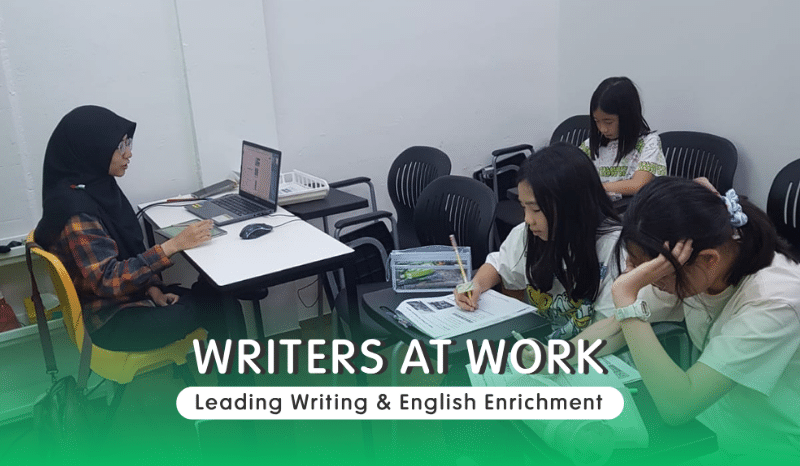
D2 helps students apply the feedback they have received from their teacher. Instead of simply reading corrections and moving on, students rewrite with purpose. This helps them understand their mistakes, improve weak areas, and build stronger writing habits over time.
Yes. A score only shows the result, but detailed marking shows students what went wrong and how they can improve. It highlights weak sentences, unclear ideas, poor vocabulary choices, grammar issues, and missed opportunities for better elaboration.
Yes. Rewriting helps students slow down, think through their mistakes, and make better choices in expression, structure, and clarity. Over time, this helps them become more independent writers who can spot and correct their own weaknesses.

Jemmies Siew, Managing Director and Co-Founder of WRITERS AT WORK Enrichment Centre. With over 15 years of experience in education, entrepreneurship, and marketing, Jemmies has helped shape Singapore’s English enrichment landscape through her vision for transformative learning.
She is passionate about connecting real-world issues with language learning, helping students think critically and express themselves clearly. Connect with her on LinkedIn to follow her insights on education, content marketing, and thought leadership.



Start practising and learning

