Creative Writing Classes for Primary School in Singapore

Spark Your Child's Imagination and Build Lifelong Writing Confidence, Powered by STORYBANKING®, for Primary 1 to Primary 6

Primary 4 English Tuition

Creative writing is the foundation of strong school compositions and PSLE Continuous Writing. The skill compounds through the primary years, shaping how clearly, vividly, and confidently they put ideas on the page.

Where Every Primary Student Finds Their Voice

Most primary students don’t struggle with the English language. They struggle with what to say.

Hand a child a composition prompt and the page often stays blank, not because the words are missing but because the ideas are. They reach for what feels safe (a school day, a holiday memory) and the writing follows the same shape as everyone else’s.


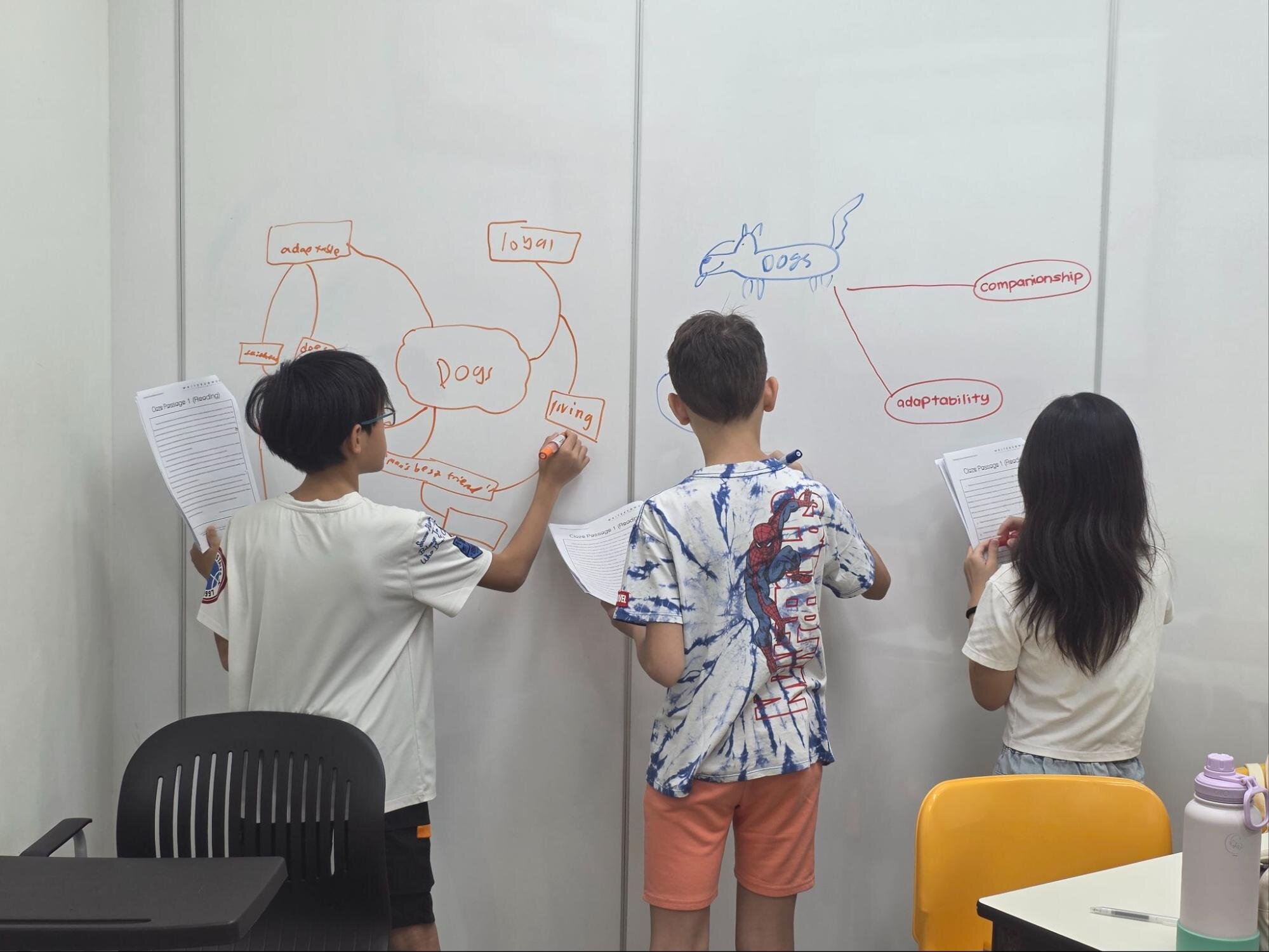
STORYBANKING® changes that by giving students a practical way to build and organise story ideas. In each lesson, your child adds to a growing bank of plots, descriptions, vocabulary and real-life examples that can be adapted to different composition themes. Over time, they learn how to approach a prompt with a clear idea, stronger structure and greater confidence, instead of staring at a blank page.


Creative writing classes at WRITERS AT WORK is embedded into two core programmes: our Comprehensive English Programme for Primary 1 to Primary 6, and our Pure Composition Writing Programme for Primary 4 to Primary 6. Both run on STORYBANKING® and are taught across all 8 centres in Singapore. Whether your child is writing their first stories or refining their PSLE composition technique, the same principles carry through.

Why choose WRITERS AT WORK?

Strong creative writing rests on four things: clear method, proven results, expert teachers, and a curriculum built with purpose. Here’s how each one works for your child.

English Writing and Enrichment Centre in Singapore

Every creative writing lesson at WRITERS AT WORK is built around a specific outcome: a writing skill, a structural technique, or a story-craft principle your child can apply immediately. Our curriculum team translates exam expectations into focused, purposeful lessons, so what's taught in class shows up in your child's school work and exam scripts.

STORYBANKING® gives students an idea bank rather than a template. Across the term, your child collects and refines original story plots, descriptive vocabulary, and character profiles tied to common exam themes. Over time, this becomes genuine writing muscle memory: they walk into composition exams with material they've practised, and adapt confidently from there.

Every teacher at WRITERS AT WORK undergoes structured in-house training in creative writing pedagogy and STORYBANKING® before stepping into a classroom. They understand PSLE composition expectations and how to guide students towards stronger content, structure and language, and how to coach your child to those standards without losing their voice.

For 14 years, WRITERS AT WORK students have achieved full marks in composition writing across school and PSLE examinations. This track record reflects the strength of our method, teacher training and curriculum, and why we believe in proof over promises. Read our model compositions to see what strong primary writing looks like.

English Writing and Enrichment Centre in Singapore
review icon
14 Years Track Record Of Full Marks in Composition and Oral
0 %
Icon
Primary and Secondary Students Impacted
0 +
award icon
Achieved PSLE AL1-2
0 in 3
light icon
Average Google review rating
0
icon
Verified parent reviews
0 +

How Our Creative Writing Classes Work

Primary 4 English Tuition
Every creative writing class follows a four-step cycle, repeated weekly. The cycle isn’t theoretical: it’s how your child moves from collecting ideas to writing exam-ready compositions.

Step 1: Build the Idea Bank with STORYBANKING®

 Students gather and refine original story ideas across common exam themes (friendship, courage, regret, change, and more), each one tagged with vocabulary and descriptive phrases. Themes and model compositions are curated by our in-house curriculum team, who analyse exam trends each year to keep the material current and aligned with school and PSLE expectations. The bank grows lesson by lesson, becoming a resource your child can adapt for any composition.

Step 2: Learn Proven Writing Techniques

Each lesson focuses on one skill: Show-Not-Tell, sensory description, character-emotion mapping, plot sequencing, strong openings, and satisfying endings. Skills are introduced in manageable layers so students internalise each one before moving on to the next.

Step 3: Apply Techniques Through Guided and Independent Writing

Guided practice has students apply one technique at a time, with the teacher modelling the thinking aloud. Independent writing then sees them plan and draft full compositions to PSLE format, building the resilience and stamina exam conditions demand.

Step 4: Receive Targeted Feedback and Refine

Teachers return marked work with component-specific feedback (plot, language, structure, mechanics) and students revise, re-draft, and re-apply. This refinement loop is where the real growth happens, and it’s what makes the difference between writing more and writing better.

How this cycle runs in each programme:

In our Pure Composition Writing Programme (Primary 4 to Primary 6), the full cycle is run weekly, with students writing a complete composition each lesson. Over a year, this typically amounts to more than 44 compositions, varying with student level and attendance.

In our Comprehensive English Programme (Primary 1 to Primary 6), students experience a portion of this cycle each lesson, alongside structured work on Paper 2 (comprehension and language) and Paper 4 (oral). The same STORYBANKING® principles apply, integrated into a broader weekly curriculum.

What Your Child Will Learn in Our Creative Writing Classes

Six core skills shape every creative writing lesson at WRITERS AT WORK. Each class builds on the last, so your child develops a complete writer’s toolkit by the time they sit for PSLE.

1. Memorable Plot Development

Your child will learn to craft original storylines with clear conflict, rising tension, and a resolution that feels earned, building plots that hold a reader’s attention from start to finish.

2. Show-Not-Tell & Sensory Description

Using the five senses, body language, and character reaction, your child will learn to write vivid scenes, replacing flat statements with detail that lets the reader feel the moment.

3. Rich Vocabulary & Phrase Banks

Your child will learn to build a working vocabulary collection organised by theme and emotion, ready to apply with precision in school assignments and exam compositions.

4. Strong Story Structure

As a strong structure carries a reader from the first sentence to the last, your child will learn to write a hook, sequence events purposefully, and close with intent.

5. Character Voice & Emotion

Your child will learn to develop characters through dialogue, thought, and reaction, giving each one a distinct voice and emotional arc that brings the story to life.

6. Exam-Smart Writing Techniques

Your child learns to plan, pace, and write within exam time limits, applying question analysis, STORYBANKING® adaptation, and disciplined editing under pressure.

Creative Writing Classes by Primary Level

Primary 1

Creative writing for Primary 1 begins with the basics. P1 students learn short, structured compositions, simple plot sequencing, and a starter vocabulary bank, building the confidence to put ideas on the page and shape complete narratives.

Primary 2

Stories grow longer and more vivid. Creative writing for Primary 2 students involves developing descriptive language, planning before writing, and the use of dialogue and character detail to hold a full narrative together.

Primary 3

Master the three-picture composition format used in P3 school exams. Creative writing for Primary 3 involves building a working phrase bank, sharpens story structure with clear beginnings, middles, and ends, and weaves themes purposefully.

Primary 4

Creative writing for Primary 4 focuses on PSLE-style composition writing in the three-distinct pictures format. P4 students learn to integrate themes meaningfully, develop characters, and write compositions that go beyond plot summary.

Primary 5

Creative writing for Primary 5 introduces advanced techniques in suspense, descriptive control, and pacing, extending writing stamina and deepening vocabulary use to produce the consistency markers reward at top-school level.

Primary 6 (PSLE)

Exam-smart strategies for the PSLE. Creative writing for Primary 6 covers question analysis, story adaptation from the STORYBANK®, and disciplined editing under timed conditions, leaving students with a method they can apply in the exam hall.

Two Programmes. One Writing Journey.

Creative writing at WRITERS AT WORK is delivered through two complementary programmes. Both are built on STORYBANKING®. The difference is focus.

Comprehensive English Programme (Primary 1 to 6)

Our all-round English programme covers composition writing, language use, comprehension, and oral, available for every primary level.

Best for: Students who want full English coverage with creative writing as one component.

Pure Composition Writing Programme (Primary 4 to 6)

An intensive programme focused entirely on composition writing. Ideal for upper primary students aiming for PSLE excellence in Paper 1 Continuous Writing.

Best for: Students who want deep, concentrated creative writing practice.

Not sure which fits? Book a free consultation and we’ll assess your child’s needs together.

Meet the Team Behind WRITERS AT WORK

Jemmies Siew

Ms-Jemmies

Managing Director

Jemmies Siew, co-founder of WRITERS AT WORK, is an NUS graduate and a visionary edu-preneur with 25+ years of education experience. She has co-authored over 50 assessment books and strategically expanded the brand to nine thriving branches, while building a digital community of over 57,000 followers within a single year.

Agnes Ng

Ms-Agnes

Teaching & Curriculum Director

Agnes Ng, co-founder and Teaching & Curriculum Director of WRITERS AT WORK, is an NUS Honours graduate with 30+ years of education experience. Since 2012, she has led curriculum development and teacher training, creating student-centric programs that empower hundreds of students to achieve outstanding results across the brand’s expanding branches.
Testimonials From
Our Students

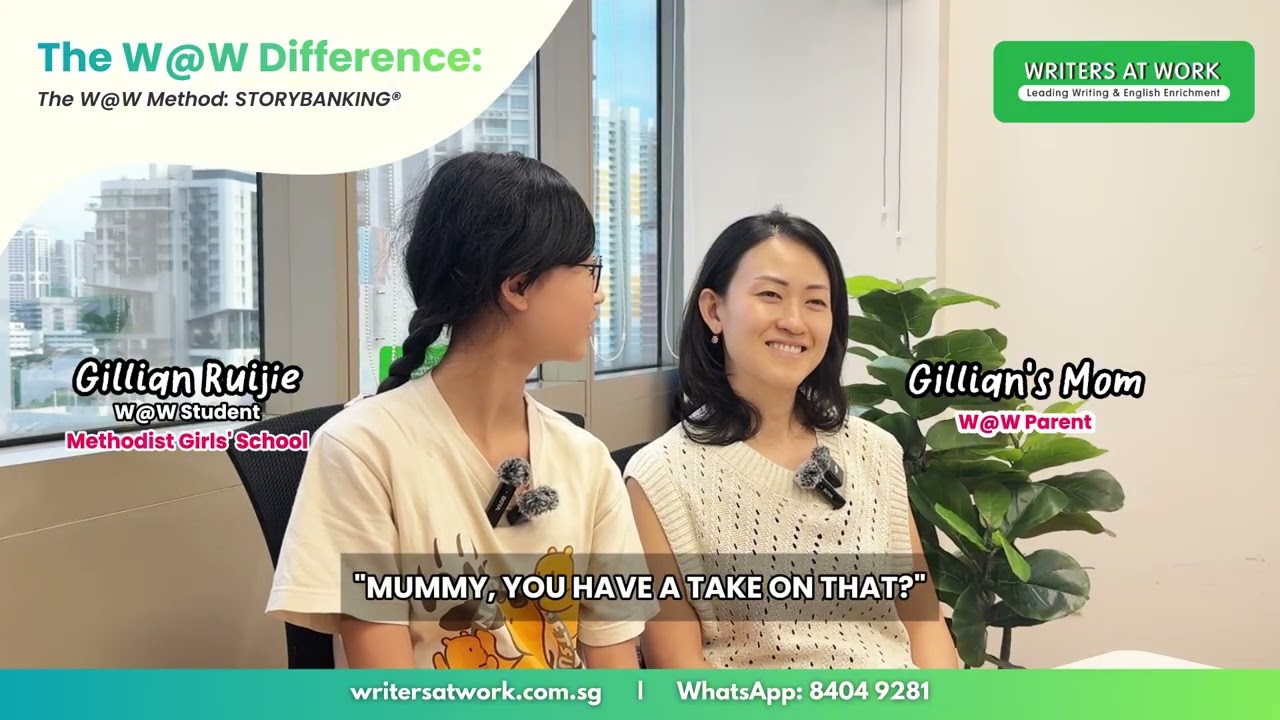
Students of WRITERS AT WORK share what their creative writing journey looked like.

Google Review

Don't Just Take Our Word For It. Hear What Parents Have Said About Us!

Media and Awards

#WRITERSATWORKsg

Keep up with us

Frequently Asked Questions About Creative Writing Classes

The best fit depends on your child, but the strongest options share three traits: a clear pedagogy, exam-aligned outcomes, and trained teachers. WRITERS AT WORK delivers all three through STORYBANKING®, a 14-year track record of full marks in PSLE Composition, and English creative writing classes for Primary 1 to Primary 6 across 8 centres in Singapore.
Yes. Lower primary creative writing classes focus on the foundations: storytelling confidence, sentence construction, descriptive vocabulary, and the rhythm of beginning, middle, and end. P1 and P2 students benefit from starting early because composition is a compounding skill. The earlier the structure is in place, the more room there is to develop voice and craft over the primary years.
Creative writing is the broader skill: imagination, storytelling, language play, and character development. Composition writing applies those skills to the exam format used in the Continuous writing section of English Paper 1. At WRITERS AT WORK, we teach creative writing first as a foundation, then layer in the conventions and structure that score well in primary school and PSLE compositions.
STORYBANKING® gives your child an idea bank rather than templates. Across the year, students collect and refine original story plots, vocabulary, and character profiles tied to common exam themes. When a composition prompt comes, they don’t start from scratch. They adapt material they’ve already practised, which means stronger ideas, better language, and more confident writing under exam pressure.
Most students show noticeable improvement within three to six months of consistent weekly practice. Foundation building (especially for P1 and P2 or students new to writing) can take longer, and that’s normal. Improvement also depends on attendance, completion of practice work, and review at home. The method works when commitment meets opportunity.
Yes. Creative writing practice itself strengthens grammar, vocabulary, and expression because it requires students to use language with intent. Students attend the class aligned to their school level, and our teachers are trained in differentiated learning, adjusting support and challenge to meet each student where they are.From there, the curriculum builds the foundation alongside the writing skills.

Ready to Spark Your Child’s Creative Writing Journey?

Tell us about your child and we’ll be in touch within 1 to 3 working days to arrange a trial class.

For more details about our classes, simply fill in the form below and we will be in touch within 1-3 working days.

Terms and Conditions

WRITERS AT WORK is committed to protecting and respecting your privacy. We will only use your personal information to administer your account and provide the products and services you requested from us. We may contact you about our products and services, as well as other content that may be of interest to you. If you provide consent for this purpose, please tick below. You can unsubscribe from these communications at any time. You can read our full Privacy Policy here.

Terms and Conditions Acknowledgement*

Submission Acknowledgement
By clicking “Submit”, you consent to allow WRITERS AT WORK to store and process the personal information submitted above to provide you with the requested content. You also acknowledge the Terms and Conditions that will apply upon enrolment.

2026 Registration
W@W-LOGO-WRITERS-AT-WORK
Primary 4 model compositions

Unlock Our Free Resources Today

Start practising and learning