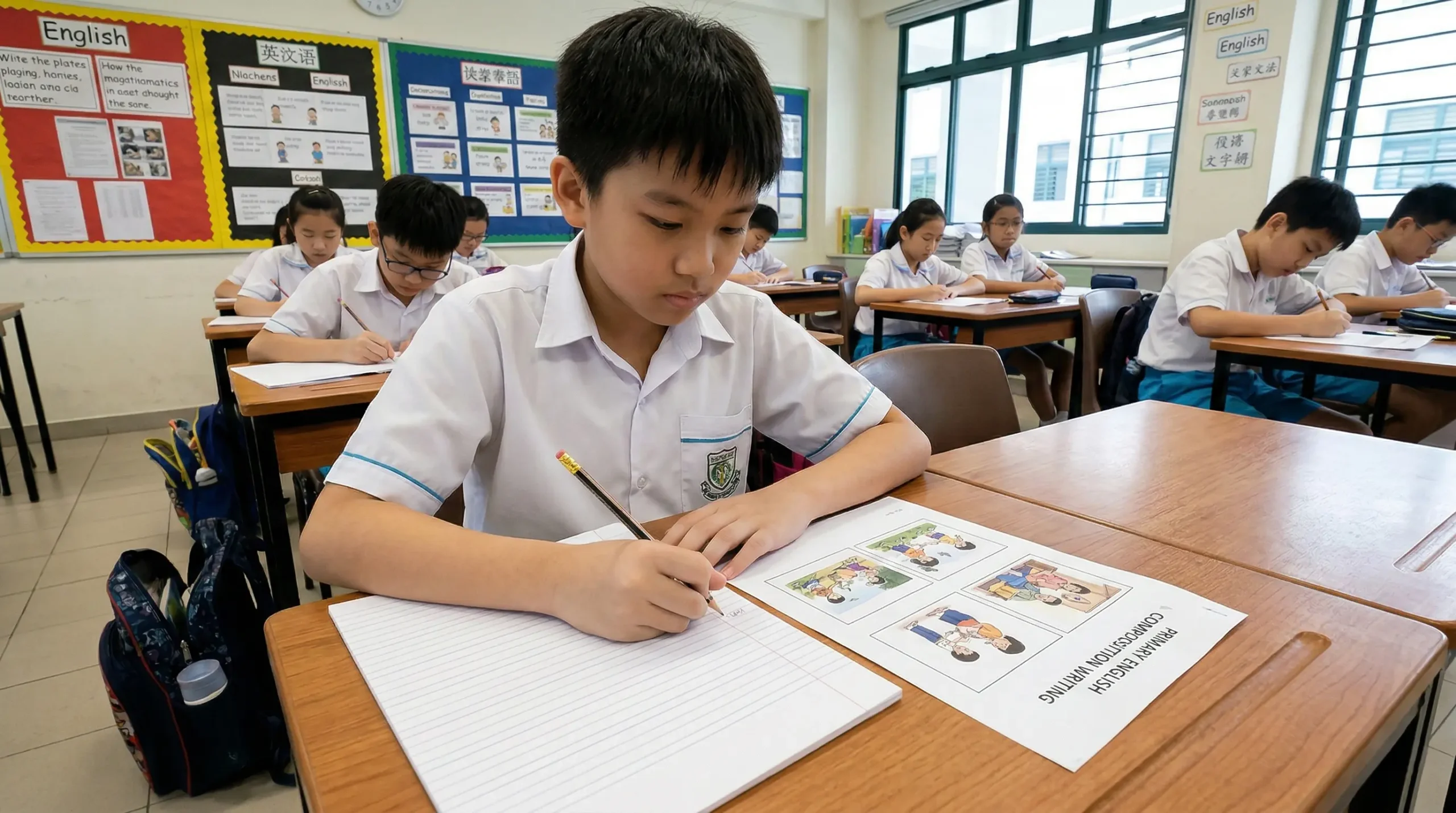
Composition writing is the single highest-scoring section in the PSLE English paper, and it is also the one that students find hardest to improve. Unlike grammar or vocabulary, where drilling can produce quick gains, composition rewards a combination of planning, creativity, language control, and exam awareness that takes time to develop.
The good news is that the marking criteria are not a mystery. Once your child understands exactly where the marks come from and how to earn them, every practice session becomes more focused and more productive. This guide breaks the process down step by step, from understanding the rubric to polishing the final draft under timed conditions.
Continuous Writing is worth 36 marks in total, split equally between two components: 18 marks for Content and 18 marks for Language. Together with Situational Writing (14 marks), Paper 1 makes up 25 per cent of the overall English grade. Students have 1 hour and 10 minutes to complete both sections.
Examiners look for a story that is relevant to the given topic, well developed, and engaging. The plot should be clear and logical, with a beginning that hooks the reader, a rising conflict, a satisfying climax, and a resolution that ties back to the theme. Characters should feel real, with thoughts, dialogue, and reactions that drive the story forward. Critically, the composition must incorporate at least one of the three picture prompts provided.
The most common mistake in PSLE composition is skipping the planning stage. Students feel pressed for time and dive straight into writing, only to find themselves stuck halfway through with a story that has drifted off topic.
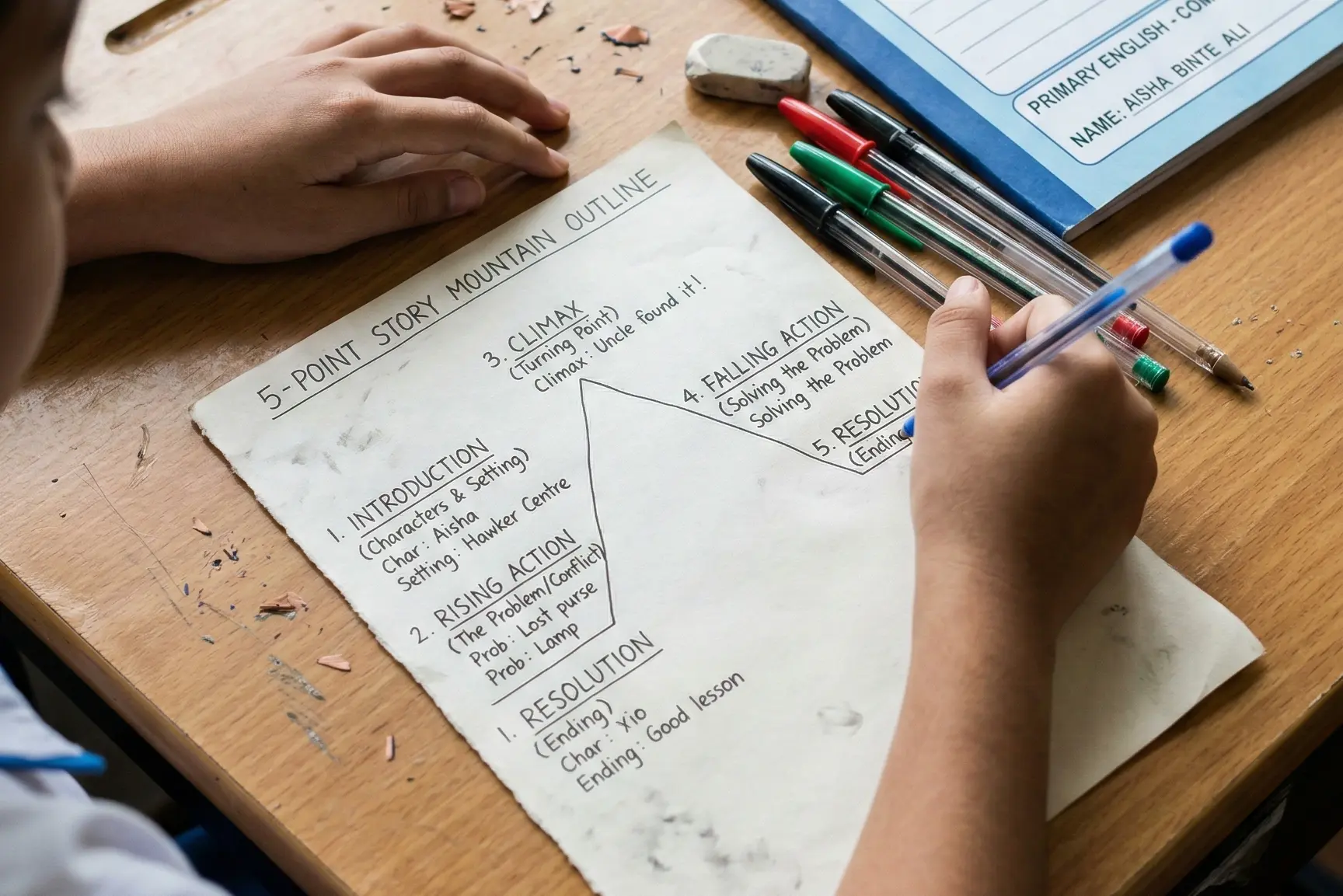
Spending five minutes on a plan saves far more time than it costs. A quick story mountain outline on rough paper gives your child a bird’s-eye view of the entire plot before a single sentence is written. The outline should cover five elements: the opening (who, where, when), the build-up (what triggers the main event), the climax (the most intense or important moment), the resolution (how the conflict is resolved), and the ending (what the character learns or how they feel).
The first few lines set the tone for the entire composition. A flat opening like “It was a sunny day” does not give the examiner any reason to feel curious about what comes next.
Strong openings pull the reader straight into the story. There are several reliable methods your child can practise. Starting with action drops the reader into the middle of a scene: “I sprinted down the corridor, my shoes squeaking against the polished floor.” Starting with dialogue creates immediate energy: “‘You have exactly five minutes,’ my teacher announced, tapping her watch.” Starting with a question sparks curiosity: “Have you ever wished you could take back the last thing you said?” Starting with a feeling draws the reader into the character’s inner world: “A knot tightened in my stomach as I stared at the notice board.”
The key principle is that the opening should connect directly to the story’s central conflict or theme. It should not be a generic description that could fit any composition. For more methods and examples, visit our posts on How to Write Good Introductions and Types of Hooks for Essay Introductions.
Once the opening is in place, the body of the composition needs to show the examiner that your child can write with depth and creativity. Three techniques make the biggest difference at this level.
This is the single most important upgrade for composition writing. “She was nervous” tells the reader a fact. “Her hands trembled as she fumbled with the zip of her pencil case, her heart hammering so loudly she was sure the boy beside her could hear it” shows the reader an experience. Showing uses sensory details, body language, and specific actions to let the reader feel what the character feels, rather than simply being informed about it.
Strong compositions appeal to more than just sight. Encourage your child to weave in sounds, smells, textures, and even tastes where they fit naturally. A hawker centre is not just “crowded” but “alive with the sizzle of woks, the clatter of porcelain, and the rich aroma of chicken rice drifting from every stall.” Sensory language turns flat descriptions into vivid scenes. For more examples of how to bring settings and emotions to life, explore our tips on Writing More Interesting Compositions.
Dialogue breaks up long blocks of narration and reveals character. However, it must serve the story. Every line of dialogue should either advance the plot, reveal something about a character, or increase tension. Avoid filler conversations that do not move the story forward. When writing dialogue, pair the spoken words with an action or emotion: “‘I’m sorry,’ she whispered, her gaze fixed on the floor” is far more effective than “‘I’m sorry,’ she said.”
Vocabulary is not about using the longest or most obscure words. It is about choosing precise words that fit the context naturally. Writing “he sauntered” instead of “he walked slowly” paints a clearer picture in fewer words. Writing “the deafening roar of the crowd” instead of “the crowd was very loud” creates a stronger sensory impression.
Encourage your child to build a personal vocabulary bank organised by theme: emotions (elated, mortified, apprehensive), settings (bustling, serene, dilapidated), and actions (scrambled, lunged, recoiled). Two well-placed phrases per paragraph is a good target. Overloading every sentence with advanced vocabulary makes the writing feel unnatural and can actually lower the language score. For a curated list of strong phrases by category, see our guide to Good Phrases for Composition Writing.
Literary devices also add depth when used with restraint. Similes (“her smile spread like sunrise”), metaphors (“the classroom was an oven”), and personification (“the wind whispered through the trees”) all enrich the writing. The key is to use them selectively so each one lands with impact.
A good conclusion does three things. It resolves the conflict, so the reader knows how the story ends. It reflects on the experience, showing what the character learned, how they changed, or how they felt. And it echoes the theme of the composition question, reinforcing relevance one final time.
After writing the conclusion, your child should reserve three to five minutes for proofreading. A quick check for tense consistency (most stories should be in the past tense throughout), subject-verb agreement, spelling, and punctuation can catch errors that would otherwise cost marks in the Language component. Reading the last sentence of each paragraph in sequence is a fast way to check whether the plot flows logically from beginning to end.
Going off topic. This happens when students do not plan, or when they get carried away with a subplot that overshadows the main theme. Every paragraph should connect back to the composition question.
Inconsistent tense. Switching between past and present tense within the same paragraph is one of the most common language errors. Students should decide on a tense during planning and stick with it throughout.
Before handing in the paper, your child should spend three to five minutes checking:
Consistent, structured practice is the fastest route to full marks. At WRITERS AT WORK, our STORYBANKING® method equips students with a personal library of over 40 adaptable story ideas, strong vocabulary banks, and proven writing techniques. Each lesson introduces a new story that students can adapt to a variety of composition topics, so they never face a blank page on exam day. If your child needs a clear system for mastering composition writing, explore our programmes and give them the tools to write with confidence.
To understand how the PSLE works overall, visit our complete guide: What Is PSLE in Singapore? For a breakdown of how PSLE scores translate into Achievement Levels, see our guide to the New PSLE Scoring System. You can also browse past exam questions for practice at our PSLE Past Years Composition Questions page.
The minimum requirement is 150 words, but top-scoring compositions typically fall between 350 and 500 words. Writing significantly beyond 500 words increases the risk of grammatical errors and time pressure. Focus on quality over quantity; a well-developed 400-word story with strong language will outscore a lengthy but repetitive piece.
Aim for four to six paragraphs. A typical structure includes an introduction, two to three body paragraphs covering the build-up and climax, and a conclusion. Each paragraph should serve a clear purpose in advancing the story.
Yes. Students may use one, two, or all three picture prompts. However, using more pictures does not automatically earn more marks. What matters is that the chosen picture or pictures are woven naturally into the plot, not forced in as an afterthought.
Recurring themes include overcoming challenges, learning from mistakes, acts of kindness, unexpected friendships, family bonds, school experiences, and personal growth. Building a bank of adaptable stories around these themes gives your child a head start on exam day.

Jemmies Siew, Managing Director and Co-Founder of WRITERS AT WORK Enrichment Centre. With over 15 years of experience in education, entrepreneurship, and marketing, Jemmies has helped shape Singapore’s English enrichment landscape through her vision for transformative learning.
She is passionate about connecting real-world issues with language learning, helping students think critically and express themselves clearly. Connect with her on LinkedIn to follow her insights on education, content marketing, and thought leadership.



Start practising and learning

