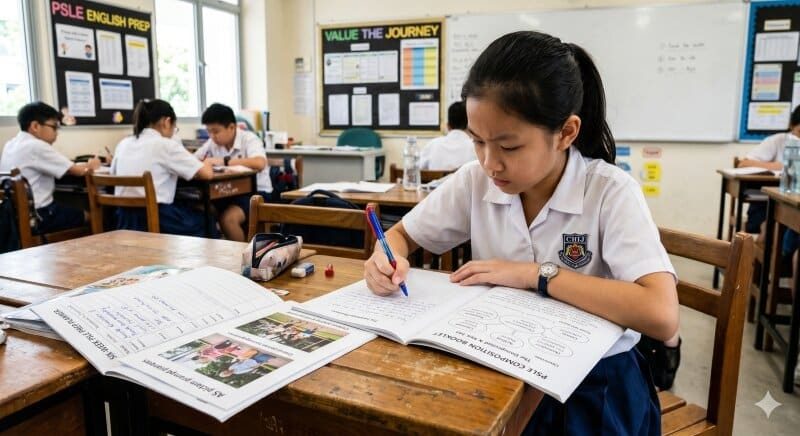
Composition is the single highest-scoring section of PSLE English. Out of Paper 1’s 50 marks, 36 belong to continuous writing, split evenly between Content (18 marks) and Language (18 marks). For parents watching their child face a blank page, that is daunting.
Composition develops over months of focused practice. Started early enough, a child can move up two grade bands.
Markers look for four things: relevance to topic and picture prompts, plot with clear conflict and resolution, ideas developed with detail, and accurate, varied language. Simple, precise English with a strong, well-paced story will outscore a vocabulary showcase with grammar errors or off-topic ideas. The MOE syllabus prizes effective communication over showmanship. For a clearer breakdown of how the 36 marks are awarded, see our guide on composition marks and rubrics.
The structure below works for P5 SA2 and for the PSLE in October. Adjust the start date to your child’s actual exam.
No full essays this week. Practise five-minute plans only. Map out the conflict and resolution for eight to ten topics drawn from past PSLE composition topics 2015 to 2024. Every plan must answer two questions: what is the conflict, and how does it resolve? By Friday, your child should plan any topic in under five minutes. Our planning tips cover the five-minute plan in detail.
Generic openers like “It was a sunny day” signal a lack of planning. Practise four reliable opening types: action openings that drop the reader into a scene, dialogue openings that establish conflict in a single line, sensory openings that create atmosphere, and reflective openings that hint at stakes. Each day, write the same topic four ways. The opening should sit as close to the conflict as possible. For worked examples, see how to start a composition and types of hooks for essay introductions.
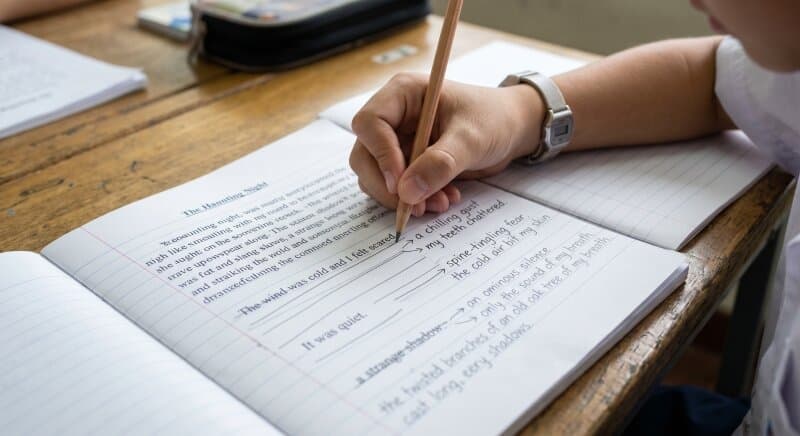
This is the highest-leverage technique at upper primary. “I was nervous” is flat. “My palms were slick with sweat. I wiped them on my school shorts for the third time, but they were damp again within seconds.” That is showing. Take five emotion words (scared, happy, relieved, angry, guilty), and rewrite each as two showing sentences using body language, physical sensation, internal thought, or action. Add four sensory details to a timed composition focused on the climax. Our guide on the five senses in writing gives ten examples to adapt.
Write two full compositions under exam conditions: 50 minutes total, five for planning and the rest for drafting and a final read-through. Our ultimate guide to writing under timed conditions walks through the minute-by-minute split. The step most students skip is rewriting the same composition after feedback. Rewriting forces precision, and our step-by-step revision guide covers the loop in detail. Build a vocabulary bank organised by emotion and situation, aiming for ten to fifteen phrases your child genuinely owns.
Rushed endings cost marks. A strong ending resolves the conflict and adds a brief reflective beat on what changed for the character. Echoing the opening creates a circular structure that examiners reward. Endings to drop entirely: “It was all a dream”, new characters in the final paragraph, generic moral lessons, and any cliffhanger that leaves the conflict unresolved. Practise story twists. One well-executed reversal can move a composition from mid-band to top-band. For seven specific ways to land a strong ending, see our composition conclusion tips.
No new techniques. Re-read three or four of the child’s best compositions from prep. Run rapid planning drills. Do one final timed composition mid-week. From Friday, stop writing new compositions. Rest is preparation too. Working with past year papers sharpens exam familiarity without producing fresh drafts.
The night before is for sleep. Read through the vocabulary bank for fifteen minutes and glance at the planning checklist. Pack the school bag, lights out by 9.30pm. P5 and P6 students need eight to ten hours.
In the morning, eat a proper breakfast (eggs on wholemeal bread or kaya toast with Milo both work well) and do five minutes of light movement. Spend no more than ten minutes priming with the vocabulary bank and a mental rehearsal of the planning steps. Arrive with buffer time.
Hovering during writing destroys independent thinking, which is precisely what the exam tests. Interrupting mid-sentence, editing in real time, or reading the draft aloud while flagging errors all train the child to ask “is this what the adult wants?” instead of “how do I make this better?”
The research-aligned alternative: let your child write a raw draft without interruption. Provide written feedback afterwards on paper. Have them rewrite independently. Review the rewrite. Real-time supervision makes composition co-authored, and the child loses the ability to generate ideas, evaluate, self-correct, and revise alone, which is exactly what they need to do for fifty silent minutes on exam day.
A secondary mistake worth flagging: drilling vocabulary lists while neglecting plot. A composition full of good phrases with a weak, off-topic story still fails on Content.
A confident child who has prepared well arrives at the exam with a planning rhythm, a small bank of well-understood phrases, a few flexible story skeletons they can adapt to whatever picture appears on the paper, and the discipline to stop writing once the story has resolved. We call this STORYBANKING®. Six weeks is enough to build it.
If your child needs help with that prep, WRITERS AT WORK runs composition programmes for P5 and P6 students throughout the year. Start with our practical guide on writing good introductions, then get in touch to find the right class for your child.
Six weeks of focused practice can lift a child by one band, but most benefit from twelve to twenty-four weeks of weekly composition work in the year before PSLE. The earlier you start, the more comfortable your child becomes with planning and revising under pressure. If your child is already in P5, begin building the planning rhythm in Term 3.
Length is not the problem. Mid-band compositions usually have one of these issues: a weak or unresolved conflict, telling instead of showing, or vocabulary used inaccurately. Audit a recent script: can your child identify the conflict and resolution in one sentence each? If not, focus on planning and show-not-tell before adding more vocabulary.
No. Real-time correction trains your child to wait for adult approval and weakens independent thinking. Let them complete a draft, then give written feedback for the rewrite. The exam gives them fifty silent minutes alone with the paper, and practice should mirror that.
Studying strong compositions for structure and phrasing is useful. Memorising and reproducing them is risky and often penalised when the topic does not match. The safer approach is to build a personal vocabulary and phrase bank organised by emotion and situation, so your child can deploy lines naturally rather than pasting them from memory.

Agnes Ng, Co-Founder and Teaching & Curriculum Director of WRITERS AT WORK. An NUS Honours graduate and published author with over 30 years of experience, Agnes has been the architect of the organization’s student-centric curricula since 2012.
Dedicated to teacher mentorship and academic excellence, she has guided hundreds of students to achieve outstanding results. Her expertise and commitment to high-quality education remain the cornerstone of WRITERS AT WORK’s success in empowering every learner.



Start practising and learning

