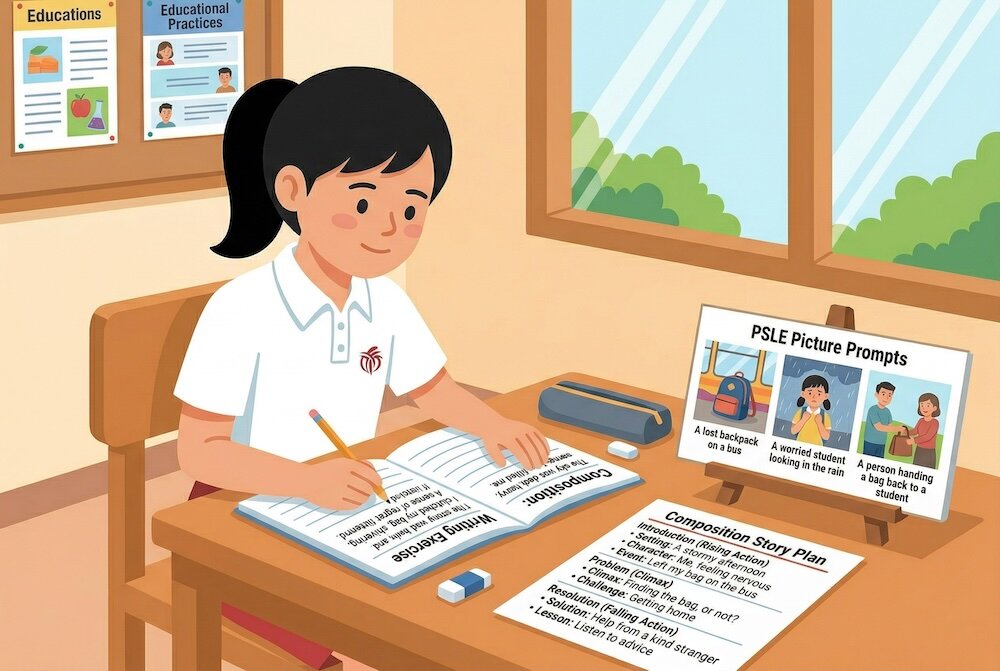
The first few lines of a PSLE composition carry more weight than most students realise. By the time an examiner finishes your opening paragraph, they have already formed an impression of how engaging the story will be, how confident the writer is, and whether this composition is heading for a higher or lower content band.
A flat opening like “It was a sunny day and I went to school” does none of that work. It tells the examiner nothing specific about the story, creates no curiosity, and could belong to any composition on any topic. Compare that with an opening that drops the reader into a moment of tension, reveals a character’s doubt, or presents a small, unexplained detail that demands explanation. The difference is immediate.
The good news is that writing a strong introduction is a learnable skill. It does not require genius or inspiration. It requires knowing a handful of reliable methods, choosing the right one for the topic, and practising until the technique becomes second nature. This guide covers five proven approaches, each with PSLE-style examples your child can adapt to any composition question. For a deeper look at common introduction mistakes and how to avoid them, see our guide on How to Write Good Introductions.
Examiners read hundreds of compositions on the same topic. The vast majority begin the same way: a generic description of the weather, an alarm clock ringing, or a character walking to school. These openings are not wrong, but they are forgettable. They do nothing to set the composition apart.
A powerful introduction does three things. It hooks the reader with something specific and interesting. It connects to the central conflict or theme of the story. And it sets the tone for what is to come, so the examiner knows this is a story worth paying attention to.
Under the PSLE marking rubric, Content rewards stories that are engaging and well developed. An introduction that creates instant curiosity signals to the examiner that the student has planned the story deliberately and has something worth reading. That first impression carries through the entire marking process. For more on the different types of hooks available, visit our guide to Types of Hooks for Writing Essay Introductions.
Instead of building slowly towards the conflict, drop the reader straight into the middle of it. This technique, sometimes called in medias res, opens at the point where something is about to go wrong or a critical decision must be made. The background can be filled in later.
Starting at a tense moment creates instant curiosity. The reader wants to know how the character got into this situation and what will happen next. It also forces the student to identify their climax during planning, because the opening is pulled directly from the story’s most intense moment.
Topic: “A Risky Decision.”
My hand hovered over the fire alarm, my fingers trembling as the echo of my friends’ dare rang in my ears.”
Topic: “Helping a Stranger.”
“By the time I noticed the little boy standing alone at the school gate, the sky had already turned dark and the car park was almost empty.”
Both openings place the reader in a specific, charged moment. The background (how the dare started, why the boy is alone) is deliberately withheld, which creates the pull to keep reading.
During planning, identify the future climax. Write two to three tense sentences from that moment as the opening paragraph. Then, in the second paragraph, step back in time: “Just two hours earlier, everything had seemed perfectly normal.” This creates a natural flashback structure that is easy to manage under exam conditions. For more on using flashback effectively, read our guide on What Is a Flashback and How to Use It in Your Writing.
This method begins with the main character’s assumption, promise, or conviction, one that the rest of the story will challenge or overturn. It immediately tells the examiner that this is a story about change, which is exactly what higher content bands reward.
Opening with a belief creates a built-in “before and after” structure. The examiner reads the opening belief and automatically anticipates how the story will test it. This makes the plot feel purposeful from the very first sentence. It also makes the conclusion easy to write, because the ending simply needs to show how the character’s belief has shifted.
Topic: “A Lesson Learnt.”
“I used to think that rules were made to be bent, especially when nobody was watching.”
Topic: “Teamwork.”
“Working with others, I decided long ago, was the fastest way to get blamed when things went wrong.”
Both lines quietly promise a transformation. The reader knows the character’s view will be challenged, and they want to see how.
Before writing, fill in two blanks: “At the start, my character believes ______.” and “By the end, my character realises ______.” Turn the first belief into a single-sentence opening. Make sure the conclusion clearly echoes and contrasts the opening belief. This technique pairs naturally with themes about personal growth, mistakes, and moral lessons, which are among the most commonly tested PSLE topics. For a collection of past topics to practise with, visit our PSLE Past Years Composition Questions page.
Rather than describing the weather or the time of day in generic terms, this method zooms into a very specific location and detail that already carries emotional weight. The setting itself pushes the character towards a choice or reveals something about their state of mind.
A charged setting does double duty. It gives the examiner a vivid picture of where the story takes place, and it foreshadows the conflict without stating it directly. The examiner sees the tension building before a single event has occurred. For more on how to plant these early hints, see our guide on Foreshadowing in Writing.
Topic: “Taking Responsibility.”
“The clock above the classroom door ticked loudly, but the seat beside me stayed empty, accusing me with every passing second.”
Topic: “Courage.”
“The line outside the principal’s office inched forward, each nervous student disappearing behind the heavy wooden door and emerging with flushed cheeks and downcast eyes.”
In both examples, the setting (the empty seat, the principal’s office queue) is chosen because it already carries tension. The clock “accusing” and the students emerging with “flushed cheeks” tell the reader something is wrong before the narrator explains a thing.
Pick a location that naturally creates pressure: an exam hall, a competition stage, a hospital waiting area, a deserted corridor after school. Then choose one specific object in that location (a door, a clock, a scoreboard, an announcement board) and describe it in a way that reflects the character’s worry or desire. Attach the composition theme to that worry, and the introduction writes itself.
This method opens with a small, specific, slightly unusual detail that raises questions but does not explain itself. It might be a mysterious object, an unexpected absence, or a strange piece of behaviour. The reader is drawn in because they want to understand what the detail means.
Curiosity is one of the most powerful hooks in storytelling. A detail that does not quite make sense forces the reader to keep going until the explanation arrives. For PSLE compositions, this technique also encourages the student to plan backwards from the ending, because the strange detail needs to be resolved or explained by the conclusion. That planning discipline often leads to tighter, more coherent stories. For tips on writing endings that resolve these details satisfyingly, see our guide to Writing Excellent Endings.
Topic: “A Secret.”
“The envelope on my desk had no name, only a single shaky word written in red ink: ‘Sorry.'”
Topic: “An Honest Mistake.”
“Every time Mr Lim passed my table, his keychain jingled, except today.”
Each line is simple but odd enough to make the reader wonder: who wrote the note? Why is the keychain silent today? The story that follows will answer these questions, and the best conclusions will circle back to the detail with new meaning.
List three “mysterious details” linked to the composition topic or picture prompt: a torn ribbon, muddy footprints, an unsent message on a phone screen, an empty chair at a full table. Choose the one that connects most naturally to the conflict. Open with it in two to three sentences, then delay the explanation. In the conclusion, bring the detail back with its full meaning revealed. This echo between the opening and the ending is a hallmark of top-band compositions.
The final method blends a short line of speech, a physical action, and the character’s private thought into a compact opening that puts the reader directly into the character’s experience. It is one of the most versatile techniques because it works for almost any topic.
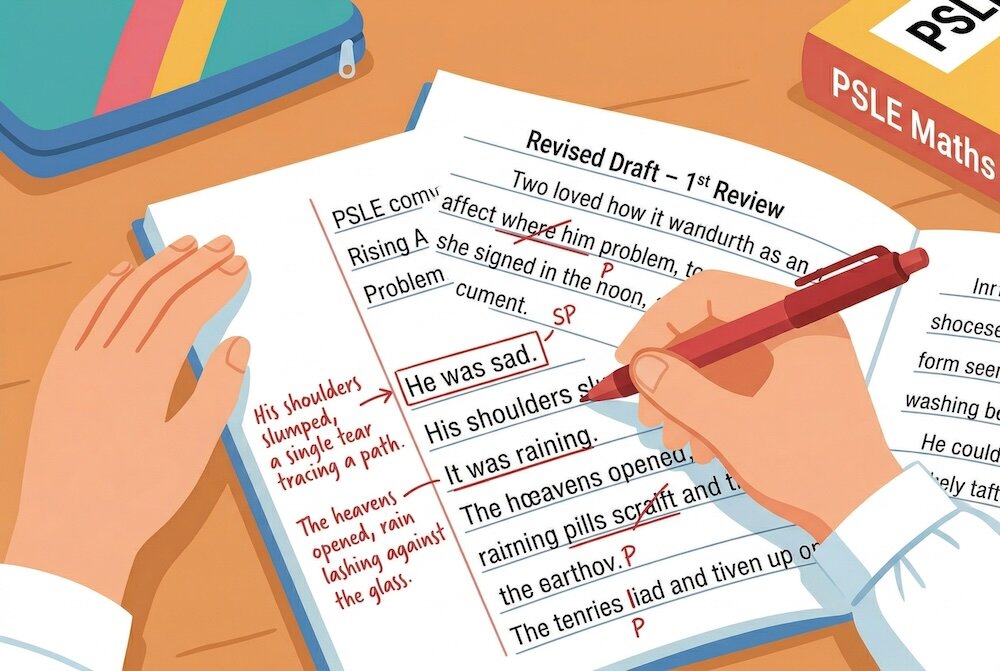
Combining action with inner voice immediately shows who the character is, what pressure they are under, and how they feel about it. Examiners value this because it demonstrates the show-not-tell skill (actions and thoughts instead of flat labels) and character development (the character’s doubt or conflict is visible from the start). For a deeper guide on writing effective dialogue within compositions, see our Guide to Writing Dialogue With Examples.
Topic: “A Guilty Conscience.”
“‘It’s just a harmless joke,’ Marcus whispered, nudging the marker into my hand. My fingers tightened around it as I stared at the blank whiteboard, wondering how ‘harmless’ our plan really was.”
Topic: “Helping Others.”
“‘Don’t get involved,’ my brother muttered, tugging at my sleeve. But as I watched the old man struggle with the heavy boxes at the bottom of the stairs, my feet refused to move.”
Each opening contains speech (the dialogue), action (nudging, tugging, staring, struggling), and inner voice (the narrator questioning “harmless” or the feet refusing to move). Together, these three layers introduce the character, the conflict, and the tone in just two to three sentences.
Draft three elements and then weave them together. First, write one short line of dialogue that shows pressure or a dilemma. Second, write one physical action linked to the picture prompt. Third, write one private thought or feeling that reacts to the pressure. Arrange these into two to three sentences, and you have a first paragraph that is vivid, specific, and impossible to confuse with a generic opening.
Not every method suits every composition question. Here is a quick guide to matching the technique to the topic.
For topics about mistakes, risks, or danger (for example, “A Narrow Escape”, “A Risky Plan”), Method 1 (tense moment) works well because the conflict is dramatic and physical.
For topics about personal growth or moral lessons (for example, “A Lesson Learnt”, “Being Honest”), Method 2 (belief that changes) creates a natural arc from ignorance to understanding.
For topics that revolve around a specific place or event (for example, “A Day I Will Never Forget”, “An Important Event”), Method 3 (charged setting) anchors the story in a vivid, atmospheric opening.
For topics involving secrets, surprises, or mysteries (for example, “A Secret”, “An Unexpected Discovery”), Method 4 (curiosity detail) creates the strongest pull to keep reading.
For topics that involve relationships and choices (for example, “Helping Others”, “A Difficult Decision”), Method 5 (action plus inner voice) introduces both the external situation and the internal struggle at once.
During the five-minute planning stage, your child should read the composition question and picture prompts, decide which method fits best, and draft the opening in rough before writing the full composition. This small investment prevents the most common trap: spending too long on a vague, wandering introduction and running out of time for the ending. For guidance on how the climax connects to the opening, visit our guide on Understanding the Climax in Writing.
The fastest way to build confidence with introductions is to practise all five methods against the same topic. Take a past PSLE question, plan the story once, and then write five different opening paragraphs, one for each method. Compare them and notice which ones feel most natural and most connected to the plot.
Over time, most students develop two or three go-to techniques that suit their writing style. Having these ready before exam day means they spend less time staring at a blank page and more time writing a story that impresses from the first sentence. Regular weekly practice locks these skills in place. For why consistent practice matters, read The Power of Writing Weekly Compositions.
At WRITERS AT WORK, our STORYBANKING® method pairs every lesson with proven opening techniques, so students build a library of adaptable introductions alongside their story ideas. Each composition is practised under timed conditions with personalised feedback, turning these five methods into habits that activate automatically on exam day. Explore our programmes and see how our approach makes writing powerful introductions second nature. For more examples of what strong openings look like, visit our detailed guide on Writing Good Introductions.
Aim for two to four sentences, roughly 40 to 60 words. The introduction should be vivid and specific but not so long that it eats into the word count for the build-up and climax. A concise, punchy opening is far more effective than a meandering one.
Yes, and many top-scoring introductions naturally blend two methods. For example, a tense moment opening (Method 1) often includes a charged setting detail (Method 3), and a dialogue opening (Method 5) can include a curiosity-sparking object (Method 4). The key is to keep the opening focused and not overload it with too many elements.
Ideally, yes. The strongest introductions either foreshadow the climax, begin at the climax (before flashing back), or establish a belief or detail that the climax will directly challenge. This connection makes the story feel planned and coherent, which examiners reward under the Content criteria.
If nothing comes to mind immediately, default to Method 5 (action plus inner voice). It works for almost any topic and requires only a line of dialogue, a physical action, and a private thought. Drafting these three elements during the five-minute planning stage gives your child a ready-made first paragraph before they begin writing the full composition.

Agnes Ng, Co-Founder and Teaching & Curriculum Director of WRITERS AT WORK. An NUS Honours graduate and published author with over 30 years of experience, Agnes has been the architect of the organization’s student-centric curricula since 2012.
Dedicated to teacher mentorship and academic excellence, she has guided hundreds of students to achieve outstanding results. Her expertise and commitment to high-quality education remain the cornerstone of WRITERS AT WORK’s success in empowering every learner.



Start practising and learning

