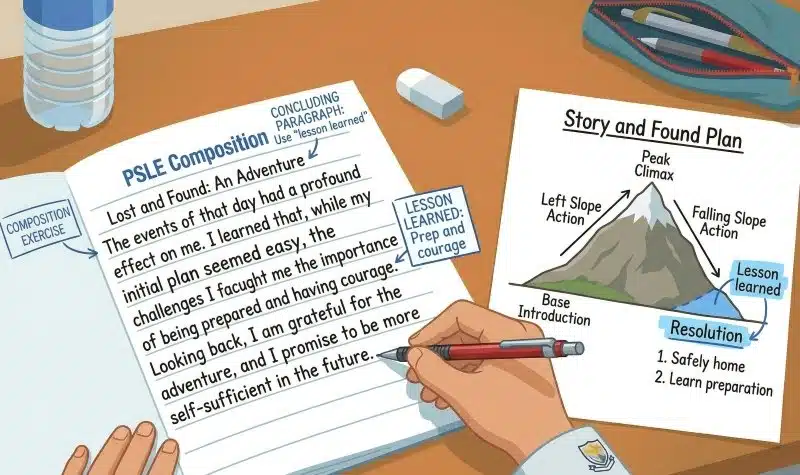
The conclusion is the last thing the examiner reads, and it shapes the final impression they carry into the marking. A strong ending can lift a composition by half a band. A weak one can drag down an otherwise well-written story. Yet conclusions are the section students neglect most, often because they have spent too long on the build-up and run out of time.
The result is depressingly familiar to examiners: “I learnt my lesson and went home. I would never do that again.” Two lines. No emotion. No reflection. No connection to the theme. The story simply stops rather than ending with purpose.
An impactful conclusion does not need to be long. Three to six well-crafted sentences are enough. What matters is that those sentences resolve the conflict, show how the character has changed, and leave the examiner with something to remember. This guide breaks the process into five clear steps, with a framework your child can use for any PSLE composition topic. For a detailed look at what makes endings work across different story types, see our guide on Writing Excellent Endings for Your Composition.
Before learning the how, your child needs to understand the what. A top-band PSLE conclusion does four things.
It resolves the main conflict so the reader knows how the story ended. It shows the character’s emotions in response to what happened. It demonstrates growth, meaning the character has learned something, changed a habit, or made a decision about the future. And it connects back to the composition topic, proving that the story answered the question from start to finish.
Short, rushed endings that skip these elements are one of the most common reasons strong compositions drop a content band. The marking rubric rewards stories that feel complete, and completeness lives in the conclusion.
A simple, exam-friendly structure for writing conclusions is RER: Result, Emotion, Reflection. Adding a Topic Link at the end ensures the conclusion stays relevant to the question. Together, these four moves form a reliable template your child can adapt to any topic.
What happened after the climax? State the concrete outcome. Did someone get punished, forgiven, praised, or helped? Was something fixed, replaced, or returned? This grounds the ending in a specific action rather than a vague summary.
How did the character feel, and why? The emotion must be linked to a specific reason from the story, not a generic label. “I felt relieved because my best friend had forgiven me even though I had lied to her” is far stronger than “I felt very happy.”
What did the character learn, decide, or change? This is the heart of a top-band ending. It shows the examiner that the character (and the student) can think beyond the surface events. Common reflection types include a lesson learned (“I realised that…”), a change in behaviour (“Since then, I have…”), or a resolution for the future (“I promised myself that…”).
One final sentence that echoes the theme keywords or circles back to a detail from the introduction. This creates a sense of unity and proves the story answered the question deliberately, not accidentally.
Many students jump straight from the climax to “I learnt my lesson” without showing what actually happened after the turning point. The result sentence bridges that gap.
What did the character do immediately after the climax? What were the consequences? Who else was affected, and how did they respond?
This sentence shows a concrete, realistic consequence. It tells the examiner the conflict is resolved without rushing past the details. For guidance on how to build towards this moment of resolution, see our guide on Understanding the Climax in Writing.
Naming an emotion is not enough. Examiners see “I was happy” and “I felt sad” hundreds of times. What lifts the ending is connecting the feeling to a specific moment from the story.
“I felt [emotion] because [specific reason from the story].”
Both examples name the emotion and then anchor it to a concrete image from the story (the grandmother’s smile, the sister’s red eyes). This show-not-tell approach extends right into the conclusion, not just the body paragraphs. For more on making emotions vivid throughout the entire composition, explore our tips on Writing More Interesting Compositions.
This is the step that separates average endings from top-band ones. The examiner wants to see that the experience changed the character in some way, whether through a lesson, a shift in attitude, or a concrete decision.
Each type works well, but the key is specificity. A reflection that could fit any story (“I learnt my lesson and it was very important”) adds nothing. A reflection tied to the exact events and characters of this story adds everything. For a bank of reflective phrases and vocabulary your child can adapt, see our guide to Good Phrases for Composition Writing.
The best PSLE conclusions create a “full circle” by echoing something from the introduction. This might be a repeated image, a phrase, or an object that now carries new meaning after the events of the story.
In the introduction, the writer mentions a specific detail: a poster, a promise, a fear, or an observation. At the time, the detail seems ordinary. In the conclusion, the same detail reappears, but the character now sees it differently because of what they experienced.
The banner has not changed, but the character has. This contrast is what makes the ending feel complete and deliberate. Planning the full-circle detail during the five-minute plotting stage ensures it appears in both the opening and the conclusion. For more techniques on creating openings that set up this kind of payoff, see our guide on How to Write Good Introductions and Types of Hooks for Essay Introductions.
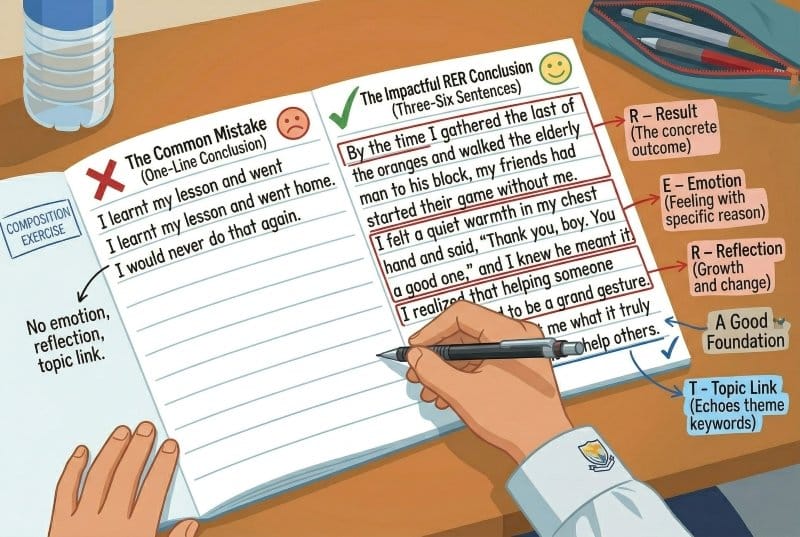
“I learnt my lesson and went home.” This is the most common ending mistake. It tells the examiner nothing about what the character learned, how they felt, or how the conflict was resolved. Even adding two more sentences using the RER framework transforms it completely.
Revealing that the entire story was a dream erases every emotion, decision, and consequence the reader invested in. Examiners almost universally penalise this because it signals that the student could not think of a real resolution.
The conclusion should close the story, not open a new subplot. Introducing a teacher, parent, or friend who suddenly appears to solve everything feels unearned and artificial. The resolution should come from the main character’s own actions or decisions.
Proverbs like “All’s well that ends well” or “Once bitten, twice shy” can work, but only if they grow naturally from the story. Dropping them in as standalone sentences without connecting them to the specific events and emotions of the composition makes the ending sound memorised rather than genuine.
This is the root cause of most weak endings. Students who spend too long on the introduction and middle simply run out of time. The fix is to set a mental checkpoint during writing: “When I finish the climax, I must have at least five minutes and 60 words left for my conclusion.”
Story summary: The narrator is rushing to meet friends at the arcade. He spots an elderly man struggling with spilled groceries. He hesitates (help and miss the outing, or walk past), then decides to help.
This conclusion resolves the time-pressure conflict, shows genuine emotion with a specific detail (the hand squeeze), demonstrates a shift in understanding, and links back to the composition topic. It runs to about 120 words, which is comfortable within the final paragraph of a 350- to 500-word composition.
Writing full compositions every time is not the only way to improve. Targeted conclusion drills are faster and build the skill more directly.
Ending rewrites: Take a weak one-line ending like “He learnt his lesson and went home” and expand it into a full RER paragraph. Do this for five different themes in a single sitting.
Full-circle tasks: Provide an introduction that contains a fear, an object, or a belief, and ask your child to write only the conclusion that echoes and transforms that element. This trains the planning habit of linking the start and finish.
Theme-based endings: Give just a theme (“Courage”, “An Embarrassing Incident”, “A Difficult Choice”) and ask your child to write three different concluding paragraphs, each showing a different lesson or change. This builds flexibility for unexpected exam topics.
For past exam questions to practise with, visit our PSLE Past Years Composition Questions page. Consistent weekly practice is the fastest route to making strong conclusions automatic. For why this matters, read The Power of Writing Weekly Compositions.
At WRITERS AT WORK, our STORYBANKING® method teaches students to plan conclusions from the very start of the writing process. Every lesson includes structured practice on endings that show real character growth and connect back to the theme. Students receive personalised feedback on their conclusions alongside their full compositions, so the ending is never an afterthought. Explore our programmes and give your child the tools to finish every story with impact.
Aim for three to six sentences, roughly 50 to 80 words. This is enough to cover the result, emotion, reflection, and topic link without rushing. The conclusion should never be shorter than the introduction.
Yes, but only if it connects naturally to the events of the story. A proverb that appears without context (“Once bitten, twice shy”) sounds memorised. A proverb woven into the character’s reflection (“My grandmother always said, ‘A stitch in time saves nine,’ and now I finally understood what she meant”) feels earned and genuine.
No. The conclusion should close the story, not open a new one. All events, characters, and conflicts should already be established by the climax. The conclusion’s job is to resolve, reflect, and reconnect, not to introduce surprises.
The root cause is almost always an introduction or middle section that is too long. Teach your child to set a mental checkpoint: “When I finish the climax paragraph, I must have at least five minutes and 60 words left.” Planning the conclusion during the five-minute plotting stage also helps, because the ending is decided before writing begins.

Jemmies Siew, Managing Director and Co-Founder of WRITERS AT WORK Enrichment Centre. With over 15 years of experience in education, entrepreneurship, and marketing, Jemmies has helped shape Singapore’s English enrichment landscape through her vision for transformative learning.
She is passionate about connecting real-world issues with language learning, helping students think critically and express themselves clearly. Connect with her on LinkedIn to follow her insights on education, content marketing, and thought leadership.



Start practising and learning

